Introduction
Talent acquisition teams in 2026 are doing more with less. Hiring volumes rebounded 5.8% while recruiter headcounts remain 14% leaner than 2021 peaks — the average recruiter now manages 93% more applications than three years ago.
The cost of a slow process shows up on both sides: 58% of candidates reject offers due to poor hiring experiences, and recruiters lose up to 80% of their week — roughly 17.7 hours per vacancy — on scheduling, resume screening, and post-interview documentation.
The right recruiting tools are what close that gap. The best platforms cut cost-per-hire, sharpen decision quality through structured evaluation, and give recruiters back the time they actually need to build relationships.
This guide breaks down the top recruiting tools across five essential categories, what makes each one effective, and how to choose the right stack for your team's specific bottlenecks.
Key Takeaways
- Top recruiting stacks cover every hiring stage: ATS, sourcing/CRM, AI interviews, conversational AI, and interview intelligence
- The highest-impact tools cut manual work—note-taking, scheduling, screening—and deliver objective data to accelerate decisions
- Prioritize native ATS integration, compliance controls, and the ability to scale without a process rebuild
- AltHire AI conducts adaptive, AI-led interviews 24/7 with built-in proctoring and detailed candidate reports
- Selection criteria matter more than brand recognition: prioritize integration depth, ease of implementation, and measurable ROI metrics like time-to-hire and cost per hire
What Are Recruiting Tools and Why Do They Matter in 2026
Recruiting tools are software platforms designed to automate, simplify, and improve specific stages of the hiring process—from sourcing to onboarding. Unlike general HR software that handles payroll, benefits, or performance management, recruiting tools focus exclusively on the talent acquisition funnel.
The category has expanded dramatically. What once meant "ATS with basic tracking" now includes AI agents that source candidates around the clock, conversational AI that screens and schedules, and interview intelligence tools that turn conversations into structured hiring evidence.
The numbers reflect this shift: AI adoption in HR surged to 72% globally by early 2025, with the AI recruitment technology market projected to reach $1.12 billion by 2030—up from $661.6 million in 2023.
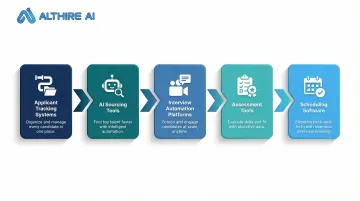
For teams trying to move faster without sacrificing quality, knowing which tools to use—and where—makes the difference. The options below cover five essential recruiting categories, selected based on efficiency impact, integration capability, and adoption among modern talent teams:
- Applicant Tracking Systems (ATS) — pipeline management and compliance
- AI sourcing tools — automated candidate discovery and outreach
- Interview automation platforms — structured, scalable screening
- Assessment tools — skills and fit evaluation
- Scheduling software — eliminating coordination bottlenecks
Top Recruiting Tools for Efficiency & Talent Teams in 2026
Selection is based on a tool's ability to reduce time-to-hire, eliminate manual work, integrate into existing hiring stacks, and produce measurable outcomes— not feature breadth or brand recognition alone.
Greenhouse
Greenhouse is a structured, hiring-focused applicant tracking system (ATS) widely adopted by mid-market and enterprise organizations as their central system of record for pipelines, workflows, and candidate evaluation.
Greenhouse stands out through its emphasis on structured hiring: customizable scorecards, multi-stage workflow configuration, and an integration marketplace with over 400 verified tools. This makes it the ATS of choice for teams that need consistency at scale across complex, multi-department processes. Greenhouse consistently ranks as the #1 ATS on G2's Enterprise and Mid-Market Grid Reports, reflecting its dominance among organizations that prioritize hiring quality and process rigor.
| Category | Details |
|---|---|
| Key Features | Structured hiring workflows, customizable scorecards, interview scheduling, compliance reporting, analytics dashboard, 400+ verified integrations, open API |
| Best For | Mid-market to enterprise teams running high-volume or multi-department structured hiring |
| Pricing | Custom enterprise pricing based on company hiring needs; available in Core, Plus, and Pro tiers |
Gem
Gem combines recruiting CRM and sourcing automation, helping talent teams build, nurture, and rediscover passive candidate pipelines through centralized outreach tracking and engagement analytics.
Gem bridges the gap between ATS tracking and ongoing relationship management. Teams use it to run outbound sourcing sequences, track candidate engagement history, and gain visibility into pipeline health. High-growth companies running continuous talent programs (rather than reactive hiring) get the most from it. Gem's standout feature is AI Rediscovery, which automatically surfaces past applicants and "silver medalists" sitting dormant in your ATS — critical given that 46% of sourced hires now come from rediscovered candidates. Mission Cloud used Gem to reduce time-to-fill by 12% (from 65 to 57 days) while managing 3x more open roles with just two recruiters.
| Category | Details |
|---|---|
| Key Features | Candidate relationship management (CRM), outreach sequencing, pipeline analytics, talent rediscovery, diversity tracking, ATS integrations, 800M+ profile database |
| Best For | Teams focused on outbound sourcing, passive candidate nurturing, and long-term pipeline development |
| Pricing | Custom pricing based on recruiter seats; available in Startups, Growth, and Enterprise tiers |
AltHire AI
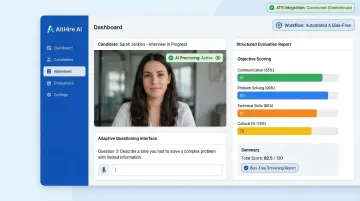
AltHire AI is an AI-powered interview and assessment platform that conducts adaptive, human-like candidate interviews 24/7, replacing manual screening rounds while delivering structured, bias-free evaluation data back to hiring teams.
Unlike traditional video interview tools, AltHire AI uses conversational AI that adapts to each candidate's responses with relevant follow-up questions, assessing skills, culture fit, and potential beyond the resume. It delivers 100% AI-proctored interviews, detailed candidate reports with objective scoring, and supports 20+ ATS integrations including Greenhouse, Lever, Ashby, Workable, and BambooHR. Results include 70% faster time-to-hire and 60% reduction in screening interview time, making it a fit for teams across tech, healthcare, finance, retail, and recruitment agencies.
| Category | Details |
|---|---|
| Key Features | AI-conducted adaptive interviews, 100% AI proctoring, bias-free structured evaluation, detailed analytics reports, 20+ ATS integrations, 24/7 hiring availability, real-time response analysis |
| Best For | TA teams and recruitment agencies looking to automate candidate screening without sacrificing quality or fairness—across technical, functional, and creative roles |
| Pricing | Custom pricing based on hiring volume; free consultation available at calendly.com/rajeev-althire/30min |
Paradox (Olivia)
Paradox is a conversational AI platform centered on its AI assistant Olivia, which automates candidate communication, interview scheduling, FAQ responses, and application workflows via text and chat, cutting the time between application and first interview.
Olivia handles the high-frequency, low-complexity interactions that typically consume recruiter time: answering candidate questions, scheduling across time zones, sending reminders, and moving candidates through early funnel stages. High-volume and frontline hiring environments benefit most, where speed and candidate experience directly affect offer acceptance rates. Checkers & Rally's saved 35,000 hours annually by eliminating manual scheduling, achieving a 97% application completion rate and a 6-day reduction in time-to-hire. McDonald's reduced time-to-hire by nearly 65% and saved recruiters 3 to 5 hours per week using a white-labeled version called McHire.
| Category | Details |
|---|---|
| Key Features | Conversational AI scheduling, automated candidate FAQs, text-based application flows, interview reminders, multilingual support, ATS integrations, SMS and chat engagement |
| Best For | High-volume and frontline hiring teams needing to automate early-funnel candidate engagement and scheduling at scale |
| Pricing | Custom enterprise pricing; SOC 2 Type II compliant with Workday/SAP integrations |
Metaview
Metaview is an AI-powered interview intelligence platform that automatically generates structured, role-specific interview notes and scorecard evidence, eliminating post-interview documentation without requiring interviewers to change how they run conversations.
Rather than producing generic transcripts, Metaview outputs hiring-grade documentation grounded in the specific role context, synced directly into ATS scorecards. It also includes AI sourcing agents for continuous candidate discovery, and integrates natively with Greenhouse, Lever, and Ashby. Automattic saves 53 hours per month per recruiter (roughly 20 minutes per interview), and Elara Caring reduced recruiter time spent on phone screens by 50%.
| Category | Details |
|---|---|
| Key Features | AI-generated structured interview notes, automatic scorecard completion with cited evidence, AI sourcing agents, ATS/CRM integrations, complete transcription and video recording |
| Best For | In-house recruiting teams wanting to improve hiring quality and reclaim recruiter and interviewer time from documentation and admin |
| Pricing | Free tier available (25 conversations/month); Pro plan starts at $50/month per user; SOC 2 Type II, GDPR, and CCPA compliant |
How We Chose the Best Recruiting Tools
The tools featured were evaluated on their ability to solve a specific, high-impact recruiting bottleneck—not just feature count. Many TA teams make the mistake of buying tools that overlap in function or add complexity rather than removing it. The focus here was on tools that each address a distinct stage of the hiring funnel.
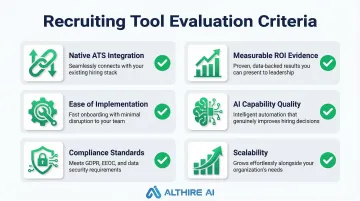
Key evaluation factors included:
- Native ATS integration depth — not just basic webhooks, but true data sync and workflow automation
- Measurable ROI evidence — time-to-hire reduction, cost savings, or recruiter hours saved backed by customer data
- Ease of implementation and adoption — setup time, training requirements, and time-to-value
- AI capability quality — whether AI features actually eliminate work or just add noise
- Compliance standards — SOC 2, GDPR, CCPA certifications for enterprise readiness
- Scalability — ability to grow with company size and hiring volume without requiring process rebuilds
A strong recruiting stack covers the right categories — pipeline tracking, sourcing and relationships, candidate screening, scheduling, and interview quality — not the most categories. Teams that identify their specific bottleneck first get dramatically better ROI from the tools they choose.
According to 2025 vendor selection data, 52% of TA leaders prioritize services and customer support, 50% prioritize product capabilities, 46% prioritize price, and 42% prioritize integration depth. Separately, 72% of companies reducing HR tech spend cite an inability to demonstrate ROI. Tools that can't show clear reductions in time-to-hire, cost-per-hire, or recruiter hours saved don't make the cut.
Conclusion
The recruiting tool landscape in 2026 rewards precision over breadth. The teams winning on efficiency aren't using the most tools—they're using the right ones aligned to where their process actually slows down. Whether the bottleneck is sourcing, scheduling, interview quality, or screening volume, there's a targeted solution that fits.
Before adding new tools, audit your current hiring stack: map where time is lost, where candidate drop-off spikes, and where recruiter admin is heaviest. Then match a vendor category to each friction point and pilot before committing.
That focus pays off. Currently, 54% of organizations integrate between two and five paid TA tools into their core technology stack, with only 10% using more than five. Consolidation around high-impact platforms is the winning strategy.
Screening is where most teams lose the most time. For organizations still running manual screening interviews at scale, AltHire AI offers a direct path to faster, more consistent candidate evaluation. AI-powered interviews run 24/7, integrate with your ATS, and deliver structured reports your team can act on immediately—cutting a major bottleneck without adding headcount. Book a free consultation to see how AltHire AI fits your hiring stack.
Frequently Asked Questions
What are the best recruiting tools?
The best recruiting tools depend on where the hiring process breaks down. Effective stacks cover categories like ATS (Greenhouse), sourcing/CRM (Gem), AI interview platforms (AltHire AI), conversational AI (Paradox), and interview intelligence (Metaview). The key is covering the full funnel without unnecessary overlap.
Which recruitment method is the most effective?
Structured interviews demonstrate a predictive validity of .44 compared to just .33 for unstructured interviews—making structured, data-driven hiring the most reliable approach. Combining proactive sourcing, standardized screening, and objective evaluation criteria reduces bias and improves screening consistency at scale.
What is the 80/20 rule in recruiting?
The 80/20 rule in recruiting suggests roughly 80% of successful hires come from 20% of sourcing channels or recruiting activities. Job boards generate 90% of applications but account for only about half of actual hires, while sourced candidates are 8x more likely to be hired than inbound applicants. TA teams should concentrate effort on the highest-performing sources—referrals, targeted outreach, or rediscovered candidates—rather than spreading resources evenly.
What is the difference between an ATS and a recruiting CRM?
An ATS manages active applicants through a structured pipeline from application to offer, tracking candidates who have formally applied for open roles. A CRM manages relationships with passive candidates not yet in a formal process, nurturing them over time until a relevant role opens. Many modern platforms combine both functions, but the core distinction is active pipeline management (ATS) versus long-term relationship building (CRM).
How do AI recruiting tools reduce time-to-hire?
AI recruiting tools reduce time-to-hire by automating the most time-consuming manual steps—including resume screening, interview scheduling, candidate Q&A, note-taking, and scorecard completion. By removing these bottlenecks, recruiters can move qualified candidates through the funnel faster while maintaining or improving evaluation quality. Companies using AI in their recruiting processes hire 26% faster on average, saving approximately 11 days.
What recruiting tools work best for small teams or startups?
Small teams benefit most from tools that combine multiple functions and require minimal setup. Tools like AltHire AI, Metaview, or lightweight ATS platforms like Ashby or JazzHR eliminate manual admin quickly without large IT lift—many offer free tiers or consultations to test fit before committing.