Introduction
Hiring bottlenecks are intensifying in 2026. Application volume tripled between 2021 and 2024, while the number of interviews required per hire jumped by over 40% in the same period.
Traditional recruiting methods—manual resume screening, phone screens, and scheduling coordination—can no longer keep pace. AI recruiting tools have shifted from experimental add-ons to essential infrastructure for teams trying to fill roles faster without sacrificing quality.
AI is now embedded across the entire hiring funnel, from sourcing passive candidates and screening resumes to conducting interviews and generating post-hire analytics. This guide delivers what matters: clear criteria for evaluating AI recruiting tools in 2026 and a curated breakdown of the top options based on where they create real impact. Whether your bottleneck is sourcing reach, screening speed, or interview consistency, the right tool can cut time-to-hire by 70% or more — and this guide shows you which ones actually deliver.
Key Takeaways
- AI recruiting tools automate sourcing, screening, scheduling, and interviewing to dramatically cut time-to-hire and reduce recruiter workload
- Top 2026 platforms go beyond resume parsing: adaptive interviews, bias reduction, and native ATS integrations are now table stakes
- Key selection criteria: AI depth, automation capabilities, ATS integrations, bias controls, and pricing transparency
- Top tools covered: AltHire AI, HireVue, Greenhouse, Paradox, and Workable—each suited to different team sizes and hiring goals
- Match the tool to your bottleneck: sourcing, screening, scheduling, or interview quality each point to a different winner
What Is AI Recruiting Software and Why It Matters in 2026
AI recruiting software uses machine learning and natural language processing to automate and enhance talent acquisition tasks across the hiring funnel. In 2026, the technology has evolved far beyond basic resume filtering — today's platforms deploy autonomous interview agents, predict candidate success, and flag potential bias in real time throughout the assessment process.
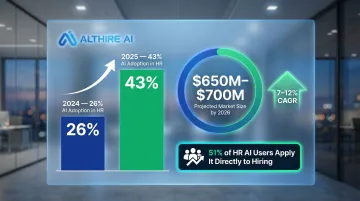
The market reflects this maturation. AI adoption in HR jumped from 26% in 2024 to 43% in 2025, with recruiting as the leading application — 51% of organizations using AI in HR apply it specifically to hiring.
The AI recruiting software market is projected to reach $650–$700 million in 2026, growing at a 7–12% CAGR. That growth is driven by a shift in priorities: companies now treat AI as a tool for making better, more objective hiring decisions, not just a way to cut administrative overhead.
With dozens of platforms making similar claims, evaluating them on measurable impact matters more than comparing feature lists. The tools below were selected because they address specific, high-cost problems in the hiring funnel — with data to back it up.
Best AI Recruiting Tools for 2026
These tools were selected based on AI depth, real-world impact on hiring outcomes, ATS compatibility, usability, and suitability for a range of company sizes and hiring goals.
AltHire AI
AltHire AI is an AI-powered interview platform built for teams that need to screen candidates at scale without adding headcount—delivering structured, adaptive interviews 24/7 with full AI proctoring and detailed post-interview analytics.
Unlike tools that only parse resumes or automate scheduling, AltHire AI conducts full conversational interviews using AI agents that adapt follow-up questions in real time, score candidates objectively, and flag impersonation attempts. The platform evaluates candidates based on demonstrated skill rather than resume keywords alone, with adaptive dialogue that adjusts based on response quality.
Organizations can create role-specific interviews in under 10 minutes using a drag-and-drop builder, then deploy AI agents around the clock. The system delivers 350+ weekly interviews with 100% AI proctoring, catching integrity issues like AI-generated answers, multiple voices, and tab switching.
| Category | Details |
|---|---|
| Key Features | AI-powered adaptive interview agents, 100% AI proctoring, drag-and-drop interview builder (under 10 minutes), detailed AI-generated candidate reports with 360° performance breakdowns |
| ATS Integrations | 20+ integrations including Greenhouse, Lever, Ashby, Workable, BambooHR, JazzHR, iCIMS, Jobvite, Smart Recruiters, Recruitee, BreezyHR, Fountain |
| Best For | Startups, scale-ups, enterprises, and recruitment agencies seeking bias-free, high-volume interview automation with 24/7 availability |
HireVue
HireVue is an enterprise-grade video interviewing and AI assessment platform trusted by large organizations for high-volume screening, offering on-demand video interviews paired with AI-driven candidate scoring.
HireVue's core strength is its enterprise support depth, transparent AI methodology, and a virtual hiring assistant that can screen, message, and schedule candidates autonomously. The platform uses a 'glass-box' AI approach—its scoring relies on transcribed verbal content analyzed through NLP models (based on RoBERTa) and explicitly excludes facial expression or tone-of-voice analysis.
That transparency makes it particularly strong for large companies requiring legally defensible, scientifically validated assessments. The cost and minimum employee threshold (2,500+), however, put it firmly in enterprise territory.
| Category | Details |
|---|---|
| Key Features | On-demand and live video interviews, AI scoring based on 19 pre-defined competencies, virtual hiring assistant, automated scheduling, text recruiting |
| Pricing | Essentials plan starts at $35,000/year for teams with 2,500–7,500 employees; Enterprise plan custom-priced |
| Best For | Large enterprises with continuous, high-volume hiring needs across structured roles |
Greenhouse
Greenhouse is a highly regarded applicant tracking system known for its structured hiring framework, deep integration ecosystem (over 400 tools), and increasingly capable AI features for resume filtering, scorecard generation, and candidate communication.
Greenhouse excels at bringing alignment across hiring teams through structured scorecards and customizable workflows—particularly strong for mid-to-large talent teams that prioritize consistency and DEI-focused reporting. Its 'Real Talent' AI suite includes Talent Match, AI-powered filtering, scorecard summaries, and interview question suggestions.
A 2025 case study with the NFL reported a 24% reduction in average time-to-fill (63 to 48 days) and candidate satisfaction rising from 67% to 93%. One gap: Greenhouse has no native sourcing or video interviewing, so those functions require third-party integrations.
| Category | Details |
|---|---|
| Key Features | AI resume filtering, structured scorecards, DEI reporting, interview scheduling automation, 400+ integrations, anti-spam and fraud detection |
| Pricing | Custom pricing (no free trial); typically positioned as a premium ATS with three tiers (Core, Plus, Pro) |
| Best For | Mid-to-large internal talent teams running structured, high-stakes hiring across multiple departments |
Paradox
Paradox is a conversational AI platform centered on its chatbot assistant, Olivia, which handles candidate screening, FAQs, interview scheduling, and follow-up communication across 100+ languages—making it especially powerful for high-volume and hourly hiring.
Olivia's key differentiator is her ability to take candidates from application to scheduled interview with near-zero recruiter involvement. The platform excels in retail, hospitality, and fast food—7-Eleven saved over 2 million hours annually and 40,000 hours per week for store leaders by automating screening and scheduling.
Time-to-hire has dropped by up to 7 days for clients, with some reaching timelines as low as 3.5 days. The tradeoff: analytics are less robust than dedicated ATS platforms, and the backend setup before launch is substantial.
| Category | Details |
|---|---|
| Key Features | Conversational AI chatbot (Olivia), automated scheduling, multilingual support (100+ languages), high-volume screening, conversational apply feature, ATS integrations |
| Pricing | Custom pricing; no free trial (demo required) |
| Best For | Large enterprises and retail/hospitality organizations with continuous, high-volume or hourly hiring needs |
Workable
Workable is an all-in-one ATS and HR platform for SMBs, offering AI-generated job descriptions, an AI Screening Assistant, passive candidate sourcing across a 400M+ profile database, and video interview capabilities in a single platform.
Workable covers more ground than most mid-market platforms—its AI job ad generator, salary estimator, and built-in screening tools cut dependency on multiple point solutions. Its pricing is also refreshingly transparent: Standard at $299/month, Premier at $599/month, compared to the demo-required black boxes of enterprise tools.
With 270+ integrations and job distribution to 200+ boards, it delivers broad coverage without enterprise-level complexity, making it a practical choice for growing teams that want AI-enhanced recruiting without juggling multiple platforms.
| Category | Details |
|---|---|
| Key Features | AI job description generator, AI Screening Assistant, passive sourcing (400M+ profiles), video interviews, 270+ integrations, job board distribution to 200+ sites |
| Pricing | Standard plan at $299/month; Premier at $599/month; premium add-ons available from $59/month |
| Best For | SMBs and growing companies seeking a well-rounded, AI-enhanced recruiting platform with minimal tool sprawl |
How We Chose the Best AI Recruiting Tools for 2026
Dozens of tools market themselves as "AI-powered," but most deliver surface-level automation with no measurable impact. The most common mistake buyers make is choosing based on brand name or feature lists rather than evaluating fit with their specific hiring bottleneck — sourcing, screening, or interviewing.
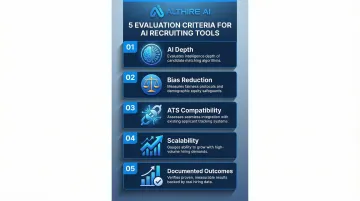
Five evaluation factors guided the selection:
AI depth — Does the platform adapt to candidate responses and learn from outcomes, or just execute pre-programmed rules? Genuine machine learning that improves over time was the baseline requirement.
Bias reduction through objective scoring — We evaluated each tool's transparency of scoring methodology and availability of bias audits, looking for structured frameworks tied to job-relevant criteria.
ATS compatibility — Seamless data flow with existing applicant tracking systems. The strongest tools integrate with 20+ ATS platforms, eliminating manual data entry and keeping candidate records synchronized.
Scalability — We assessed whether tools impose minimum employee counts, offer transparent pricing, and handle diverse hiring scenarios — from technical roles to hourly positions — across startups and enterprises alike.
Documented outcomes — Time-to-hire reduction, cost savings, and candidate experience quality, backed by case studies showing real numbers rather than marketing copy.
These criteria shaped the final list — but no single tool solves every problem. Start by identifying your biggest hiring bottleneck: candidate volume, screening consistency, sourcing reach, or scheduling delays. A platform built for high-volume conversational screening like Paradox serves a different need than AltHire AI's adaptive technical interviews or Greenhouse's structured hiring frameworks. Match the tool to the problem, not the other way around.
Conclusion
The right AI recruiting tool for 2026 depends on your team's specific constraint — not the length of a feature list. Match the tool to the bottleneck:
- Interview capacity and skills-based assessment: AltHire AI delivers autonomous interview automation with objective scoring, evaluating candidates on demonstrated skills rather than resume keywords.
- High-volume hourly hiring and top-of-funnel engagement: Paradox's conversational AI handles candidate outreach and screening at scale.
- Structured, bias-aware hiring with deep ATS integrations: Greenhouse provides the workflow framework and integration depth.
Pilot before committing. Prioritize tools with free trials or transparent pricing, and evaluate AI depth by asking vendors how their models are trained, what bias controls exist, and how outcomes are measured. The right questions reveal whether you're buying genuine AI capabilities or rebranded automation.
For teams looking to eliminate interview bottlenecks and assess candidates based on skills—not just resumes—AltHire AI offers a free demo to show exactly how AI-driven interviews work in practice.
Frequently Asked Questions
How is AI used for recruitment?
AI covers every stage of the hiring funnel — sourcing passive candidates, screening resumes, scheduling and conducting interviews, and generating post-interview analytics. The most advanced platforms now run fully autonomous adaptive interviews, adjusting follow-up questions based on each candidate's responses in real time.
How much does AI recruiting software cost?
Pricing ranges from $15–$79/user/month for lightweight tools such as Manatal, up to $299–$599/month for mid-market platforms like Workable, and $35,000+/year for enterprise solutions like HireVue. Evaluate ROI on recruiter hours saved and cost-per-hire reduction, not just sticker price.
What is the best AI recruiting software?
The right choice depends on where your hiring bottleneck lies. AltHire AI leads for interview automation with adaptive AI agents and 100% proctoring; Greenhouse suits structured ATS workflows with DEI reporting; Paradox fits high-volume conversational screening across 100+ languages.
Which AI recruitment platform offers the best automation features?
It depends on the task: Paradox leads for end-to-end candidate communication, GoodTime for complex multi-panel scheduling, and AltHire AI for autonomous adaptive interviews with full proctoring. The best platform is the one that targets your biggest time drain.
Which ATS has the best AI capabilities?
Greenhouse and Workable lead as AI-enhanced ATS platforms, offering resume filtering, scorecard generation, and sourcing tools. Tools like AltHire AI layer on top of these systems, adding specialized interview automation without replacing your existing ATS.
What AI do companies use for hiring?
Enterprise teams typically use HireVue or Paradox for high-volume screening, while mid-market teams favor Workable or Greenhouse for all-in-one ATS and sourcing. Fast-growing companies increasingly layer in specialized tools like AltHire AI for interview automation, building modular stacks where each tool handles a distinct hiring stage.