Introduction
Recruiting volume has exploded while hiring capacity hasn't kept pace. Applications per hire have surged 182% since 2021, U.S. time-to-hire has climbed from 33 to 41 days, and teams now run an average of 20 interviews per hire—up 42% from just 14 three years ago.
AI adoption in recruiting has responded accordingly: 69% of HR professionals now use AI to support recruiting activities, up from 51% the year before. These aren't pilot programs anymore — AI is running inside live hiring workflows at companies of every size.
This guide covers what AI recruiting tools actually do, which categories matter, what features to prioritize, and where teams go wrong when adopting them.
What Are AI Recruiting Tools?
AI recruiting tools are software platforms that use artificial intelligence—including machine learning, natural language processing, and generative AI—to automate, improve, or accelerate specific parts of the talent acquisition process. "AI recruiting tool" is an umbrella term covering many tool categories, not a single type of software.
These tools span the full hiring funnel. According to research, 62% of employers expect to use AI for most or all hiring stages by 2026. That includes:
- Writing and optimizing job descriptions
- Sourcing and ranking candidates
- Screening, scheduling, and initial assessments
- Interview automation and post-hire analytics
Recruiters remain the final decision-makers. AI handles the repetitive work — screening, scheduling, initial assessments — so recruiting teams can spend more time on the conversations, relationships, and judgment calls that actually fill roles with the right people.
What Can AI Be Used for in Recruitment?
Candidate Sourcing and Outreach
AI sourcing tools scan talent databases, professional networks, and the open web to match candidate profiles to job requirements, then automate personalized outreach. For passive candidates especially, this cuts prospecting time significantly.
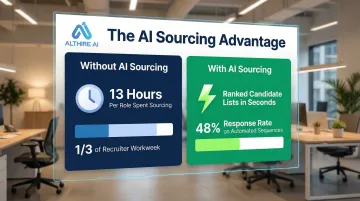
Studies show that sourcing candidates consumes nearly one-third of a standard recruiter's workweek—about 13 hours per role. AI sourcing tools scan hundreds of millions of profiles against specific job criteria and return ranked candidate lists in seconds, not hours. One sourcing platform reported a 48% response rate on automated sequences—far above industry averages for cold recruiting outreach.
Resume Screening and Candidate Filtering
AI screening tools parse and rank inbound applications against a job description, surfacing top candidates while filtering out unqualified ones. More advanced tools go beyond keyword matching to evaluate skills, career trajectory, and context—reducing the manual burden of reviewing hundreds of applications.
Resume screening takes up 22% of recruiter time. AI-powered screening can cut this by 75% or more. Unilever reported that its AI-assisted hiring process reduced time-to-hire from 4 months to 4 weeks and cut recruiter hours spent on screening by 75%.
AI-Powered Interviewing
Conversational AI platforms conduct structured interviews autonomously—asking adaptive, role-specific questions, following up based on candidate responses, and generating scored evaluations. These tools are available 24/7 and allow candidates to complete interviews at their convenience, which expands the talent pool and speeds up screening significantly.
AI phone screening boasts a 95% completion rate, compared to only 40-60% for video interviews. Companies using AI phone screening have reduced average screening time from 45 to just 12 minutes.
AltHire AI operates in this category: its AI interview agents conduct human-like, fully structured interviews 24/7 across any role type, complete with AI proctoring to ensure integrity and 20+ ATS integrations to keep results flowing into existing workflows.
Interview Scheduling and Coordination
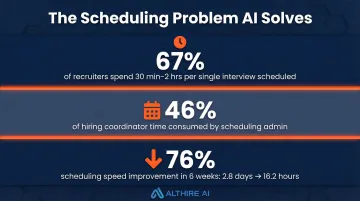
AI scheduling tools eliminate the back-and-forth of coordinating calendars by matching candidate and interviewer availability automatically, sending reminders, and handling rescheduling. Scheduling is one of the highest time-sink tasks in recruiting, and the data reflects it:
- 67% of recruiters report that scheduling a single interview takes 30 minutes to 2 hours
- Coordinators spend 46% of hiring time on scheduling-related admin tasks
- One company improved scheduling speed by 76% in 6 weeks, dropping from 2.8 days to 16.2 hours
Reporting, Analytics, and Talent Rediscovery
AI analytics tools surface patterns across the hiring funnel: time-to-hire, drop-off rates, pipeline diversity, and interviewer scorecards. Separately, AI-powered talent rediscovery combs existing ATS databases to resurface past candidates who may now fit new openings.
The opportunity here is significant:
- 30–70% of ATS candidate profiles are outdated, yet most go unreviewed for new roles
- Rediscovered hires from internal CRM or ATS databases rose from 29.1% in 2021 to 44.0% in 2024
AI semantic search makes these databases searchable in ways keyword filters never could, turning sunk recruiting costs into active pipeline.
Types of AI Recruiting Tools
The global AI recruitment market is valued at approximately $660-707 million in 2025, growing at a CAGR of 7.2-7.4%. The market includes several functional categories:
AI Sourcing Tools
Built for top-of-funnel talent discovery, these tools identify and surface candidates from external databases, LinkedIn, and the open web, often automating the initial outreach. They work best for outbound recruiting and roles with strong online candidate presence (e.g., tech, finance).
Examples include:
- hireEZ - Uses agentic AI that goes beyond keywords to pull context from full resumes, flags inconsistencies, and automates scheduling
- Fetcher - Sends recruiters profiles in batches from the potential talent pool and allows personalized email campaigns
- Findem - Generates 3D data from billions of data points, connecting person and company data over time
AI Applicant Tracking Systems (ATS)
Many modern ATS platforms have embedded AI features for resume parsing, candidate scoring, automated communications, and reporting. These are typically the system-of-record for recruiting teams and often serve as the hub that other AI tools integrate into.
Examples include:
- Greenhouse - Talent Matching extracts skills, job titles, years of experience without using names or contact information to avoid bias
- Workable - Uses AI to scan 400 million passive candidate profiles and automatically resurfaces qualified past candidates
- Manatal - AI Advanced Search combines traditional filters with intelligent semantic search
AI Interview Platforms
Among the fastest-growing categories, AI interview platforms use conversational AI to conduct structured, adaptive interviews at scale. Unlike asynchronous video tools that simply record answers, these platforms ask follow-up questions, adapt to candidate responses, score candidates objectively, and generate detailed evaluation reports.
AltHire AI sits in this category: its AI interview agents conduct structured, conversational interviews 24/7 across any role type, complete with AI proctoring to ensure integrity and 20+ ATS integrations including Greenhouse, Lever, Ashby, Workable, and BambooHR.
AI Scheduling and Coordination Tools
Purpose-built for automating interview logistics—calendar syncing, self-scheduling links, interviewer load balancing, and candidate communications. These are often used as an orchestration layer on top of an existing ATS.
Examples include:
- GoodTime - Fully automates scheduling for any interview loop, selects the right interviewers, resolves conflicts automatically
- Calendly - Uses workflows to automatically send email and text reminders and routing forms to present specific booking pages
AI Analytics and Reporting Tools
Some tools specialize in analyzing recruiting performance data, generating insights on pipeline health, diversity metrics, and spend efficiency. Enterprise TA teams and high-volume recruitment agencies get the most value here, where data visibility directly shapes hiring decisions.
Examples include:
- Visier - Tracks pipeline health, time-to-fill, and offer acceptance rates across teams
- Gem - Combines CRM and analytics to surface bottlenecks and forecast hiring capacity
Key Features to Look for in AI Recruiting Tools
Adaptive Intelligence vs. Scripted Automation
The difference between tools that follow rigid, pre-set scripts and those that use true AI to adapt in real time is critical. For example, an AI interviewer that asks a follow-up question based on what the candidate just said produces richer, more reliable signal than one that moves to the next fixed question.
When evaluating vendors, ask: Does the AI adapt based on candidate responses, or does it simply execute a predetermined script?
Bias-Reduction and Structured Evaluation
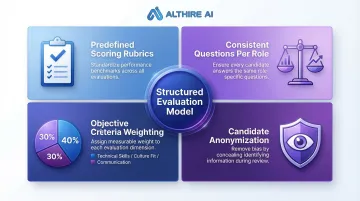
Unstructured hiring processes introduce unconscious bias, but AI tools with structured scoring rubrics, objective criteria weighting, and anonymization features help level the playing field.
Structured interviews emerged as the predictor with the highest mean validity, having significantly lower impact on racial groups than other top predictors. Research shows that blinded interviewers ranked underrepresented applicants higher than non-blinded interviewers.
A structured evaluation model looks like this:
- Predefined scoring rubrics for each competency
- Consistent questions across all candidates for the same role
- Objective criteria weighting (e.g., technical proficiency 40%, communication 30%, problem-solving 30%)
- Anonymization of candidate identifiers during initial screening
Consistency across candidates is critical for both fairness and legal compliance.
ATS and HR Tech Integration
AI tools that can't talk to a team's existing ATS or HRIS create data silos and add manual work rather than removing it. The most common challenge reported is a lack of integration within and between systems, cited by 46% of respondents.
Buyers should check not just whether integrations exist, but how deep they go. Bidirectional data sync, automated candidate progression, and real-time status updates are the benchmark. Support for 20+ ATS platforms — such as Greenhouse, Lever, Workable, and BambooHR — signals a product built for teams with existing infrastructure.
Reporting Depth and Actionable Insights
A ranked list of candidates isn't enough. The best platforms produce detailed, human-readable reports that go several layers deeper:
- Score rationale: explains why a candidate ranked where they did
- Skills demonstrated: maps responses to specific competencies
- Gap identification: flags where candidates fell short of role requirements
- Next-step recommendations: suggests whether to advance, hold, or pass
This reporting also gives hiring teams the data to track diversity metrics and quality-of-hire trends over time.
Data Privacy, Security, and Compliance
AI recruiting tools handle sensitive personal data, so buyers need to evaluate data privacy standards, retention policies, and whether AI decisions can be explained and audited.
Tools used for interviewing or assessment may be subject to emerging AI employment regulations:
- EEOC: Federal laws prohibit employment discrimination based on protected characteristics and apply to the use of AI in employment
- EU AI Act: Classifies AI systems for recruitment or candidate evaluation as High-Risk
- NYC Local Law 144: Requires bias audits within one year for automated employment decision tools
- Illinois AI Video Interview Act: Requires employer notification, consent, and data deletion within 30 days of request
Before signing with any vendor, ask them to walk through their audit trail and explain how their AI reaches a decision.
How to Choose the Right AI Recruiting Tool for Your Team
Start with the problem, not the product
Identify your biggest recruiting bottleneck first—is it too many inbound applications to screen? Slow interview scheduling? Poor quality-of-hire from unstructured interviews? Then select a tool category that directly addresses that problem, not because it has the most features.
Evaluate for your hiring volume and team size
Enterprise-grade platforms like HireVue or Eightfold are built for teams conducting thousands of hires per year, while SMBs and growing companies often get more value from focused, purpose-built tools that are faster to implement and easier to manage.
Simple framework:
- Low volume / lean team = focused point solutions
- High volume / multiple open roles = full-funnel platform or best-of-breed integrations
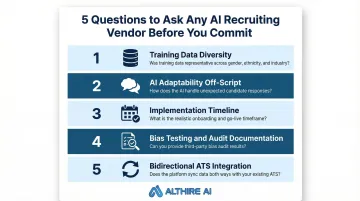
Ask the right questions before committing
5 critical demo questions to ask any AI recruiting vendor:
- Ask whether the model was trained on diverse, unbiased data or on historical hiring data that may perpetuate bias.
- Find out whether the AI adapts intelligently or breaks down when candidates go off-script.
- Clarify whether setup takes days, weeks, or months—and what your team needs to own during that process.
- Request documentation of bias testing, fairness metrics, and any third-party audits the vendor has completed.
- Confirm your existing ATS is supported and that data flows bidirectionally, not just one way.
Common Pitfalls to Avoid When Adopting AI Recruiting Tools
Over-automating the candidate experience
Removing every human touchpoint in the name of efficiency creates a cold, impersonal candidate experience that drives top talent away. 41% of employers say they are seeing candidates 'ghosting' the organization during the interview process.
AI tools should handle the repetitive and transactional—screening, scheduling, initial assessments—while recruiters focus on the high-value interactions that build trust and reflect employer brand.
AI bias and training data risks
AI systems learn from historical data, and if that data reflects past hiring biases (such as overrepresentation of certain demographics in previous hires), the AI can perpetuate and amplify those biases.
Amazon famously shut down an AI résumé screener in 2018 after discovering it downgraded résumés containing the word 'women's'. That case isn't an outlier—in 85% of AI-driven hiring decisions, recruiters followed AI recommendations without questioning their fairness or accuracy.
Buyers must ask vendors how their models are trained, tested, and audited for fairness—and human review of AI outputs is essential, especially in early deployment.
Treating AI as a replacement rather than an accelerator
AI excels at pattern recognition and speed—but it can't read a room, sense a candidate's motivations, or weigh the team dynamics that make a hire succeed long-term. Those judgment calls belong to humans.
The strongest recruiting teams use AI to surface better candidates faster, then apply human insight to decide who actually gets the offer. That division of labor is where AI recruiting delivers its real value.
When evaluating tools, look for platforms that keep humans in the loop at every decision point, not just at the end.
Frequently Asked Questions
What is the best AI recruiting tool?
No single tool fits every team. The right choice depends on which hiring stage you're optimizing (sourcing, screening, interviewing, or scheduling), your team size, and your existing tech stack. AI interview platforms like AltHire AI are purpose-built for structured, bias-free candidate assessment at scale.
What can AI be used for in recruitment?
AI covers nearly every stage of the hiring funnel: sourcing and outreach, resume screening, AI-powered interviewing, interview scheduling, and analytics/talent rediscovery. Adopt tools selectively based on your biggest pain points rather than trying to automate everything at once.
How do AI recruiting tools help reduce hiring bias?
AI reduces bias through resume anonymization, structured scoring rubrics, and consistent evaluation criteria applied to every candidate. The key caveat: the AI must be trained on diverse data and audited regularly, or it can replicate the same biases it was meant to eliminate.
What should I look for when choosing an AI recruiting tool?
Prioritize depth of AI adaptability, ATS integration capabilities, bias-reduction features, reporting quality, and ease of implementation for your team's size and hiring volume. Also verify compliance with relevant regulations like GDPR, NYC Local Law 144, and the EU AI Act.
Are AI recruiting tools worth the investment for small businesses and startups?
Yes. Many AI recruiting tools are built for lean teams, with affordable pricing and fast setup. Teams report 20–40% lower cost per hire when AI automates screening and scheduling, making even a single tool worthwhile for small HR functions.