Introduction
Most companies still treat hiring as a transactional, reactive process—waiting until a position opens to scramble for candidates. This approach carries real financial consequences. Unfilled roles cost companies an average of $500 per day in lost productivity, while a bad hire costs between 50% and 200% of their annual salary. Yet only 1 in 8 HR functions operate at high maturity levels—which means most teams are absorbing these costs without the processes to prevent them.
This guide gives HR teams a practical foundation for talent acquisition: what it is, how it differs from recruiting, the six-stage process, proven strategies, and the metrics that drive results.
What Is Talent Acquisition?
Talent acquisition is the set of strategies, processes, and programs an organization uses to identify, attract, and hire the right people to meet both current and future workforce needs. Unlike reactive recruiting that responds to open positions, TA is proactive and ongoing—building pipelines, nurturing candidate relationships, and planning for roles before they exist.
Strategic talent acquisition drives measurable business outcomes. Organizations with high-maturity TA functions exhibit 18% higher revenue and 30% greater profitability compared to low-maturity peers.
The financial case goes further: high-maturity HR organizations have a 90% likelihood of meeting or exceeding financial goals, versus just 44% for low-maturity organizations. Each one-point increase in HR maturity yields a $62,000 revenue gap per full-time employee.
The function integrates several interconnected disciplines:
- Employer branding to attract passive candidates who aren't actively job searching
- Workforce planning that forecasts hiring needs before gaps appear
- Candidate experience design, from first contact through offer
- Diversity initiatives that build representative, inclusive pipelines
- Talent analytics that track hiring performance and surface strategic insights
When these elements align, talent acquisition shifts from a cost center into a driver of competitive advantage—directly influencing which teams a company can build and how fast it can grow.
Talent Acquisition vs. Recruiting vs. HR: Key Distinctions
Talent Acquisition vs. Recruiting
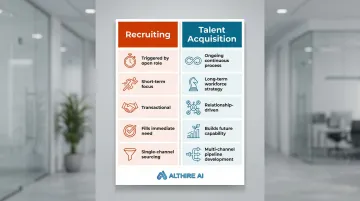
Recruiting is reactive: it responds to an open position with the goal of filling it quickly. Talent acquisition takes the opposite approach — building pipelines, nurturing relationships, and planning for roles before they even open.
Key differences:
| Recruiting | Talent Acquisition |
|---|---|
| Triggered by open role | Ongoing, continuous process |
| Short-term focus | Long-term workforce strategy |
| Transactional | Relationship-driven |
| Fills immediate need | Builds future capability |
| Single-channel sourcing | Multi-channel pipeline development |
Talent Acquisition Specialist vs. HR Professional
The two roles cover different ground:
- TA specialists focus on sourcing, screening, interviewing, and managing hiring pipelines — partnering with hiring managers and maintaining warm candidate pools for future roles
- HR professionals own the broader employee lifecycle: compensation, compliance, performance management, engagement, and off-boarding
In smaller organizations, these roles often overlap—one person wears both hats. As companies scale, they typically separate into distinct functions. TA sits within or closely alongside HR but operates with a distinct mandate: bringing the right people into the organization.
When Talent Acquisition Becomes Its Own Function
Growing companies benefit from dedicated TA roles when hiring volume, specialized positions, or competitive talent markets make reactive recruiting insufficient. Common triggers include:
- Hiring more than 20-30 people annually
- Competing for specialized technical or executive talent
- Expanding into new markets or geographies
- Experiencing high cost-per-hire or extended time-to-fill
- Needing consistent employer brand management
At this inflection point, a dedicated TA function typically cuts cost-per-hire, shortens time-to-fill, and improves the caliber of candidates reaching hiring managers — outcomes that compound as headcount grows.
The Talent Acquisition Process: A Step-by-Step Breakdown
Step 1: Workforce Planning
Before any hiring begins, HR and leadership must align on current and future talent needs. This includes identifying skills gaps, forecasting headcount based on business growth, and prioritizing which roles are hardest to fill—technical specialists, senior leadership, or niche positions.
The intake meeting between TA and hiring managers is the critical starting point. This conversation establishes role requirements, evaluation criteria, hiring timeline, and sourcing strategy. Without this alignment, even the best TA process produces mismatched hires.
Step 2: Sourcing Candidates
Modern TA teams use multiple sourcing channels simultaneously:
- Job boards and career sites
- LinkedIn and professional networks
- Employee referral programs
- Talent communities and past applicants
- Bootcamp partnerships and university programs
- Internal talent pools
Building a diverse sourcing mix prevents pipeline homogeneity and expands access to underrepresented talent. The best TA teams maintain warm pipelines for hard-to-fill roles, starting relationship-building months before positions open.
Step 3: Attraction and Employer Branding
Great candidates have choices. 81% of job seekers would not join a company with a bad reputation, and 83% actively research company reviews before applying. This creates a "reputation tax" for poorly branded organizations—they pay higher salaries or suffer prolonged vacancies.
Essential attraction tools include:
- Strong employer brand communicated through authentic content
- Compelling job descriptions with pay transparency and clear expectations
- Company culture narrative that differentiates your organization
- Active review management on Glassdoor and LinkedIn
Candidates read an average of six company reviews before forming an opinion. Organizations that respond to reviews and maintain active profiles see 70% higher application rates.
Step 4: Screening and Shortlisting
The screening stage separates qualified candidates from unqualified applicants through initial resume review, skills assessments, and pre-screening calls or automated screening tools.
Structured, consistent screening criteria reduce bias and improve candidate quality. Define clear requirements upfront—must-have skills, experience levels, and competencies—then apply them uniformly across all applicants. Automated screening tools can process thousands of resumes in seconds, freeing recruiters to focus on relationship-building with top candidates.
Step 5: Evaluation and Interviews
Structured interviews built around role-specific competencies consistently outperform unstructured conversations at predicting on-the-job performance. This stage is where evaluation rigor directly determines the quality of your hire.
Best practices include:
- Standardized interview questions aligned to role competencies
- Consistent evaluation rubrics applied to every candidate
- Panel interviews that reduce individual bias
- Skills assessments that validate technical capabilities
AI-powered interview platforms are now used at this stage to maintain evaluation consistency at scale. These tools conduct adaptive interviews around the clock, accommodate candidate schedules, and generate structured scoring reports — reducing both drop-off rates and time-to-decision.
Step 6: Offer, Onboarding, and Integration
Extend a verbal offer first to maintain engagement and address questions immediately. Follow with a written offer including total compensation details, benefits, start date, and key terms.
Onboarding is also the most commonly neglected stage of the TA process — and the one with the most immediate consequences. The numbers tell the story clearly:
- 1 in 3 new hires quits within 90 days — often citing poor onboarding as the reason
- 31% leave within the first six months, erasing the recruiting investment entirely
- Employees with structured onboarding are 18x more committed and 89% report high engagement
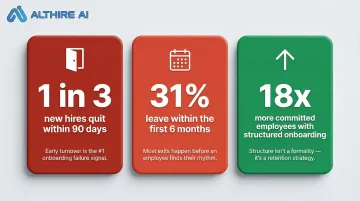
The effort spent on sourcing and evaluating candidates only pays off when onboarding sets them up to stay and perform.
Proven Talent Acquisition Strategies for HR Teams
Strategy 1: Talent Pipelining
Rather than starting from zero each time a role opens, proactive TA teams maintain warm pipelines of qualified candidates. This is especially valuable for hard-to-fill roles that take 3-6 months to close.
How to build pipelines:
- Use CRM tools to track candidate interactions and maintain relationships
- Tag candidates in your ATS by skills, experience level, and role fit
- Conduct regular outreach with company updates and relevant content
- Host talent community events and webinars
- Re-engage past applicants when similar roles open
Pipeline candidates convert faster and accept offers at higher rates — sourcing investment drops significantly compared to cold outreach.
Strategy 2: Skills-Based Hiring
The shift away from degree requirements and years-of-experience proxies toward evaluating candidates based on demonstrated skills and competencies expands the talent pool and improves long-term role fit.
81% of employers now use skills-based hiring, up from 56% in 2022. McKinsey research shows that hiring for skills is five times more predictive of job performance than hiring for education.
ROI of skills-based hiring:
- 90% reduction in mis-hires
- 91% improved retention
- 81% reduced time-to-hire
- 78% reduced cost-to-hire
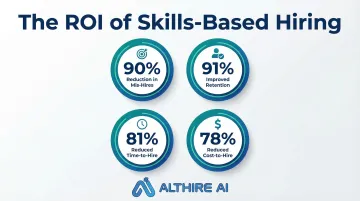
Employees hired without a traditional four-year degree stay at their companies 34% longer than employees with such a degree, demonstrating that skills-based hiring builds loyalty while expanding access to diverse talent.
Strategy 3: Internal Mobility
Developing and promoting internal candidates rather than defaulting to external hiring delivers multiple advantages. Internal hires onboard faster, retain longer, and signal a culture of growth and opportunity.
How to build internal mobility programs:
- Create transparent career pathing frameworks
- Post open roles internally before external advertising
- Offer stretch assignments and cross-functional projects
- Provide mentorship and skills development programs
- Track internal promotion rates as a key TA metric
Beyond cost savings, internal mobility preserves institutional knowledge that walks out the door when organizations over-rely on external hiring.
Strategy 4: DEI-Focused Sourcing
Diverse hiring teams outperform less diverse ones. Building inclusive pipelines requires intentional sourcing strategies and bias-reduction mechanisms throughout the TA process.
Effective DEI strategies:
- Write inclusive job descriptions that avoid gendered or exclusionary language
- Source from underrepresented talent communities and diverse job boards
- Use structured interviews with standardized rubrics to reduce bias
- Implement blind resume screening to remove demographic identifiers
- Set diversity hiring goals and track progress transparently
Sourcing diverse candidates is only half the equation. Without structured evaluation frameworks, bias re-enters at the assessment stage — structured rubrics ensure every candidate is measured on skill and potential.
Strategy 5: Candidate Experience Investment
Candidate experience covers every touchpoint from the job post to the offer letter. In competitive hiring markets, timely communication, transparent process stages, and feedback for rejected candidates are real differentiators — most employers skip them entirely.
Key experience elements:
- Clear job descriptions with compensation ranges
- Transparent hiring timelines and next steps
- Prompt communication at every stage
- Respectful interview scheduling with minimal disruption
- Feedback provided to finalists, even when not selected
A poor candidate experience has measurable downstream consequences. Rejected candidates post reviews on Glassdoor and LinkedIn, shaping how future applicants — and sometimes customers — perceive your company.
How Technology and AI Are Transforming Talent Acquisition
The modern TA technology landscape includes applicant tracking systems (ATS), candidate relationship management tools, AI-powered sourcing platforms, and interview automation. Together, these tools cut the manual work out of recruiting — freeing HR teams to focus on strategy and relationships. AltHire AI, for example, integrates with 20+ ATS systems including Greenhouse, Lever, Ashby, Workable, and BambooHR, syncing directly into existing workflows without requiring a platform overhaul.
69% of HR professionals now use AI to support recruiting activities, up from 51% the year prior. Overall AI adoption for HR tasks jumped to 43% in 2025, up from 26% in 2024.
Efficiency gains are substantial:
- AI reduces time-to-hire by up to 50%
- Automates 75% of candidate communications
- Delivers 20-40% lower cost per hire through automated screening and scheduling
AI's Impact on Screening and Interviews
AI tools screen thousands of resumes in seconds, conduct structured pre-screening interviews autonomously, and generate objective candidate scorecards. This acceleration is particularly valuable at the top of the funnel, where high application volumes create bottlenecks.
AI-powered interview platforms conduct adaptive conversations that adjust questions based on candidate responses — maintaining consistent evaluation standards while personalizing the experience. Dimensional scoring covers technical skills, communication, problem-solving, and role-specific competencies, giving reviewers a structured basis for comparison rather than subjective notes.
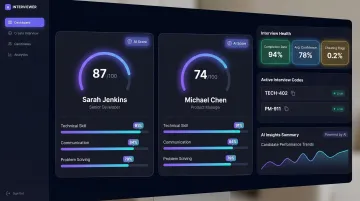
Bias Reduction Through AI
When properly designed, AI-powered evaluation tools apply consistent rubrics across every candidate — eliminating the inconsistency of human interviewers who may be influenced by affinity bias, fatigue, or unconscious demographic preferences.
Transparency matters here. Key considerations when choosing AI tools:
- Auditable scoring models that explain how hiring decisions are made
- Structured evaluation rubrics applied identically across all candidates
- Human review checkpoints before final decisions are made
74% of candidates doubt AI will evaluate them fairly, and 25% trust employers less if they use AI. That means human oversight isn't optional — it's what keeps AI tools from eroding candidate trust and employer brand in the process of saving time.
24/7 Hiring Availability
Asynchronous and AI-conducted interviews allow candidates to complete evaluations on their own schedule, reducing drop-off rates and speeding up the hiring funnel. Rather than coordinating schedules across multiple time zones, candidates receive interview links and participate when ready. Recruiters review results when convenient — a practical advantage for global talent pools where a two-week wait for an interview slot often means losing the candidate to a faster-moving competitor.
The format works especially well for high-volume hiring, passive candidates with limited availability, and roles where speed-to-offer is a real differentiator.
Key Metrics to Measure Talent Acquisition Success
Without data, talent acquisition is guesswork. Tracking structured analytics separates mature TA functions from reactive ones. High-maturity HR organizations that leverage data and analytics have a 90% likelihood of meeting or exceeding financial goals, yet 15% of organizations don't measure TA efforts at all.
Core TA Metrics
Every HR team should track these foundational metrics:
| Metric | What It Measures | Benchmark |
|---|---|---|
| Time-to-fill | Calendar days from requisition open to offer acceptance | 45 days (median) |
| Time-to-hire | Days from first candidate contact to offer acceptance | Role-dependent |
| Cost-per-hire | All recruiting expenses ÷ total hires | $1,200 (non-exec); $10,625 (exec) |
| Source-of-hire | Which channels produce the highest-quality candidates | N/A — tracks ROI by channel |
| Offer acceptance rate | Offers accepted vs. declined | 90–91% (median) |
| New hire retention | Retention at 90 days and one year | Signals onboarding quality |
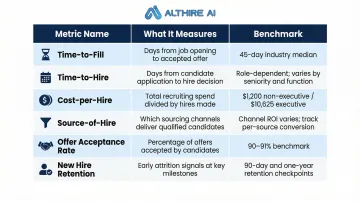
Cost-per-hire for executive roles has spiked 113% since 2017, making sourcing efficiency more critical than ever.
Quality-of-Hire: The Most Important Long-Term Signal
Quality-of-hire ties TA performance directly to business outcomes like productivity and retention — and it's the metric most predictive of long-term hiring success. Proxy measures include:
- Hiring manager satisfaction scores
- Performance review ratings at 6 months
- Early turnover rates (departures within first year)
- Time-to-productivity for new hires
- Promotion rates for recent hires
Platforms like AltHire AI surface quality-of-hire data automatically — linking structured interview scores to downstream performance ratings so teams can spot which sourcing channels and screening criteria actually predict success.
Frequently Asked Questions
What does a talent acquisition specialist do?
A TA specialist sources and screens candidates, manages interview pipelines, maintains talent pools for future roles, supports employer branding initiatives, and partners with hiring managers to close positions efficiently.
What is the difference between talent acquisition and HR?
HR covers the full employee lifecycle — onboarding, compensation, compliance, performance management, and off-boarding. Talent acquisition is a specific function within HR focused on identifying and hiring candidates; in smaller companies the roles overlap, while larger organizations typically run them as separate teams.
Is talent acquisition the same as recruiting?
No. Recruiting is reactive and role-specific, responding to open positions with the goal of filling them quickly. Talent acquisition is proactive and strategic—encompassing pipeline building, employer branding, workforce planning, and long-term candidate relationship management before roles even exist.
What are the most important metrics in talent acquisition?
The key TA metrics are time-to-fill, time-to-hire, cost-per-hire, source-of-hire quality, offer acceptance rate, and quality-of-hire measured through early retention rates and performance scores.
Is onboarding part of talent acquisition?
Yes. Onboarding is the final stage of the talent acquisition process — poor onboarding accelerates early turnover and wastes recruiting investment, while structured onboarding significantly increases long-term employee retention and commitment.
What role does AI play in modern talent acquisition?
AI tools assist with candidate sourcing, automated resume screening, structured interview delivery, bias reduction through consistent scoring, and analytics that compress time-to-hire and improve recruiter productivity. AI adoption has reached 69% of HR professionals, delivering up to 50% reductions in time-to-hire and 20-40% lower cost-per-hire.