Introduction
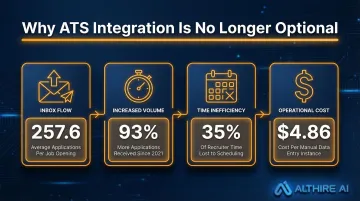
Hiring teams face a brutal numbers problem: application volumes have surged to an average of 257.6 applications per job, while time-to-hire expectations keep tightening. Recruiters now manage 93% more applications and 40% more open roles than in 2021, yet teams are 14% smaller.
The result? 35% of recruiter time evaporates into interview scheduling alone, with another 17.7 hours per vacancy lost to manual admin tasks.
AI candidate screening platforms have emerged to automate early-stage evaluation, but that value only materializes with direct ATS integration. Disconnected tools create more work, not less. Manual data re-entry costs $4.86 per instance and forces recruiters to toggle between systems, losing candidate context and hiring momentum. When AI screening syncs directly into your ATS, candidate scores, interview insights, and evaluation data flow automatically into your hiring pipeline, keeping every stakeholder aligned in real time.
Key Takeaways
- AI screening platforms use machine learning and NLP to evaluate, score, and rank candidates on skills, communication, and role fit — not just keywords
- ATS integration keeps candidate data, scores, and interview results synced directly into your pipeline — no manual re-entry
- Strong platforms go beyond resume parsing with adaptive AI interviews, bias-free scoring, proctoring, and real-time analytics
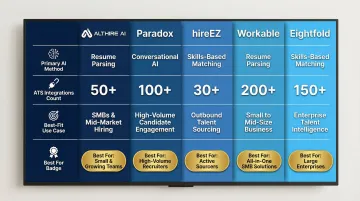
- Leading options include AltHire AI for full interview automation, Paradox for high-volume mobile hiring, hireEZ for outbound sourcing, Workable for all-in-one ATS + AI, and Eightfold for enterprise skills matching
What Is AI Candidate Screening—and Why Does ATS Integration Matter?
AI candidate screening refers to software that uses machine learning, natural language processing, and conversational AI to evaluate candidates against role requirements. This spans everything from semantic resume analysis to live AI-driven interviews that adapt questions based on responses. Unlike traditional manual screening—where recruiters spend hours reading resumes and conducting phone screens—AI screening applies consistent evaluation criteria at scale, identifying top candidates in minutes rather than days.
ATS integration acts as a force multiplier. Without it, screening scores and interview insights live in a separate system, forcing recruiters to manually re-enter data, export reports, and update candidate records across platforms. This creates delays, information loss, and version control chaos.
With native ATS integration, candidate evaluations automatically sync into your hiring pipeline:
- Scores appear directly in candidate profiles
- Interview transcripts attach to existing records
- Hiring managers see real-time updates without leaving their ATS
That friction carries a real price tag. Manual data entry by HR professionals costs an average of $4.86 per instance, draining productivity and budgets at scale. When 93% of recruitment professionals rely on an ATS as their system of record, AI screening tools that don't integrate tightly become expensive bottlenecks rather than efficiency gains.
Best AI Candidate Screening Platforms with ATS Integration
These platforms were evaluated on ATS integration breadth, AI screening methodology, ease of setup, bias controls, and documented hiring outcomes—not marketing claims.
AltHire AI
AltHire AI is an AI-powered interview and candidate screening platform that conducts adaptive, human-like interviews 24/7, delivers 350+ weekly interviews, and integrates with 20+ ATS platforms including Greenhouse, Lever, Ashby, Workable, and BambooHR. Companies that want to fully automate early-stage screening—without sacrificing structure or fairness—are the core use case.
Several capabilities set it apart:
- 100% AI-proctored interviews prevent impersonation through camera verification, screen monitoring, and audio integrity analysis
- Adaptive conversational AI adjusts follow-up questions based on each candidate's actual responses, evaluating communication, problem-solving, and role-specific knowledge
- AI-generated scorecards sync back to the ATS automatically after each interview
- Drag-and-drop interview creation takes under 10 minutes, with documented outcomes of 70% faster time-to-hire and 60% reduction in screening time
| Feature Category | Details |
|---|---|
| Key Features | Adaptive AI interviews, 100% proctoring, AI-generated scorecards, bias-free structured evaluation |
| ATS Integrations | 20+ platforms including Greenhouse, Lever, Ashby, Workable, BambooHR |
| Best For | Companies of all sizes wanting to fully automate candidate screening interviews with ATS sync |
Paradox (Olivia)
Paradox is a conversational AI recruiting platform whose AI assistant, Olivia, engages candidates through chat and SMS to conduct screening conversations, qualify applicants, and schedule interviews—integrating results directly into major ATS systems. Olivia communicates via text, WhatsApp, and web chat, making it especially effective for high-volume and hourly hiring where candidates prefer mobile-first experiences.
Mobile-first screening combined with instant scheduling is where Paradox pulls ahead. Compass Group hires 160,000 workers annually with just 20 recruiters, while 7-Eleven saved store leaders 40,000 hours per week by automating recruiting tasks. The platform also achieved a 58% decrease in time-to-apply by eliminating friction in the candidate experience.
| Feature Category | Details |
|---|---|
| Key Features | Chat/SMS-based conversational screening, instant qualification, automated interview scheduling |
| ATS Integrations | Native integrations with Workday, SAP SuccessFactors, iCIMS, and other enterprise ATS platforms |
| Best For | High-volume and hourly hiring where mobile-first candidate experience is critical |
hireEZ
hireEZ is a comprehensive AI recruiting platform that unifies outbound sourcing, candidate engagement, and applicant screening. Its Agentic AI technology analyzes resumes and generates fit predictions that sync with connected ATS platforms. The platform integrates with Greenhouse, Workday, Oracle, and iCIMS.
The key advantage: transparent, explainable scoring that shows recruiters exactly why a candidate matches or doesn't. ResumeSense fraud detection flags misleading resumes early—internal testing revealed 3% to 5% of resumes contained hidden or deceptive content, which ResumeSense detects while providing human-readable insights.
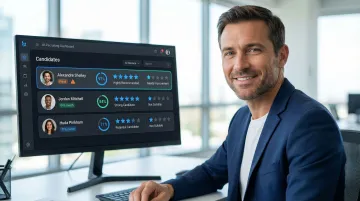
This is particularly valuable for teams managing large inbound pipelines where resume manipulation has become common.
| Feature Category | Details |
|---|---|
| Key Features | AI-powered resume ranking, explainable scoring, ResumeSense fraud detection, CRM-style candidate engagement |
| ATS Integrations | Works with major ATS platforms including Greenhouse, Workday, Oracle, iCIMS |
| Best For | Recruiting teams that need outbound sourcing and inbound screening in a single connected platform |
Workable
Workable is an all-in-one recruiting platform with built-in ATS and AI-powered screening. It uses deep learning to semantically analyze resumes, generate candidate summaries, and assign percentage match scores against job requirements. The AI evaluates candidates on hard requirements and provides explainable checklists showing exactly why each candidate matches.
Because Workable's AI screening is native to its ATS, there is no integration setup required. Candidate data, scoring, anonymized screening, and outreach all live in one platform. Hugging Face scaled global hiring by 300% without adding recruiters, saving 2+ hours per recruiter per week.
| Feature Category | Details |
|---|---|
| Key Features | Semantic resume screening, AI-generated summaries, anonymized bias-reduction screening, intelligent parsing |
| ATS Integrations | Native (ATS built-in); also connects with BambooHR, Slack, Microsoft Teams, and other HR tools |
| Best For | SMBs and mid-market teams wanting an all-in-one ATS + AI screening platform with minimal setup |
Eightfold AI
Eightfold is an enterprise-grade Talent Intelligence Platform that uses deep learning to evaluate candidates on skills, potential, and career trajectory. It goes beyond resumes to infer transferable capabilities and recommend candidates from both external applicants and internal talent pools. The platform integrates with Workday, SAP SuccessFactors, Greenhouse, and other enterprise ATS systems.
Where Eightfold separates itself: its talent graph connects skills, roles, and career paths across 1.5 billion global data points, surfacing qualified candidates that traditional keyword-based ATS screening would miss.
AirAsia achieved 80% faster progression to interviews and 36% faster time-to-offer after integrating Eightfold with Workday—making it a strong fit for large enterprises with complex pipelines and DEI hiring goals.
| Feature Category | Details |
|---|---|
| Key Features | Skills-based deep learning matching, internal mobility insights, bias-mitigating screening, predictive fit modeling |
| ATS Integrations | Integrates with major enterprise ATS platforms including Workday, SAP, Greenhouse, and others |
| Best For | Large enterprises focused on skills-based hiring, workforce planning, and internal mobility |
What to Look For When Choosing an AI Screening Platform with ATS Integration
Depth and Reliability of ATS Integrations
"Integrates with ATS" can mean anything from a basic webhook to a fully bi-directional data sync. Ask whether candidate scores, interview transcripts, and AI-generated reports automatically update inside the ATS, or whether manual export steps are still required. Native integrations that sync data in real time eliminate the $4.86-per-instance cost of manual data entry and keep hiring teams aligned.
Look for platforms that specify:
- Which ATS platforms are supported (Greenhouse, Lever, Workday, etc.)
- Whether the integration is native or middleware-dependent
- What candidate data fields sync automatically
- How frequently data updates (real-time vs. batch)
Quality of AI Evaluation Beyond Resume Parsing
Distinguish between platforms that only scan resumes for keywords versus those that conduct dynamic, adaptive screening. AI interviews that ask follow-up questions based on responses produce much more useful data for hiring decisions and generate more consistent, auditable evaluations.
Resume-only screening misses critical signals:
- Communication ability and clarity
- Problem-solving approach and reasoning
- Cultural fit and behavioral traits
- Real-time technical skills demonstration
Conversational AI platforms like AltHire AI and Paradox evaluate these dimensions through adaptive dialogue, while skills-based platforms like Eightfold infer transferable capabilities that resumes don't explicitly state.
Compliance, Fairness, and Proctoring Safeguards
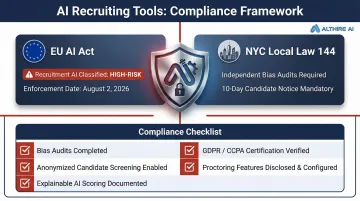
AI screening tools must address bias risk, data privacy regulations, and candidate impersonation — and the regulatory pressure is real. The EU AI Act classifies recruitment AI as "high-risk" with enforcement beginning August 2, 2026. NYC Local Law 144 mandates independent bias audits and 10-day candidate notices before using automated employment decision tools. Research also shows that while AI can reduce human bias by applying consistent criteria, uncritical deployment risks amplifying existing structural biases — making human-in-the-loop oversight essential, not optional.
Teams should look for:
- Documented bias audits and fairness testing
- GDPR and CCPA compliance certifications
- Anonymized evaluation options
- Proctoring features (camera verification, screen monitoring)
- Explainable AI that shows why candidates were scored
Scalability and Time-to-Value
Setup complexity varies widely across both the ATS and the AI screening layer on top of it. Some AI platforms go live in minutes with drag-and-drop interview builders, but the underlying ATS can create bottlenecks: Greenhouse implementations typically take 6 to 12 weeks, and Workday integrations commonly run 3 to 6 months. Choose an AI platform that minimizes its own setup burden, so ATS complexity doesn't compound your timeline.
Before committing, confirm how long it takes from sign-up to your first interview, whether IT involvement is required, and what support looks like during rollout. Those details matter as much as the feature list.
How We Chose These Platforms
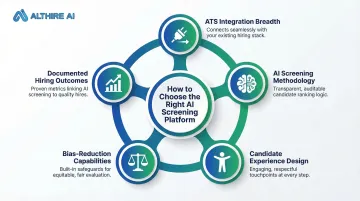
Each platform was evaluated against five criteria — not vendor marketing materials:
- ATS integration breadth: number of supported platforms and quality of real-time sync
- AI screening methodology: resume parsing only vs. conversational/interview-based assessment
- Candidate experience design: clarity, accessibility, and drop-off rates
- Bias-reduction capabilities: structured scoring, anonymization, and audit trails
- Documented hiring outcomes: measurable impact on time-to-hire, quality of hire, and recruiter workload
Common mistakes buyers make:
- Prioritizing UI aesthetics over integration depth
- Choosing platforms that only do resume parsing when their workflow demands full interview automation
- Overlooking compliance requirements until after implementation
- Failing to verify whether "ATS integration" means real-time sync or manual export
The platforms that made this list earned their place on all five criteria — not just one or two.
Conclusion
The right AI candidate screening platform is not just a time-saving tool—it determines the quality of candidates who reach your pipeline, how efficiently recruiters work, and whether evaluation stays fair across the board. The platforms listed represent different approaches suited to different organizational contexts: AltHire AI for full interview automation, Paradox for high-volume mobile hiring, hireEZ for outbound sourcing, Workable for all-in-one simplicity, and Eightfold for enterprise skills matching.
Map your current ATS ecosystem, identify where the biggest screening bottlenecks occur (volume management, interview scheduling, bias in evaluation), and pilot a platform that integrates natively with your existing stack before committing. A poorly integrated tool creates duplicate workflows and data gaps; a native integration removes both.
For teams looking for a platform that combines AI-driven interview conduction, bias-free structured scoring, and direct ATS integration in one place, AltHire AI is built to deliver—with 20+ ATS integrations, 100% AI proctoring, and documented results across companies of all sizes. Explore AltHire AI or book a free consultation to see how it fits your hiring workflow.
Frequently Asked Questions
How do I integrate AI candidate screening platforms with an ATS for interviews?
Most modern AI screening platforms offer native integrations or API connections with popular ATS systems. Once connected, candidate profiles, AI scores, and interview results automatically sync into the ATS pipeline, eliminating manual data entry and keeping all hiring data in one place.
Are there AI candidate screening platforms that can conduct interviews?
Yes, platforms like AltHire AI and Paradox go beyond resume parsing to conduct full AI-driven screening interviews. AltHire AI uses conversational AI agents that ask adaptive follow-up questions based on responses, while Paradox's Olivia qualifies candidates through SMS/chat conversations—with results synced to the ATS automatically.
What is the difference between AI resume screening and AI interview screening?
AI resume screening analyzes static documents to rank candidates by keyword or skill match, while AI interview screening uses dynamic conversation — the AI asks adaptive questions and evaluates responses in real time. The latter provides deeper insight into communication ability, role-specific knowledge, and candidate behavior.
How does AI candidate screening reduce hiring bias?
AI screening platforms reduce bias by applying consistent, structured criteria to every candidate — removing subjective judgment from early-stage screening. Still, only 26% of applicants trust AI will evaluate them fairly, so verify that any platform you consider has been audited for algorithmic bias.
What ATS platforms do most AI screening tools support?
The most commonly supported ATS platforms include Greenhouse, Lever, Workable, Ashby, BambooHR, Workday, and SAP SuccessFactors. Confirm whether each integration is native (direct, bi-directional) or middleware-dependent — this affects sync reliability and implementation complexity.