Introduction
Corporate job postings attract an average of 250 to 258 applications per opening, yet only 0.1% to 2% of cold applicants receive an offer. While recruiting teams sift through hundreds of resumes, top candidates disappear within 10 days—and 42% of candidates drop out because scheduling takes too long.
The financial cost makes a slow process even harder to justify. The U.S. Department of Labor estimates that a bad hire costs at least 30% of first-year earnings, reaching $240,000 for executive roles. Harvard Business Review research puts 80% of turnover directly on poor hiring decisions.
The right candidate screening software determines whether hiring moves at the speed of business or grinds to a halt. The wrong tool wastes recruiter hours, introduces bias, and loses top candidates to faster-moving competitors. This guide breaks down what to look for—and which tools actually deliver.
Key Takeaways
- Candidate screening software automates resume review, candidate scoring, and early-stage evaluation so recruiters focus on high-value conversations
- The right tool type depends on your bottleneck: ATS, AI interviews, skills assessments, resume parsing, and async video each solve different problems
- Evaluate tools across six factors: hiring volume fit, AI depth, bias controls, ATS integration, candidate experience, and compliance reporting
- AI screening quality varies widely — the best tools evaluate skills, culture fit, and potential, not just resume text
- AltHire AI cuts screening time by 60% and recruiting costs by up to 50% with adaptive AI interviews and full ATS integration
What Is Candidate Screening Software?
Candidate screening software helps recruiting teams evaluate and shortlist applicants before the first live conversation, using automated resume review, structured scoring, assessments, and AI-driven interview capabilities.
The distinction matters: while an ATS manages the pipeline and tracks applicants across stages, screening software is the evaluation layer. It determines who deserves a recruiter's time, not just where candidates sit in a workflow.
Types of Candidate Screening Tools
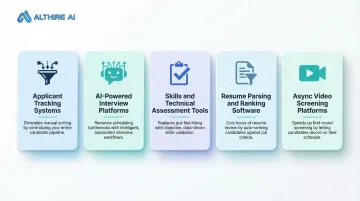
The market segments into five main categories, each addressing a different hiring friction point:
- Applicant Tracking Systems (ATS) — Organize pipeline stages, post jobs, manage collaboration, and track candidates from application to offer
- AI-powered interview platforms — Run structured early-stage conversations using conversational AI that adjusts follow-up questions based on each candidate's responses
- Skills and technical assessment tools — Test role-specific competencies through coding challenges, psychometric evaluations, or realistic job simulations
- Resume parsing and ranking software — Process high-volume applicant pools by extracting structured data from resumes and surfacing the strongest matches automatically
- Async video screening platforms — Replace first-round phone screens with recorded video responses that candidates complete on their own schedule
Most companies combine two or more types. The right mix depends on where your hiring process struggles most — whether that's managing application volume, verifying skills before interviews, or reducing time lost to scheduling.
Key Factors to Consider When Choosing Candidate Screening Software
Picking the wrong screening tool doesn't just slow hiring — it skews your shortlists, frustrates candidates, and creates compliance risk. These six factors connect specific software capabilities to the hiring outcomes that actually matter.
Hiring Volume and Role Complexity
High-volume hiring (50+ roles simultaneously) demands automation at the intake layer—AI ranking, async interviews, and structured assessments. Specialized or senior roles benefit more from tools that evaluate nuanced skills, culture alignment, and adaptive follow-up questions rather than keyword filters.
KPIs this factor influences:
- Time-to-shortlist
- Application-to-interview conversion rate
- Recruiter hours spent per hire
AI Depth and Adaptive Capability
Surface-level AI—keyword matching and basic resume parsing—risks missing strong candidates who describe experience differently. Deep AI includes adaptive interview agents that adjust follow-up questions based on candidate responses, semantic skill inference, and AI-generated insight reports.
Metrics to track:
- Quality of hire
- Candidate pass-through rate
- Hiring manager satisfaction with shortlist relevance
Bias Reduction and Structured Evaluation
Unstructured, subjective screening is the primary source of hiring bias. Tools that apply consistent scoring criteria across every applicant, anonymize demographic data, and provide reasoning for recommendations create a defensible, equitable process.
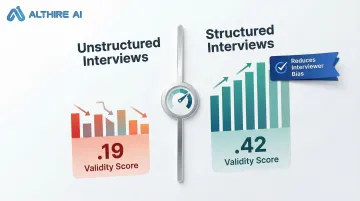
The data backs this up: meta-analyses show structured interviews yield a predictive validity of .42 versus just .19 for unstructured interviews, while simultaneously reducing demographic bias.
KPIs this factor influences:
- Diversity of shortlists
- Legal compliance posture
- Offer acceptance rates
ATS and Tech Stack Integration
A screening tool that doesn't write results back cleanly to your ATS forces manual data re-entry, breaks workflow momentum, and creates compliance gaps.
Look for native integrations with your existing ATS (Greenhouse, Lever, Workable, BambooHR, Ashby) and confirm that assessment triggers can fire automatically from stage changes — not just manually.
The average HR tech stack has grown to 9.1 systems (11+ for enterprises), and 52% of organizations report higher-than-expected costs due to integration challenges.
KPIs this factor influences:
- Recruiter productivity
- Time-to-fill
- Data accuracy across systems
Candidate Experience and Completion Rates
Assessments with too much friction—long test batteries, required app downloads, no mobile support—cause candidates to abandon mid-process, shrinking the top of your funnel before you've even evaluated anyone.
57% of job applications are abandoned if the process is too lengthy or complex, and 78% of workers expect the application process to take under 30 minutes.
Watch these numbers:
- Application completion rate
- Employer brand perception
- Time-to-offer on competitive roles
Reporting, Analytics, and Compliance
Teams without screening analytics can't identify where strong candidates are dropping off, can't demonstrate process fairness under audit, and can't improve over time.
Look for tools that provide:
- Audit trails for evaluation decisions
- Data retention policies aligned with GDPR/EEOC requirements
- Dashboards showing completion rates, time-to-shortlist, and adverse impact metrics (screening outcomes by demographic group)
The EEOC and OFCCP explicitly state that employers are strictly liable for adverse impact caused by third-party AI screening vendors—you cannot delegate compliance.
KPIs this factor influences:
- Compliance risk exposure
- Process iteration speed
- Recruiter accountability
Questions to Ask Vendors Before You Commit
Vendor demos are optimized to showcase best-case scenarios. These questions reveal real capabilities and limitations before you sign a contract.
1. What data does the AI actually analyze—and what is the methodology behind candidate scoring?
Request specifics on how scores are calculated, what weights are applied to different signals, and whether the model has been audited for adverse impact. Vendors that can't answer this clearly are waving a flag.
2. Do results integrate into your ATS as structured fields or freeform notes, and what triggers assessment invitations?
Structured fields enable downstream reporting and automation — freeform notes sit in a silo and can't be actioned at scale. Confirm whether invitations trigger automatically from ATS stage changes or require a recruiter to fire them manually.
3. What candidate data is collected, how long is it retained, and what happens to it if you cancel?
Data privacy regulations — GDPR, CCPA, and others depending on your region — require vendors to have clear retention policies. Ask for specifics on retention periods, deletion procedures, and whether your data can be exported or destroyed when you leave.
Before you sign: Walk the tool yourself as a candidate — on mobile — before purchasing. Completion rates are a real differentiator, and a tool that feels clunky will show up immediately in your funnel metrics.
How AltHire AI Can Help
AltHire AI is an AI-powered interview platform built to go beyond resume screening. It assesses skills, cultural fit, and candidate potential through adaptive, conversational interviews available 24/7 — removing the scheduling bottleneck and the guesswork that comes with keyword-only evaluation.
Core Differentiators
Questions that adapt, not a script that repeats AltHire's AI interview agents adjust follow-up questions dynamically based on each candidate's responses. The conversational AI asks relevant, role-specific questions tailored to what the candidate actually said — keeping them engaged rather than walking through a fixed list.
Built-in integrity, not bolted on The platform prevents impersonation and ensures assessment fairness through comprehensive monitoring: identity verification, environment checks, behavior alerts, detection of external help, multiple voices, suspicious eye movements, and AI-generated answers.
Interviews ready in under 10 minutes Deploy structured interviews for any role — technical, functional, or creative — using drag-and-drop creation. Upload a job description, and AltHire's AI automatically crafts role-specific questions and evaluation criteria.
Measurable Outcomes
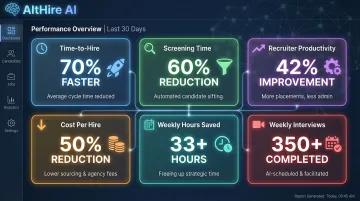
Based on platform data across active customers, AltHire AI delivers:
- 70% faster time-to-hire
- 60% reduction in screening interview time
- 42% improvement in recruiter productivity
- 50% reduction in recruiting costs
- 33+ recruiter hours saved per week
- 350+ weekly interviews delivered
Seamless Integration
The platform integrates with 20+ ATS platforms including Greenhouse, Lever, Ashby, Workable, BambooHR, JazzHR, iCIMS, Jobvite, Smart Recruiters, Recruitee, and BreezyHR. All candidate data, interview results, and feedback sync automatically in real time.
Bias-Free Evaluation
AltHire's structured scoring models and objective evaluation criteria are applied consistently across every candidate, supporting fair, defensible shortlists without relying on recruiter intuition or resume aesthetics.
Conclusion
The right candidate screening software is the one that solves your actual bottleneck — not the one with the longest feature list. Match your tool to what's genuinely slowing you down:
- Applicant volume — you need faster filtering and automated triage
- Skills verification — you need structured assessments or AI-led technical screens
- Scheduling friction — you need self-serve booking and async interview options
- Shortlist quality — you need smarter scoring and bias-reduced evaluation
Screening technology isn't a one-time purchase. Hiring needs shift as teams scale, roles change, and AI capabilities advance. Revisit your tool stack against actual hiring metrics — your requirements at 50 hires per quarter look very different at 500.
Frequently Asked Questions
What's the difference between candidate screening software (ATS) and a CRM?
An ATS organizes and tracks applicants through the hiring pipeline (stage management, collaboration, offers), a CRM manages relationships with passive and future candidates before they apply, and screening software is the evaluation layer that sits between them—assessing candidates through scoring, assessments, and AI-driven interviews.
Can AI screening software eliminate hiring bias?
No tool eliminates bias entirely, but well-designed AI screening tools reduce it by applying consistent evaluation criteria across all candidates and anonymizing demographic identifiers. Look for tools that surface their scoring logic so you can audit what's actually being measured.
What's the difference between resume screening software and interview screening software?
Resume screening tools filter and rank applicants based on their submitted documents, while interview screening software (such as async video platforms or AI interview agents) evaluates candidates through structured conversations—the latter captures skills, communication, and cultural alignment that a resume alone cannot surface.
How do I know which type of candidate screening tool my team actually needs?
Start by identifying your biggest hiring bottleneck:
- Too many applicants: prioritize AI interview or async screening tools
- Skills verification gaps: focus on assessment platforms
- Poor shortlist quality: look for tools that evaluate potential and fit beyond the resume
- Scheduling friction: any async screening tool will help
Does candidate screening software replace human recruiters?
Screening software handles repetitive tasks—resume review, scoring, early-stage interviews—so recruiters can spend their time where it counts: evaluating finalists, advising hiring managers, and sourcing hard-to-find talent.
How much does candidate screening software typically cost?
Pricing varies widely by category and scale. Self-serve tools typically start at $39–$299/month, while enterprise platforms with implementation support can run $1,200–$50,000+/year. AI interview platforms like AltHire AI are best evaluated through a demo, where you can weigh the cost against your current recruiting spend.