Introduction
Bad hires are expensive. A single mis-hire can cost organizations up to 30% of the employee's first-year earnings, not counting productivity losses, team disruption, and the cost of restarting the search.
The problem is that traditional resume screening and gut-feel interviews measure credentials and likability — not what candidates can actually do, how they think under pressure, or whether their working style fits your team.
Pre-employment tests fill that gap. These standardized assessments measure job-relevant attributes — cognitive ability, technical skills, personality traits, and judgment — before you make a final decision, giving you hard evidence to weigh alongside your interview impressions.
This article breaks down the 7 most impactful types of pre-employment tests, the specific business benefit each delivers, and how to choose the right combination for your hiring process without introducing legal risk or candidate friction.
Key Takeaways
- Pre-employment tests evaluate skills, personality, cognitive ability, and judgment before hiring
- They replace guesswork with objective data on each candidate
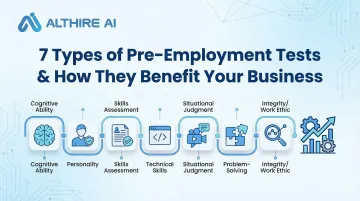
- 7 test types covered: cognitive ability, job knowledge, skills, personality, emotional intelligence, integrity, and situational judgment
- Each serves a different purpose—choose based on role requirements and hiring stage
- Together, they cut screening time, improve hire quality, and support defensible, compliant decisions
What Is Pre-Employment Testing?
Pre-employment testing refers to standardized assessments administered during the hiring process to evaluate candidates on job-relevant attributes before making a final hiring decision. Unlike background checks, which verify past behavior, pre-employment tests measure forward-looking factors: how a person thinks, what they can do, and whether their traits align with the role.
These assessments give employers an early, evidence-based read on fit — helping distinguish between candidates who look good on paper and those who will actually perform in the job.
Key Business Benefits of Pre-Employment Testing
The value shows up in three areas that directly affect hiring efficiency and quality:
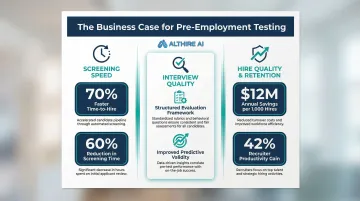
Screening speed: Structured assessments filter unqualified candidates early, cutting time spent on manual resume reviews and phone screens. Organizations using pre-employment testing report 70% faster time-to-hire and a 60% reduction in screening interview time.
Interview quality: Test results give interviewers objective data to guide targeted questions — probing specific competency gaps rather than starting from scratch. Research confirms that structured evaluation processes improve interrater reliability and predictive validity compared to unstructured interviews.
Hire quality and retention: Better-fit hires reduce turnover and the costs that come with it. Companies using pre-employment assessments report $12 million in annual savings per 1,000 hires and a 42% improvement in recruiter productivity.
7 Types of Pre-Employment Tests
No single test captures the full picture of a candidate. Different test types target different competencies, and the most effective hiring processes combine two or three based on the role's core requirements.
Cognitive Ability Tests
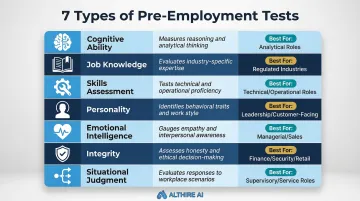
Cognitive ability tests assess reasoning, memory, numerical ability, verbal comprehension, and problem-solving speed. Decades of industrial-organizational psychology research identify cognitive ability as the strongest single predictor of job performance across roles—particularly for positions requiring rapid learning, analytical thinking, and complex decision-making.
Business Benefit: These tests are especially valuable for intellectually demanding roles—strategy, finance, engineering, and management—where learning speed directly impacts output quality. They surface candidates who can master new systems quickly, solve novel problems, and adapt to shifting requirements.
Key Limitation: Cognitive tests may disadvantage candidates with test anxiety or non-traditional learning backgrounds, and they don't capture practical or interpersonal skills. They should be paired with other assessment types to avoid over-relying on a single dimension of capability.
Job Knowledge Tests
Job knowledge tests measure a candidate's existing understanding of duties, concepts, regulations, or technical content relevant to the position. For example, testing a financial analyst on accounting principles or a compliance officer on industry-specific regulations.
Business Benefit: They quickly verify whether a candidate has the foundational domain knowledge required to be productive from day one, reducing onboarding time and the risk of costly mistakes in specialized roles. This is particularly critical for regulated industries (healthcare, finance, legal) where knowledge gaps can create compliance exposure.
Key Limitation: These tests measure what a candidate already knows, not their potential to learn. They can overlook high-potential candidates who are strong learners but lack specific prior exposure, potentially screening out talent who could quickly close knowledge gaps with training.
Skills Assessment Tests
Skills assessments are practical, hands-on tests that measure a candidate's ability to perform specific tasks tied directly to the job—typing speed, Excel proficiency, coding exercises, writing samples, or customer communication scenarios.
Business Benefit: They provide concrete, observable proof of capability rather than self-reported claims. This is especially critical for technical, functional, or operational roles where a skill gap would immediately affect team performance.
AI-powered interview platforms like AltHire AI can administer adaptive skills assessments through conversational AI, adjusting follow-up questions in real time based on each candidate's responses—enabling scalable, role-specific evaluation without manual test design.
Key Limitation: Skills tests measure current capability but may miss a candidate's capacity for growth. A strong learner with a minor skill gap today could outperform a technically proficient but rigid hire within months, particularly in fast-evolving fields.
Personality Tests
Personality tests measure stable behavioral traits—conscientiousness, openness, agreeableness, emotional stability—to predict how a candidate will behave in a team, handle pressure, or interact with colleagues and customers. Common frameworks include MBTI, DISC, and the Hogan Personality Inventory.
Business Benefit: They help identify candidates whose natural working style and values align with team dynamics and organizational culture. This is most useful for customer-facing roles, leadership positions, or collaborative environments where team fit directly affects performance and retention.
Key Limitation: Personality tests can be influenced by a candidate's current mood or motivation to appear favorable. They should never be the sole decision factor, and employers must ensure the traits assessed are genuinely job-relevant to avoid legal challenges under EEOC guidelines.
Emotional Intelligence (EQ) Tests
EQ assessments measure a candidate's ability to recognize, understand, and regulate their own emotions, and to empathize with and respond effectively to others. These are typically evaluated through scenario-based questions, situational simulations, or self-report surveys.
Business Benefit: High EQ is strongly associated with effective leadership, team collaboration, conflict resolution, and customer relationship management. It's a reliable predictor for managerial, sales, HR, or client-facing roles where interpersonal dynamics drive results.
Key Limitation: EQ is inherently harder to measure objectively than cognitive or technical skills. Tests can be gamed by candidates who understand the "right" responses, and results should be validated through behavioral interview questions that probe real-world examples.
Integrity Tests
Integrity tests measure a candidate's honesty, reliability, and likelihood of engaging in counterproductive work behaviors—theft, fraud, absenteeism, or policy violations. These typically use overt questions about attitudes toward workplace ethics or covert scenarios that reveal behavioral tendencies.
Business Benefit: For roles involving access to sensitive data, financial assets, inventory, or customer trust (security, finance, retail, healthcare), integrity tests reduce organizational risk and can significantly lower incidents of workplace misconduct. Employee theft costs U.S. businesses an estimated $50 billion annually, making integrity screening a high-return investment for vulnerable positions.
Key Limitation: Candidates may provide socially desirable answers rather than truthful ones, and cultural differences in ethical norms can affect results. These tests are most reliable when used as a screening signal, not as a standalone judgment.
Situational Judgment Tests (SJTs)
SJTs present candidates with realistic, hypothetical workplace scenarios and ask them to choose or rank the most appropriate course of action. They test decision-making, problem-solving, prioritization, and interpersonal judgment under conditions that mimic actual job demands.
Business Benefit: Unlike tests that measure abstract traits, SJTs evaluate how a candidate would behave in context—making them highly predictive for roles with complex interpersonal dynamics, competing priorities, or high-stakes decisions. They're well-suited for customer service, sales, supervisory, or operational management roles.
Key Limitation: SJTs are more resource-intensive to design well. Poorly written scenarios can favor candidates who are good test-takers rather than genuinely strong performers. Using validated, role-specific scenarios is essential for predictive accuracy.
How to Choose the Right Pre-Employment Tests for Your Business
The best test for your business is the one aligned with what the role actually demands. Start by defining the top 5–7 job-critical attributes before selecting any assessment.
Key Selection Factors:
- Prioritize cognitive tests for complex roles that demand analytical thinking and rapid learning
- Weight personality and EQ tests more heavily for leadership positions where interpersonal dynamics shape team outcomes
- Use skills and cognitive tests for high-volume pipelines — they filter large applicant pools efficiently
- Sequence assessments by stage: lighter screens early (cognitive, skills), deeper evaluations for finalists (personality, EQ, SJTs)
Beyond fit and function, every assessment decision carries legal weight.
Legal Compliance as a Non-Negotiable Criterion
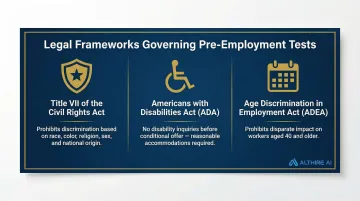
Under EEOC guidelines, pre-employment tests must be job-relevant, consistently administered to all candidates for the same role, and validated to avoid disparate impact on protected groups. Three federal frameworks govern this:
- Title VII of the Civil Rights Act: Prohibits tests that discriminate based on race, color, religion, sex, or national origin
- Americans with Disabilities Act (ADA): Prohibits disability-related inquiries before a conditional offer and requires reasonable accommodations during testing
- Age Discrimination in Employment Act (ADEA): Prohibits tests that have discriminatory impact on workers aged 40 and older
Running assessments through a documented ATS workflow keeps administration consistent across all candidates — a requirement for EEOC compliance. Platforms like AltHire AI, which integrates with 20+ ATS tools including Greenhouse, Lever, Ashby, and Workable, make that audit trail automatic rather than an afterthought.
Common Mistakes to Avoid When Using Pre-Employment Tests
Even well-designed assessments backfire when applied incorrectly. These three mistakes account for most of the legal exposure and hiring misses teams run into.
Using a Single Test as the Sole Hiring Decision
No score alone should determine a hire. Tests work best as one signal alongside interviews, resume review, and references—not as a filter that stands on its own. EEOC enforcement cases show that assessments causing disparate impact must be proven "job-related and consistent with business necessity," a standard far easier to meet inside a holistic evaluation process.
Choosing Tests Based on Brand Rather Than Validation
Familiarity with a test vendor's name is not a substitute for evidence that the test predicts performance in your specific role. Watch out for these common selection errors:
- Picking the most sophisticated test when a simpler, validated one fits the role better
- Ruling out candidates based on a single low score without investigating what it actually signals (test anxiety, format mismatch, or a dimension that barely matters for the job)
- Skipping job-relevance reviews when deploying an assessment across multiple roles with different requirements
Failing to Update Tests as Roles Evolve
Revisit assessments annually—or whenever a role's core requirements shift. A skills test built three years ago likely doesn't reflect current job demands, and outdated assessments can quietly skew decisions or introduce unintended bias over time.
Conclusion
Pre-employment tests give businesses a structured, evidence-based way to evaluate candidates beyond the resume. Each type serves a distinct purpose:
- Cognitive tests predict how quickly someone will learn and adapt
- Skills assessments verify that a candidate can actually do the job
- Personality tests gauge cultural fit and working style
- SJTs reveal judgment and decision-making under realistic pressure
The key is selecting the right combination based on role requirements, hiring volume, and legal compliance — then treating results as one input in a complete hiring evaluation, not a final verdict.
Done well, pre-employment testing shortens time-to-hire, surfaces stronger candidates earlier in the funnel, and builds a hiring process that holds up to scrutiny as your organization grows.
Frequently Asked Questions
What are the most common pre-employment tests?
The most widely used types are cognitive ability tests, personality assessments, and skills evaluations. These three appear across industries because they balance predictive validity with practical administration — covering learning speed, cultural fit, and job-specific capability in a single screening layer.
When in the hiring process should pre-employment tests be administered?
Lighter tests like cognitive and skills assessments work best early in the funnel, screening large applicant pools efficiently. Deeper assessments — personality, EQ, and situational judgment — are better suited for shortlisted finalists, where the time investment aligns with proximity to a hiring decision.
Can a candidate be rejected solely based on pre-employment test results?
No. Test scores should be one input in a broader evaluation that includes interviews, references, and work samples. Using results as a standalone disqualifier increases legal risk and can screen out strong candidates who underperformed due to test anxiety or format mismatch, not actual skill gaps.
Do pre-employment tests help reduce hiring bias?
Structured, standardized tests can reduce subjective bias compared to unstructured interviews, which are highly susceptible to affinity bias and inconsistent evaluation. However, tests must be validated and consistently applied to avoid introducing new forms of bias, particularly disparate impact on protected groups.
Are pre-employment tests legally required?
No, tests are not legally mandated. When used, however, they must comply with EEOC guidelines: job-relevant, non-discriminatory, and consistently applied to all candidates for the same role to avoid violations of Title VII, ADA, or ADEA.
How long should a pre-employment test take?
Most pre-employment assessments should be kept to 15–45 minutes to respect candidate experience. Research analyzing over 222,000 job-seekers found that assessment length does not predict candidate drop-off; most abandonment occurs within the first 20 minutes regardless of total test length.