Introduction
A preliminary technical assessment is a structured, early-stage screening tool that evaluates a candidate's job-relevant technical skills before they advance further in the hiring pipeline. Unlike a full technical interview or take-home project, this assessment is narrower in scope, shorter in duration, and focused on establishing baseline competency rather than deep problem-solving evaluation.
Without a structured preliminary filter, teams waste time interviewing candidates who lack foundational skills — a real problem for hiring managers, recruiters, and talent acquisition teams, especially in tech, SaaS, and engineering-heavy roles.
The scale of the issue is well-documented. HireRight found that 85% of employers caught applicants lying or misrepresenting information on their resumes, and HackerRank's 2024 Developer Skills Report revealed that 68% of recruiters and 69% of executives struggle to verify that candidates actually possess the technical skills they claim. That gap between resume claims and real ability slows time-to-fill and inflates recruiting costs.
Key Takeaways
- Preliminary technical assessments screen candidates for baseline job-relevant skills early in the funnel, before interviews begin
- Saves recruiter time, reduces mis-hires, and brings structure to shortlisting—critical in high-volume technical hiring
- Defining skill criteria, administering a standardized test, and filtering candidates objectively are the three core steps
- Platforms like AltHire AI administer and score assessments 24/7 across large candidate pools, with no manual effort required
- Top pitfalls: assessments that are too long, misaligned with the role, or applied as one-size-fits-all filters
What Is a Preliminary Technical Assessment?
A preliminary technical assessment is a structured, early-funnel screening tool—short and skills-focused—that verifies a candidate meets a minimum technical threshold before advancing to live interviews or more resource-intensive evaluation stages.
The assessment separates unqualified applicants from viable candidates using objective, role-specific criteria rather than resume signals alone. Instead of relying on self-reported skills or educational credentials, hiring teams get evidence-based proof of technical capability before committing time to live interviews.
Preliminary assessment vs. full technical interview:
| Preliminary Assessment | Full Technical Interview | |
|---|---|---|
| Duration | 20–60 minutes | 60–120+ minutes |
| Scope | Foundational, role-specific skills | Problem-solving, architecture, culture fit |
| Goal | Pass/fail qualification | Deep evaluation of thinking and communication |
| Stage | Early funnel screening | Later-stage candidate evaluation |
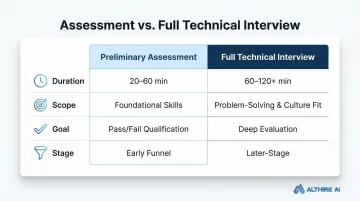
A preliminary assessment asks one core question: does this candidate have the foundational skills the role requires? Full technical interviews explore how they think—not just whether they can do the job.
Why Companies Use Preliminary Technical Assessments in Hiring
The Resume Credibility Gap
Resumes and cover letters frequently overstate or obscure actual technical ability. A preliminary assessment introduces an evidence-based checkpoint that surfaces real skill before any time is invested in live interviews. Research shows that 85% of employers have caught applicants lying on resumes, while 68% of recruiters and 69% of executives agree it is difficult to ensure candidates actually possess the technical skills they claim.
High-Volume Hiring Demands
Preliminary assessments address what high-volume technical hiring demands: consistency in evaluation, scalability across hundreds of applicants, and a defensible, standardized basis for shortlisting. Ashby's 2025 Talent Trends Report analyzing 31 million applications found that applications per hire tripled from 2021 to 2024, with technical roles now requiring approximately 14 more interview hours per hire than business roles.
The Cost of Skipping Preliminary Screening
The operational cost of skipping preliminary screening is severe:
- Wastes recruiter hours on unqualified candidates who never should have advanced
- Extends time-to-fill as teams cycle through unsuitable applicants
- Increases mis-hire risk when screening relies on subjective resume review
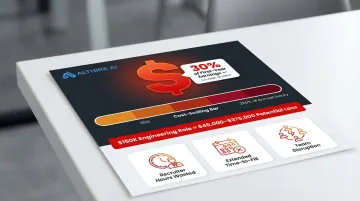
The U.S. Department of Labor estimates that a bad hire costs 30% of first-year earnings. For a $150,000 SaaS engineering role, that's a minimum $45,000 loss per mis-hire. SHRM research indicates the cost can scale from 50% to 250% of annual salary for specialized or senior technical roles, easily reaching six figures when factoring in lost engineering hours, team disruption, and customer impact.
Fairness and Bias Reduction
A well-designed preliminary technical assessment evaluates candidates on demonstrated ability alone — regardless of educational background, name, or prior employer. Harvard Business Review notes that unstructured interviews are "fraught with bias and irrelevant information", and SHRM reports that 48% of HR managers admit unconscious biases affect their hiring decisions.
Structured work-sample tests remove that subjectivity from the equation. By standardizing the early screening stage, organizations make bias harder to act on — not through intention alone, but through process design.
Industry Best Practice and Compliance
Preliminary technical assessments are now an industry standard in technical hiring, particularly in technology and SaaS. LinkedIn's Future of Recruiting 2025 report states that 75% of recruiters identify skills-based hiring as their top priority, with 25% of job postings now omitting degree requirements entirely. SHRM's 2024 research found that 54% of organizations now use pre-employment assessments to gauge applicants' knowledge and skills.
Legal compliance note: Preliminary technical assessments are governed by federal anti-discrimination law. The Uniform Guidelines on Employee Selection Procedures (UGESP) establish the "four-fifths rule" — if any protected group's selection rate falls below 80% of the highest group's rate, that constitutes evidence of adverse impact, requiring content, construct, or criterion-related validity studies.
The EEOC explicitly warns that employers are liable for disparate impact from algorithmic or AI hiring tools. Vendor claims of "bias-free" assessments are not a legal defense — validation is the employer's responsibility.
How a Preliminary Technical Assessment Works
The End-to-End Process
At a high level, the process follows this sequence: a hiring team defines what skills to test → candidates receive and complete the assessment → scores are evaluated against a defined threshold → qualifying candidates advance to the next stage.
Each stage of this process has a defined input, action, and output:
- Assessment design: The role's core technical requirements determine question types — multiple-choice knowledge checks, coding challenges, situational problem-solving, or async AI-driven interviews — along with difficulty level and pass threshold.
- Candidate completion: Candidates complete the assessment asynchronously within a set time window. Automated scoring and proctoring tools flag suspicious behavior or evaluate response quality, producing a structured score for each candidate.
- Consistency controls: Standardized rubrics, role-specific question banks, and adaptive AI questioning improve signal quality. Platforms like AltHire AI run these screenings 24/7, delivering objective, bias-free results at scale.
- Recruiter output: Recruiters receive a ranked shortlist with objective scores, reducing the volume of candidates advancing to live interviews. Research shows AI screening tools enable 25% reductions in time-to-hire, while AI-enabled technical evaluations save 40–50 hours per hire and cut time-to-hire by up to 50%.
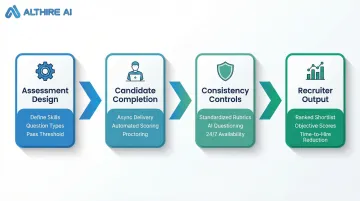
Here's how each step works in practice.
Step 1: Define Assessment Criteria
Before any candidate sees the assessment, the hiring team must identify the minimum technical competencies for the role, translate them into measurable test criteria, and set a pass threshold. Without this step, the assessment produces noise rather than signal.
Key considerations:
- What are the 3-5 core technical skills required on day one?
- What proficiency level is needed (foundational vs. advanced)?
- What scoring threshold separates qualified from unqualified candidates?
Step 2: Administer the Assessment
Candidates receive the assessment via a link, ATS integration, or platform invite and complete it asynchronously within a defined window. The format may include:
- Multiple-choice questions for knowledge verification
- Coding prompts for software roles
- Async video responses for broader technical functions
- AI-driven conversational interviews that adapt to candidate responses
AltHire AI delivers assessments through direct shareable links or native ATS integration with platforms like Greenhouse, Lever, Ashby, and Workable. Candidates can complete assessments 24/7 without scheduling coordination, while AI proctoring monitors integrity in the background.
Step 3: Score, Review, and Shortlist
Automated scoring tools evaluate responses against the pre-set rubric and generate a report for each candidate. Recruiters then use these reports to shortlist candidates above the threshold for the next hiring stage.
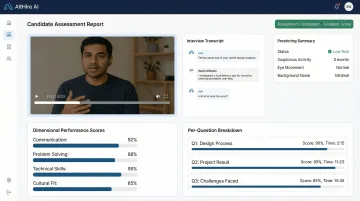
AltHire AI generates comprehensive reports instantly upon completion, including dimensional performance scores, question-by-question evaluation, complete video recordings with time-stamped transcripts, and detailed proctoring data. This enables recruiters to make faster, data-backed hiring decisions without manual scoring.
What to Expect in a Preliminary Technical Assessment
Typical Candidate Experience
Assessments are usually 20-60 minutes long, self-paced or time-limited, and delivered online. Questions focus on a specific technical domain relevant to the role rather than broad conceptual knowledge.
Research points to clear timing benchmarks that keep candidates engaged:
- 15-30 minutes for early-stage screening to prevent drop-off among top candidates
- 30-45 minutes for role-specific technical screening
- Under 40 minutes to maintain completion rates around 80%
Common Assessment Formats by Role
Software Engineering Roles:
- Coding challenges or debugging tasks
- Live coding environments that assess problem-solving, code optimization, and debugging
- Language-flexible environments (Python, JavaScript, Node.js, etc.)
Systems and Infrastructure Roles:
- Knowledge-check quizzes covering architecture, networking, or cloud platforms
- Configuration or troubleshooting scenarios
Data Analytics Roles:
- Data interpretation or analysis prompts
- SQL queries or data manipulation tasks
Broader Technical Functions: These often use async video or text questions covering core technical concepts, sometimes with AI-driven conversational interviews that adapt follow-up questions based on each response.
Evaluation Criteria
While candidates focus on completing the assessment, employers are running a parallel process on the back end. Evaluation includes:
- A defined score threshold separating qualified from unqualified candidates
- Rubric-based evaluation of approach and accuracy
- Built-in proctoring that flags impersonation or unauthorized assistance
Common Mistakes and Misconceptions About Preliminary Technical Assessments
Misconception: Assessments Must Be Comprehensive to Be Effective
The most common misconception is that a preliminary technical assessment must be comprehensive or difficult to be effective. In reality, overloading the assessment with complex tasks discourages strong candidates and inflates drop-off rates before any meaningful screening occurs.
Contrary to popular belief, peer-reviewed research analyzing 222,772 job-seekers found that assessment length does not predict completion rates. Over 50% of candidate dropout occurs in the first 5-10 minutes, driven by poor user experience or perceived irrelevance— not the overall length. A short, poorly designed assessment loses more candidates than a longer one that's well-structured and clearly relevant to the role.
Mistake: Using Generic Assessments for All Technical Roles
Complexity isn't the only problem — specificity matters just as much. Applying one generic assessment across every technical role, without tailoring it to the actual skills required, produces two predictable failures:
- False positives: Advancing candidates who pass a test irrelevant to their job
- False negatives: Filtering out strong candidates whose skills don't match the test format
The landmark Supreme Court case Griggs v. Duke Power Co. (1971) established that general intelligence tests not specifically related to job performance are prohibited if they cause disparate impact. Generic tests often fail the EEOC's requirement for "job-relatedness and business necessity."
Risk: Inconsistent and Subjective Scoring
When hiring managers manually evaluate preliminary assessments without a standardized rubric, results become subjective and legally vulnerable. Organizations lacking a structured interviewing and scoring process are five times more likely to make a bad hire.
AI-powered platforms like AltHire AI address this directly by applying consistent, objective scoring across high-volume pipelines. The platform scores each candidate against customizable criteria defined by your hiring team, with per-question breakdowns and automated flags for suspicious activity. That structure removes the guesswork — and the legal exposure — that comes with unstructured manual review.
Conclusion
A preliminary technical assessment acts as an objective, early-funnel filter that separates qualified technical candidates from those who don't meet baseline requirements. It protects recruiter time, raises hiring quality, and builds a defensible, bias-reduced screening process — one that holds up across high-volume pipelines.
That value only holds if the assessment is built well. A poorly structured screen creates friction for strong candidates, surfaces misleading data, and undermines every hiring decision that follows. The goal is a short, targeted screen tied to actual job demands:
- Duration: 20–60 minutes — enough to signal fit, not enough to burn out applicants
- Scope: Role-specific questions, not generic trivia
- Evaluation: Standardized scoring criteria applied consistently across all candidates
Platforms like AltHire AI make this easier to execute — delivering 350+ weekly interviews around the clock, with instant scoring reports and bias-free evaluation built into every assessment. For teams hiring at volume, that combination of speed and consistency is the difference between a screening process that scales and one that breaks under pressure.
Frequently Asked Questions
What does a preliminary technical assessment mean?
A preliminary technical assessment is a structured, early-stage evaluation that verifies a candidate meets the minimum technical skill requirements for a role before advancing to deeper interview stages. Unlike a full technical interview, it's deliberately short and pass/fail — not a deep problem-solving exercise.
What is the purpose of a preliminary technical assessment?
It filters unqualified candidates early, saves recruiter time, and creates an objective basis for shortlisting. This makes it especially useful in high-volume or technical hiring pipelines where resume screening alone can't confirm genuine technical capability.
What to expect in a preliminary technical assessment?
Candidates typically encounter a time-limited, online assessment covering role-specific technical topics, completed on their own schedule and usually taking between 20 and 60 minutes. The focus is on foundational competency rather than advanced problem-solving depth, with questions tailored to the specific role's technical requirements.
How long does a preliminary technical assessment typically take?
Most preliminary technical assessments are designed to take between 20 and 60 minutes. Anything longer risks candidate drop-off and typically means the scope has expanded beyond a preliminary screen into full evaluation territory.
How is a preliminary technical assessment different from a full technical interview?
A preliminary assessment is a short, standardized screen applied to all applicants to confirm a baseline. A full technical interview is a deeper, interactive evaluation reserved for shortlisted candidates. The screen asks: can this person do the job at a foundational level? The full interview digs into problem-solving approach, architecture decisions, and real-time collaboration.