Introduction
More tools haven't made hiring easier. Talent teams now manage 10+ technology solutions on average—yet the median time-to-hire still sits at 41 days for technical roles. Meanwhile, 75% of organizations struggle to fill positions due to skills gaps, and recruiters spend up to 16 hours weekly just scheduling interviews.
The wrong tools make this worse. Data fragmentation pushes 66% of HR professionals into making "educated guesses" rather than data-driven decisions. Poor hiring decisions cost U.S. companies nearly $900 billion in voluntary turnover in 2023 alone — a price tag that starts with a bad recruiting stack.
This guide covers the top recruiting software tools talent teams need, what to look for when evaluating them, and how AI-native platforms are redefining what essential looks like.
Key Takeaways
- Recruiting software covers ATS, CRM, sourcing, AI interviewing, and analytics — top talent teams layer these categories strategically
- Top tools include Greenhouse, Workable, iCIMS, AltHire AI, and Manatal—each serving a distinct need across the hiring lifecycle
- AI-powered tools reduce screening time, eliminate bias, and enable 24/7 hiring at scale
- The right stack matches your team size, hiring volume, integration requirements, and budget
- Fewer, well-integrated tools consistently outperform bloated stacks when it comes to cutting time-to-hire and improving quality of hire
What Is Recruiting Software (and Why Your Talent Team Needs the Right Stack)
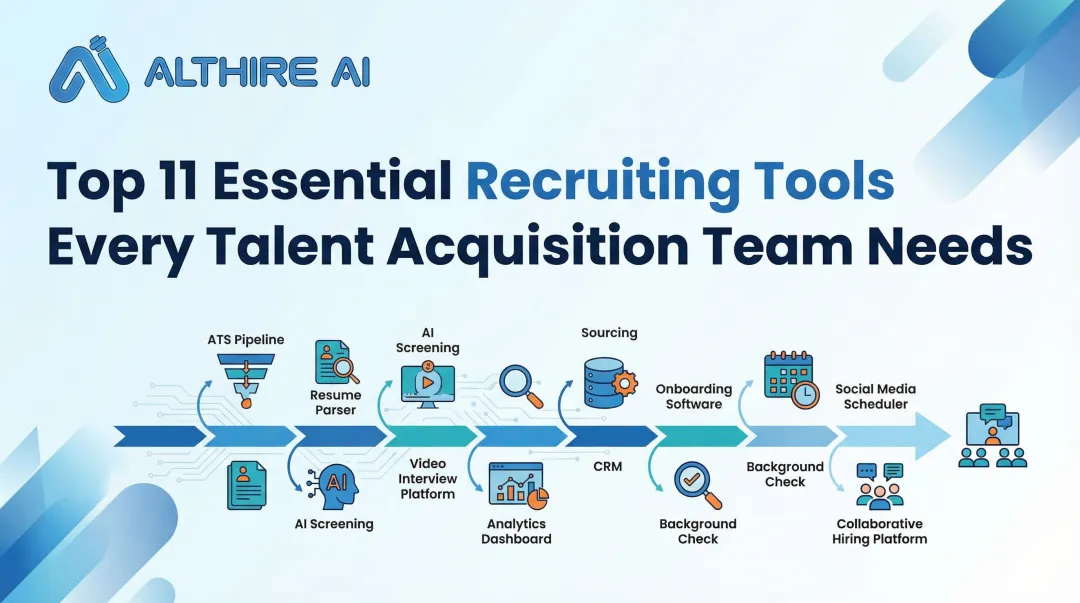
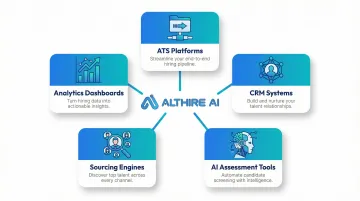
Recruiting software encompasses any technology that supports talent acquisition from job posting to offer acceptance. The category spans several distinct tool types:
- ATS platforms — manage applications, pipelines, and compliance workflows
- CRM systems — nurture passive candidates and build talent pools
- AI assessment tools — screen and evaluate candidates at scale
- Sourcing engines — surface qualified candidates across job boards and networks
- Analytics dashboards — track hiring metrics and surface bottlenecks
The global recruitment software market is projected to reach $5.5 billion by 2031, growing at 7.85% annually as organizations invest to combat hiring inefficiencies.
No single tool does everything well. According to Aptitude Research, companies invest in more than 10 different technology solutions on average for their recruitment function — with ATS-based suites forming the operational backbone and integration capabilities driving vendor selection.
Yet nearly 70% of HR professionals say data fragmentation limits their ability to make fair hiring decisions, pushing teams toward guesswork over precision. Prioritizing integrated suites or vendors with well-documented APIs is how high-performing talent teams close that gap.
Top Recruiting Software Tools Every Talent Team Needs
These tools were evaluated on reliability, feature depth, user adoption, integration ecosystem, and measurable recruiting impact—not just brand recognition.
Greenhouse
Greenhouse is a talent acquisition platform trusted by thousands of mid-size and enterprise companies. It centers on structured, collaborative, and equitable hiring, combining an ATS with onboarding and sourcing automation.
Differentiators: Greenhouse stands out for its highly customizable interview kits and scorecards that standardize evaluation across hiring teams. With 400+ native integrations connecting tools like LinkedIn, Slack, and background check providers, it eliminates workflow fragmentation. Its focus on reducing bias through anonymized screening and diversity dashboards makes it a leader in equitable hiring. In published case studies, Greenhouse helped hipages reduce average time-to-hire by 38% (from 49 to 31 days).
| Feature | Details |
|---|---|
| Key Features | Structured interview plans, drag-and-drop workflow builder, job post distribution, onboarding module, DEI reporting, and sourcing automation |
| Best For | Mid-size to enterprise companies with multiple hiring managers who need structured, scalable, and bias-conscious recruitment processes |
| Pricing | Custom pricing based on team size; no free trial available — contact sales for a quote |
Workable
Workable is an all-in-one recruiting platform built for growing SMBs and mid-market teams. It combines applicant tracking, AI-powered sourcing, candidate assessments, and onboarding in a single system.
Differentiators: Workable's one-click job posting to 200+ job boards, built-in AI Recruiter that surfaces best-fit candidates automatically, and candidate anonymization for bias-free screening are especially useful for teams without a dedicated sourcing function. Transparent pricing starting at $299/month and a 15-day free trial (no credit card required) keep the barrier to entry low. Elite Construction Solutions reduced cost per hire by 41% while increasing total hires by 78.3% using Workable.
| Feature | Details |
|---|---|
| Key Features | AI candidate sourcing, 200+ job board posting, anonymized screening, structured scorecards, interview self-scheduling, offer management, and onboarding workflows |
| Best For | SMBs and growing companies seeking a consolidated recruiting-plus-HR solution without needing separate tools for each hiring stage |
| Pricing | Starts at $299/month for the Recruiting suite; 15-day free trial available; add-ons for video interviews and assessments available separately |
iCIMS
iCIMS is an enterprise-grade talent cloud platform combining ATS, CRM, recruitment marketing, text engagement, offer management, and AI recruiting in one system. More than 4,400 companies across 200 countries — including a quarter of the Fortune 500 — trust iCIMS.
Differentiators: iCIMS' Coalesce AI powers candidate matching, job description writing, and more. Its Talent Cloud architecture keeps data synchronized across all modules, so recruiters aren't reconciling records between disconnected tools. Its analytics dashboards offer deep KPI tracking by role, department, recruiter, and location. iCIMS is recognized as a Leader in the Gartner Magic Quadrant for Talent Acquisition Suites and the IDC MarketScape for Worldwide Talent Acquisition.
| Feature | Details |
|---|---|
| Key Features | Enterprise ATS, CRM, recruitment marketing, career site builder, text recruiting, onboarding, internal mobility, AI copilots, and predictive analytics |
| Best For | Large enterprises and high-volume hiring teams that need a unified, end-to-end talent acquisition suite with enterprise-level security and compliance |
| Pricing | Custom enterprise pricing; contact iCIMS sales for a demo and quote |
AltHire AI
AltHire AI is an AI-powered interview platform that deploys adaptive interview agents to conduct structured, human-like interviews 24/7, regardless of recruiter availability. It integrates with 20+ ATS platforms including Greenhouse, Lever, Workable, Ashby, and BambooHR.
Differentiators: Unlike conventional tools, AltHire AI evaluates candidates on skills, culture fit, and potential beyond resumes, using conversational AI that adapts follow-up questions in real time based on each candidate's responses. Its 100% AI-proctored interviews ensure fairness and prevent impersonation through facial recognition, audio monitoring, screen tracking, and AI-generated answer detection. AI-generated detailed reports with 360° performance breakdowns help recruiters make faster, bias-free decisions. Teams using AltHire AI report up to 70% faster time-to-hire, 60% reduction in screening interview time, and 33+ recruiter hours saved per week.
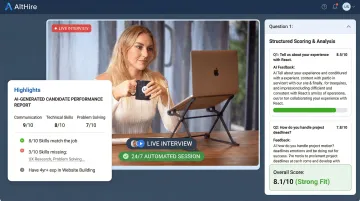
Interview setup is fast: recruiters upload a job description and the AI generates role-specific questions and evaluation criteria automatically. Builds take under 10 minutes using drag-and-drop plugins. Candidates complete interviews asynchronously on their own schedule, and recruiters get AI-powered reports as soon as each interview wraps.
| Feature | Details |
|---|---|
| Key Features | AI-powered adaptive interview agents, 100% AI proctoring, conversational follow-up questions, detailed candidate reports, drag-and-drop interview creation (under 10 minutes), and 20+ ATS integrations |
| Best For | Talent teams of all sizes — from startups to enterprises — that want to scale candidate screening without scaling recruiter headcount, while maintaining fairness and depth of evaluation |
| Pricing | Contact AltHire AI for pricing details; supports teams globally with remote and on-demand hiring capabilities |
Manatal
Manatal is an AI-powered ATS and recruitment CRM built for small businesses, staffing agencies, and budget-conscious talent teams. With pricing starting at $15/user/month and a 14-day free trial, it removes the cost barrier to professional-grade recruiting software.
Differentiators: Manatal's AI recommendation engine automatically scores and ranks candidates against job descriptions, while its profile enrichment feature pulls data from LinkedIn and other sources to give recruiters a fuller picture of each applicant. Its dual interface for corporate HR and staffing agencies covers both internal hiring and agency client management in one platform. With a 4.8/5 rating on G2, Manatal delivers enterprise-level features at SMB-friendly pricing.
| Feature | Details |
|---|---|
| Key Features | AI candidate scoring and recommendations, drag-and-drop pipeline, profile enrichment, branded career page builder, job board distribution, and CRM for agency client management |
| Best For | Small businesses, recruitment agencies, and growing teams that want affordable, AI-assisted applicant tracking without complex implementation |
| Pricing | From $15/user/month (billed annually); 14-day free trial with no credit card required |
How We Chose These Recruiting Software Tools
These tools were selected based on feature depth, market adoption, user reviews, integration capabilities, and real-world impact on recruiter efficiency and hiring outcomes—not just brand visibility or vendor size.
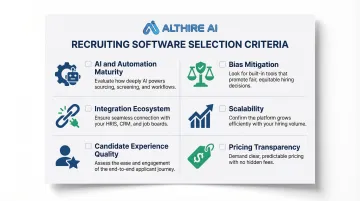
Key selection factors included:
- AI and automation maturity — reduces manual screening, sourcing, and scheduling at scale
- Integration ecosystem — connects cleanly with your existing ATS, HRIS, and communication tools
- Candidate experience quality — creates a positive impression from first touchpoint to offer
- Bias mitigation — supports structured, equitable evaluation across all candidate pools
- Scalability — works for a 10-person startup and a 10,000-person enterprise
- Pricing transparency — delivers clear value without hiding key features behind expensive add-ons
These criteria exist because the selection process itself is where most teams go wrong. Choosing software based on brand familiarity alone often leads to tools that don't integrate with your stack or bury essential features behind costly upgrades. Before committing, research peer reviews on G2 and Capterra, and always request a live demo.
One in three TA professionals report that their IT departments view talent acquisition integration as a low priority, creating data silos that force recruiters to spend up to four hours pulling together data for a single performance review. Prioritize tools that integrate seamlessly with your existing stack.
Conclusion
The recruiting software tools a talent team uses directly impact how fast, fairly, and efficiently they can hire. The right stack covers the full hiring lifecycle—from sourcing and screening to evaluation and onboarding—while maintaining data integrity across systems.
Audit your current stack against hiring goals. Assess integration gaps, manual bottlenecks, and where AI could eliminate repetitive work—especially in the screening and interview stages where most recruiter time is lost. According to Aptitude Research, recruiters spend up to 10 hours per week just finding candidates within their own ATS. At that scale, automation isn't optional—it's the difference between a functional hiring process and a broken one.
If first-round screening is still eating hours of recruiter time, AltHire AI is worth a closer look. Its AI-powered adaptive interviews run 24/7, and structured bias-free scoring reports cut screening time by 60%—giving recruiters more bandwidth for the decisions that actually require human judgment. Book a demo to see it in action.
Frequently Asked Questions
What is the best recruiting software?
There is no single "best" tool—the right choice depends on company size, hiring volume, budget, and hiring stage. Enterprise teams often lean toward iCIMS or Greenhouse for deep integration and compliance, while growing teams favor Workable or Manatal for ease of use. AI-first teams layer in platforms like AltHire AI for interview automation and bias reduction.
What is the most common recruiting tool?
Applicant tracking systems (ATS) are the most widely used recruiting tools, serving as the central hub for managing job postings, applications, and candidate pipelines. Tools like Greenhouse, Workable, Lever, and iCIMS are among the most commonly adopted, with cloud deployments capturing 68.73% of market share.
What are examples of recruitment tools?
The main categories include ATS platforms (Greenhouse, iCIMS), AI interview tools (AltHire AI), sourcing tools (Manatal, LinkedIn Talent Solutions), CRM platforms (Lever, Zoho Recruit), video interview tools, and analytics dashboards. Modern talent teams layer these across sourcing, screening, engagement, evaluation, and reporting to cover every phase of the hiring funnel.
What are the 4 pillars of recruitment?
The 4 pillars are sourcing (finding candidates), screening (evaluating fit), selection (making the hire decision), and onboarding (integrating new hires). Modern recruiting software maps directly to each pillar—ATS platforms handle sourcing and pipelines, AI interview tools manage screening, and analytics dashboards drive selection decisions.
What is the difference between an ATS and a CRM in recruiting?
An ATS manages active applicants through the hiring pipeline for current open roles, while a recruiting CRM nurtures passive talent and maintains long-term candidate relationships through targeted campaigns before positions even open. Most mature talent teams run both: the ATS fills today's roles, and the CRM ensures qualified candidates are already warm when the next requisition drops.
How do AI recruiting tools help reduce hiring bias?
AI tools reduce bias by anonymizing candidate profiles, applying structured evaluation criteria, and scoring on skills rather than subjective impressions. Research shows AI-anonymized resumes increased callback rates for Black women from 14.1% to 22.3%. Platforms like AltHire AI apply consistent scoring models across every candidate, removing the variability that allows unconscious bias to enter decisions.