Manual hiring processes can't keep pace with these demands. Recruiters spend up to 92.5% of their week on administrative tasks—screening resumes, coordinating schedules, sending follow-up emails—leaving only 3 hours for the strategic work that actually closes candidates. Meanwhile, 42% of candidates abandon the process simply because interview scheduling takes too long.
This article explains the specific, operational advantages of talent acquisition software—not just what vendors claim it does, but how it actually changes hiring outcomes. You'll see how automation addresses the bottlenecks that slow funnels, drain recruiter capacity, and cost organizations top talent.
Key Takeaways
- Talent acquisition software handles screening, scheduling, assessment, and communication automatically — so recruiters spend time on decisions, not admin tasks
- Delivers faster time-to-hire (up to 40% reduction), higher quality-of-hire through structured assessment, and measurable cost savings
- Without it: slow funnels, inconsistent candidate experiences, recruiter burnout, and zero hiring data to act on
- Fits companies of all sizes, especially those handling high volume or frequent hiring cycles
What Is Talent Acquisition Software?
Talent acquisition software automates and structures the end-to-end hiring process — from job posting and candidate screening to interview management and offer — so hiring decisions move faster and more consistently.
It's typically applied across multiple hiring stages:
- Sourcing: AI-powered candidate discovery from job boards and talent pools
- Resume screening and ranking: Automated matching of candidate profiles to job requirements
- Scheduling: Self-serve interview booking that eliminates calendar coordination
- Assessment: Structured interviews and skills evaluations with objective scoring
- Communication: Automated status updates and candidate engagement
- Reporting: Analytics on funnel performance, source quality, and hiring outcomes
- ATS integration: Direct data flow between systems to eliminate manual entry
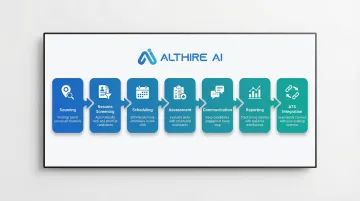
The real value is in eliminating manual steps that slow funnels, introduce inconsistency, or drain recruiter capacity. That frees human judgment for where it matters most: evaluating culture fit, closing candidates, and advising hiring managers.
Key Advantages of Talent Acquisition Software
These three advantages show up where it counts: in the metrics that finance, operations, and HR leadership track every quarter.
Advantage 1: Drastically Reduced Time-to-Hire
Most hiring delays aren't caused by a shortage of candidates — they're caused by process friction. Manual resume review queues, back-and-forth scheduling, slow inter-stage communication, and waiting on hiring manager feedback all compress time you don't have.
How the software removes those bottlenecks:
- AI-powered screening ranks candidates the moment they apply, eliminating the 5-8 day average screening delay
- Self-serve scheduling eliminates calendar coordination—candidates book their own interview slots instantly
- Automated status updates keep candidates moving instead of dropping off while they wait for responses
Why this matters:
Open roles carry direct costs. A $500-per-day vacancy over 44 days costs $22,000 in lost productivity—far exceeding the $4,700 average cost-per-hire. For customer-facing or revenue-generating positions, monthly vacancy costs can reach $7,000-$10,000.
Speed is also a competitive differentiator. Top candidates are off the market within 10 days, yet the median time-to-fill is 44 days. Companies that make offers within one week of the final interview see significantly higher acceptance rates — 60% of candidates drop out when the process drags past two weeks.
Deloitte reports that automating routine tasks can reduce time-to-hire by up to 40%. Companies using AI hire 26% faster, saving an average of 11 days per hire.
KPIs impacted:
- Time-to-fill
- Time-in-stage (where candidates stall)
- Offer acceptance rate (faster processes correlate with higher acceptance)
- Cost-per-hire
When it matters most:
High-volume hiring (retail, hospitality, logistics), seasonal recruitment spikes, and any organization regularly losing candidates to competitors who move faster through the process.
Advantage 2: Higher Quality Hires Through Objective, Skills-Based Assessment
Traditional hiring has a flaw baked in: decisions driven by resume keywords and first impressions rather than demonstrated competency. Those mismatches surface months later as early attrition and underperformance — after the cost of a bad hire has already accumulated.
How objective assessment changes the outcome:
Structured AI-driven interviews assess skills, cultural fit, and role-specific competencies consistently across every candidate. Scoring is based on predefined criteria rather than gut feel. Proctoring and adaptive follow-up questions prevent gaming the process.
Platforms like AltHire AI conduct adaptive, human-like assessments 24/7 through conversational AI interview agents. These systems evaluate candidates beyond the resume with objective scoring and AI-generated detailed reports that include question-by-question analysis, video recordings, and comprehensive proctoring data.
Why the data supports it:
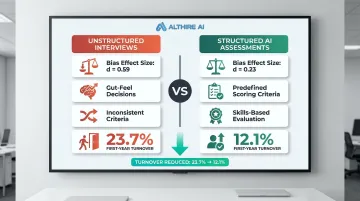
Bias in unstructured interviews is well-documented. A peer-reviewed meta-analysis found unstructured interviews are highly susceptible to bias (effect size d=0.59), while structured interviews significantly reduce it (d=0.23). The U.S. Department of Labor estimates a bad hire costs at least 30% of the employee's first-year earnings — $36,000 for a $120,000 role.
Objective scoring also produces measurably better downstream outcomes. Hiring for skills is five times more predictive of job performance than hiring for education. Organizations using structured, skills-based assessments saw first-year turnover drop from 23.7% to 12.1%.
KPIs impacted:
- Quality-of-hire score
- 90-day and 6-month retention rates
- New hire performance ratings
- Diversity-of-hire metrics
When it matters most:
Organizations hiring at scale where inconsistent interviewer standards create wide variation in hire quality; companies under regulatory or reputational pressure to demonstrate fair, bias-free hiring; and roles where early attrition is costly.
Advantage 3: Greater Recruiter Productivity and Measurable Cost Savings
Recruiters spend most of their time on tasks that software handles better — and faster. Scheduling, follow-up emails, manual data entry, status tracking: these are rule-based, repeatable, and collectively consume the majority of a recruiter's week, leaving little time for the work that actually requires human judgment.
Where the productivity gains come from:
Once configured, the system runs screening rules and communication sequences at no added cost per candidate. A recruiter managing 20 requisitions can maintain the same candidate experience as one managing 5 — without the proportional time investment.
Why this matters financially:
Traditional recruiters spend up to 37 hours of a 40-hour workweek (92.5%) on manual tasks, leaving only 3 hours for strategic work like relationship building and employer branding. Integrating AI into talent acquisition workflows saves recruiters an average of 20% of their workweek — effectively returning a full day.
Recruiter productivity connects directly to cost. Lower cost-per-hire, reduced agency dependency, and the ability to absorb hiring volume growth without headcount additions all translate into quantifiable ROI. Deloitte reports companies using AI in recruitment save 30% on cost-per-hire.
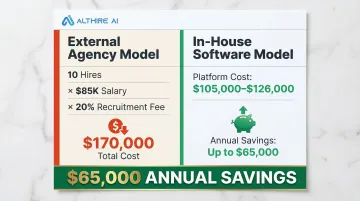
External recruitment agencies typically charge 15-25% of a candidate's first-year salary. For a company making 10 hires at an $85,000 average salary, agency fees at 20% run $170,000. Building an in-house model powered by talent acquisition software costs between $105,000-$126,000 — saving up to $65,000 annually while building internal institutional knowledge.
AltHire AI platform benchmarks illustrate the ceiling on these gains: 42% recruiter productivity improvement, 33+ hours saved per week, and 50% reduction in recruiting costs.
KPIs impacted:
- Recruiter-to-requisition ratio
- Cost-per-hire
- Agency spend as a percentage of total recruiting cost
- Recruiter satisfaction/retention
When it matters most:
Growing companies scaling hiring faster than they can scale recruiting headcount; organizations with high agency dependency looking to bring sourcing and screening in-house; and enterprise TA teams under pressure to reduce per-hire costs while maintaining fill rates.
What Happens When Talent Acquisition Software Is Missing or Ignored
Without automation, small inefficiencies compound into serious hiring problems. Here's what teams consistently run into when managing talent acquisition manually:
- Different recruiters apply different evaluation standards, creating unpredictable hire quality and real legal exposure — the EEOC secured nearly $700 million in monetary relief for discrimination victims in FY 2024.
- Without automated communication and self-serve scheduling, strong candidates accept elsewhere before reaching the offer stage; 42% abandon the process when scheduling takes too long.
- High administrative load leads to missed follow-ups and overlooked candidates — 54% of recruiters say their jobs are more stressful today, with 44% pointing to growing requisition volumes as the main driver.
- Hiring surges require proportional increases in recruiter time, making growth and seasonal spikes expensive to manage; enterprise recruiters already handle up to 60 open roles annually.
- Without structured tracking, teams can't identify where candidates stall, which sources deliver quality hires, or what their actual cost-per-hire looks like — so improvement stays guesswork.
How to Get the Most Value from Talent Acquisition Software
The software delivers growing results over time as the system accumulates data, refines screening rules, and shortens cycle times across more roles.
Three conditions maximize impact:
Automate the full funnel, not just one stage. Applying automation to screening but leaving scheduling manual still creates significant delays. Map every repeatable step in your hiring workflow and automate each one. AltHire AI supports 20+ ATS integrations—including Greenhouse, Lever, Workable, and BambooHR—so data moves between systems without manual transfers.
Set KPIs before you go live. Align HR, operations, and finance on the metrics that matter: time-to-fill, quality-of-hire, cost-per-hire, and 90-day retention. Agreeing on these upfront means results get measured and reported across teams, not just observed anecdotally.
Use the platform's reporting to refine screening criteria and spot funnel drop-off points after each hiring cycle. Treat it as a continuous improvement tool—the longer it runs, the more precise your results become.
Conclusion
Talent acquisition software compounds its value across speed, quality, and productivity — and each reinforces the others. Faster hiring reduces vacancy cost. Objective assessment reduces bad hires. Higher recruiter productivity allows teams to fill more roles with fewer resources.
These advantages don't materialize from adoption alone. They grow when teams apply the system consistently, review outcomes regularly, and use the data to raise their hiring standards over time. Platforms like AltHire AI are built for exactly this — giving recruiting teams the structure and analytics to treat hiring as an ongoing operational capability, not a project with a completion date.
Frequently Asked Questions
What is talent acquisition software and how is it different from an ATS?
Talent acquisition software covers the full hiring lifecycle—sourcing through offer—with automation for screening, scheduling, and assessment. An ATS is primarily a tracking and record-keeping tool. Many modern platforms combine both functions.
How does talent acquisition software reduce time-to-hire?
Automating screening, scheduling, and candidate communication removes the manual waiting periods between stages. Candidates move from application to offer in days rather than weeks, with AI ranking applicants instantly and self-serve scheduling eliminating calendar coordination.
Does automating the hiring process hurt candidate experience?
When configured correctly, automation improves candidate experience through faster responses, clear next steps, and consistent communication. Candidates disengage most when they go days without hearing anything. Automated touchpoints solve that problem directly.
Can talent acquisition software improve the quality of hires, not just the speed?
Structured, AI-driven assessments evaluate skills and competencies consistently across all candidates, removing subjective bias and improving the predictability of hire quality. Organizations using structured assessments saw first-year turnover drop from 23.7% to 12.1%.
Is talent acquisition software suitable for small businesses and startups?
Modern platforms are built for scalability. Small teams benefit from automation because it allows a lean recruiting function to handle volume without additional headcount. Most tools offer tiered pricing for smaller organizations.
What should companies look for when evaluating talent acquisition software?
Prioritize these three areas when evaluating platforms:
- Automation depth: screening, scheduling, and assessment capabilities
- ATS integration: consistent data sync with your existing systems
- Reporting quality: analytics that track hiring outcomes over time