Introduction
According to NSI Nursing Solutions' 2025 National Health Care Retention & RN Staffing Report, the average time-to-fill for an experienced Registered Nurse (RN) is 83 days—nearly 40 days longer than the cross-industry median reported by SHRM. That gap isn't just a scheduling inconvenience.
Every unfilled clinical role compounds fast: the average cost of a single RN turnover is $61,110, and hospitals collectively lose between $3.9 million and $5.7 million annually to nurse turnover alone. Delays drive up temporary staffing spend, erode revenue, and put patient care quality at risk.
None of this is fixed. Slow hospital hiring is largely the result of specific process gaps, structural decisions, and reactive habits—each of which can be addressed. This guide breaks down practical strategies across three areas: sourcing and screening, day-to-day process management, and the structural conditions that either accelerate or stall hiring.
Key Takeaways
- Hospital time-to-hire averages 83 days for RNs—significantly above the 45-54 day cross-industry average
- Delays stack across pipeline stages, so identifying the exact bottleneck matters before applying fixes
- Reducing time-to-hire requires changes at three levels: upfront decisions, process management, and structural conditions
- AI-powered tools cut scheduling delays and screening bottlenecks that eat the most recruiter time
- Faster hiring directly improves patient care quality, staff morale, and long-term retention
How Hiring Delays Build Up in Hospital Recruiting
Hospital time-to-hire delays rarely stem from a single bottleneck. They are cumulative, emerging at every handoff: from posting to sourcing, sourcing to screening, screening to interview scheduling, interviews to offer, and offer to credentialing clearance. Each transition introduces friction, and small delays compound into weeks or months of total pipeline time.
In healthcare, back-end delays are often as damaging as front-end sourcing gaps. Post-offer credentialing and compliance verification typically add 30 to 120 days to the hiring timeline. The back-end stages most likely to stall offers include:
- License verification and background checks — 2 to 4 weeks on average
- Hospital privileging for physicians and advanced practitioners — 90 to 180 days
- Medical staff committee review cycles — missing a single meeting adds 30+ days automatically
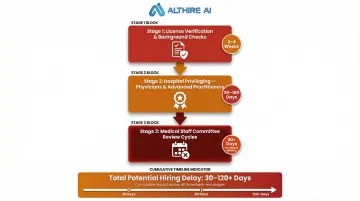
These back-end delays don't announce themselves — they stack up across multiple departments until the total pipeline time is already weeks longer than expected. Without stage-by-stage tracking, hospitals often misdiagnose the real bottleneck and apply fixes to the wrong part of the process.
Key Drivers of Long Time-to-Hire in Hospitals
Structural Talent Shortages
Healthcare faces a persistent supply problem. The national RN vacancy rate is 9.6%, and the Health Resources and Services Administration (HRSA) projects an 8% shortage in 2028, moderating to a 3% shortage by 2038—translating to a deficit of 108,960 full-time equivalent (FTE) RNs. Demand for qualified clinical professionals consistently outpaces available candidates, meaning sourcing alone takes longer than in most industries.
The shortage extends beyond nursing. An AMN Healthcare survey found that 85% of healthcare facilities were experiencing significant labor shortages for allied health professionals. Federal projections forecast substantial FTE shortfalls for critical roles, including a 12,770 FTE shortfall for Respiratory Therapists and a 60,610 FTE shortfall for Physical Therapists.
The educational pipeline cannot meet demand. The American Association of Colleges of Nursing (AACN) reported that in 2023, U.S. nursing schools turned away 65,766 qualified applications from baccalaureate and graduate nursing programs due to insufficient faculty, clinical sites, preceptors, and classroom space.
Credentialing and Compliance Requirements
Regulatory and credentialing requirements specific to healthcare add mandatory time that cannot simply be eliminated—only streamlined. A series of federally or state-mandated compliance checks must be completed before a clinical employee can start:
- Screening against the HHS Office of Inspector General (OIG) List of Excluded Individuals/Entities (LEIE)
- Verification of DEA registration for providers who prescribe controlled substances
- Primary source verification of state board licenses (nursing, medical)
- Querying the National Practitioner Data Bank (NPDB) for malpractice history
- Ensuring compliance with OSHA/CDC guidelines for immunizations and TB screening
These checks are non-negotiable, but hospitals that begin credential verification earlier in the pipeline—rather than waiting until the offer stage—compress the post-offer timeline significantly.
Internal Approval Chains
Hospitals often require sign-off from multiple stakeholders—department heads, HR, compliance, finance—before extending offers. According to SHRM's 2024 Talent Trends report, 19% of organizations cite a "lengthy or complicated hiring process" as a top recruitment challenge.
Common bottlenecks include:
- Slow requisition approvals and multi-layer budget sign-off
- Redundant interview rounds without clear decision authority
- Poor communication between HR, clinical, and finance teams
In a competitive market, candidates rarely wait out these bottlenecks. By the time an offer is approved, top candidates have often accepted competing offers.
Reactive, Requisition-Triggered Hiring
When a role opens, most hospitals start sourcing from scratch rather than drawing from a pre-built candidate pool. The consequences show up in predictable ways: overtime mandates, critical staffing pay, and reliance on travel nurses—short-term fixes that don't shorten the next hiring cycle.
Building proactive talent pipelines requires deliberate infrastructure, which many hospital HR teams lack the bandwidth to develop while managing day-to-day requisitions.
Technology Fragmentation
Disconnected ATS systems, manual scheduling, and siloed communications introduce administrative delays that inflate time-to-hire without improving hiring quality.
The staffing numbers behind these delays are stark. Hospital HR departments average just 0.79 HR FTEs and 0.25 recruitment FTEs per 100 employees in acute care settings, according to the NSI report. SHRM's 2024 data reinforces this: 57% of HR professionals are working beyond normal capacity and 56% say their department lacks sufficient staff. With that recruiter-to-openings ratio, every manual step—scheduling, approvals, follow-ups—compounds the delay.
Strategies to Reduce Hospital Time to Hire
Strategies must target the specific stage and driver responsible for delays in each organization's unique pipeline. There is no single fix. The most effective approach combines changes to decisions, process management, and structural conditions.
Strategies That Reduce Time by Changing Upfront Decisions
Focus on changes made before a vacancy becomes urgent—decisions about how roles are defined, where candidates are sought, and what criteria are actually required versus assumed.
Write precise, realistic job descriptions: Vague or inflated requirements deter qualified candidates and generate unqualified applicants, both of which lengthen the pipeline. Removing non-essential credentials from job postings can immediately expand the qualified candidate pool. For example, if a role requires "3-5 years of experience" but strong candidates with 2 years could succeed, the stricter requirement unnecessarily narrows the pool.
Diversify sourcing channels strategically: Posting only to generalist job boards limits reach in a talent-short market. Hospitals should actively use:
- Healthcare-specific platforms (Incredible Health, Health eCareers)
- Professional associations (ANA, AACN, state nursing boards)
- Social media (LinkedIn, nursing-focused Facebook groups)
- College and clinical program partnerships
This multi-channel approach reaches both active and passive candidates, expanding the pipeline at the top.
Build proactive talent pipelines before roles open: Maintaining a living candidate database—through ongoing engagement with nursing schools, alumni networks, and past applicants—allows hospitals to move candidates into open roles days rather than weeks after a vacancy appears. Case studies demonstrate significant improvements:
- Presbyterian Healthcare Services & CHG Healthcare reduced the time from open job requisition to a confirmed candidate from 26 days to 7 days through a delegated, proactive credentialing model
- New Jersey Nurse Residency Collaborative achieved a one-year new nurse retention rate of 88.6% with a mean time-to-start for residents of just 28 days
- CommonSpirit Health achieved an aggregate residency retention rate of approximately 91% with an estimated cost savings of around $16.3 million
Incentivize and structure employee referral programs: Referred candidates tend to enter the pipeline pre-vetted, move faster through screening, and have higher offer acceptance rates. Data from healthcare-focused referral platforms shows:
- Time-to-fill was just 20 days with a referral program, compared to a baseline of 79 days without one
- Referrals lead to time-to-hire that is, on average, 10 days faster than non-referral baselines
- 28.2% of referred candidates who apply are ultimately hired, compared to 2-5% conversion rates typical of job boards
- Referral hires have a 52% higher retention rate than hires from traditional sources
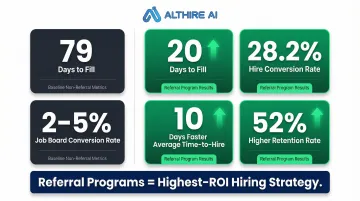
This makes referral programs one of the highest-ROI strategies for reducing time-to-hire.
Strategies That Reduce Time by Improving How Hiring Is Managed
Focus on approaches that compress time within an active pipeline—reducing days lost to scheduling, communication gaps, slow screening, and delayed decisions.
Automate and compress the screening stage: Initial screening interviews are one of the largest time sinks in hospital hiring. AI-powered interview platforms like AltHire AI enable candidates to complete structured, adaptive interviews on-demand—24/7, without recruiter scheduling—cutting screening time by 60% while maintaining consistency and fairness. The platform delivers 70% faster time-to-hire by eliminating scheduling friction entirely.
Recruiters share an interview link; candidates complete the interview on their own schedule. AltHire AI then generates reports highlighting key strengths, improvement areas, and suitability scores, enabling faster decision-making.
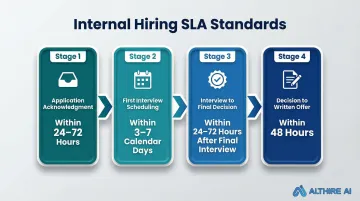
Standardize candidate communication at every stage: Consistent, timely follow-up (ideally automated) keeps candidates engaged, reduces drop-off, and prevents the costly scenario of a candidate accepting a competing offer while waiting for a response. Automated acknowledgments within 24-72 hours of application, interview scheduling within 3-7 days of passing initial screening, and hiring manager decisions within 24-72 hours after final interviews all contribute to maintaining candidate momentum.
Reduce internal approval delays by establishing hiring decision SLAs: Pre-agreed timelines for each approval stage—from recruiter to hiring manager to HR to offer—keep the pipeline moving. Common pragmatic internal SLA targets include:
- Application acknowledgment/initial screen: Within 24-72 hours
- First interview scheduling: Within 3-7 calendar days of passing initial screen
- Interview-to-final-decision: Within 24-72 hours after final interview
- Decision-to-offer extension: Within 24 hours of decision, with written offer within 48 hours
A healthcare organization reduced its time-to-fill from 40 days to 18 days by simplifying its application process and speeding up screening, which also resulted in a 60% reduction in candidate drop-off rate.
Make the application process frictionless and mobile-first: Clinical staff often search for positions between shifts. According to Appcast Recruitment Marketing Benchmark Report data, approximately 61% of all job applications are completed on mobile devices. A mobile-optimized, single-step application meaningfully increases conversion from job view to submission—Workable reported a 15-20% uplift after redesigning forms for mobile.
The impact compounds at scale. Asbury Communities experienced a 69% reduction in their overall vacancy rate and a 33% reduction in time-to-hire (down to an average of 31 days) after implementing a mobile-centric recruitment strategy.
Strategies That Reduce Time by Changing the Surrounding Conditions
Process improvements only go so far when the underlying infrastructure creates friction. Structural changes—to technology, partnerships, and credentialing workflows—address the conditions around the hiring process itself.
Integrate ATS and recruitment tech into a unified system: Disconnected tools force manual data re-entry, slow recruiter decision-making, and create candidate experience gaps. Hospitals with integrated ATS + scheduling + communication platforms move candidates through faster with fewer errors. AltHire AI integrates with 20+ ATS platforms—including Greenhouse, Lever, Ashby, Workable, BambooHR, iCIMS, and Jobvite—to enable automatic candidate hand-off and real-time data synchronization without manual entry.
Pre-clear credentialing and compliance workflows: Credential verification does not need to wait until the offer stage. Hospitals can begin license checks, background processing, and immunization documentation earlier in the pipeline to compress the post-offer timeline. Presbyterian Healthcare Services shortened the time from candidate confirmation to start from 112 days to 90 days through a delegated, proactive credentialing model. Initiating all credentialing and background checks immediately upon verbal acceptance (rather than after written offer or start date) eliminates weeks of delay.
Leverage RPO partners or embedded recruiters for high-volume or niche roles: External recruitment partners with existing healthcare talent networks can fill roles faster than internal teams starting from scratch, particularly for specialized or hard-to-fill clinical positions. Alameda Health System filled 70% of hires made through a talent marketplace for historically difficult-to-fill specialties (L&D, ICU, cardiac), with 30% of hires supporting the system's Level I trauma center.
Conclusion
Faster hospital hiring starts with diagnosing the specific bottleneck in your pipeline—whether that's slow credentialing, fragmented interview scheduling, or approvals stuck in committee—and applying the right structural fix at that point.
The organizations consistently filling clinical roles fastest share a common approach:
- They use hiring data to surface delays before they compound
- They automate screening and scheduling to eliminate calendar friction
- They build proactive talent pipelines instead of reacting to each vacancy
- They keep decision authority close to the hiring need, not buried in approval chains
Compliance and quality standards aren't at odds with speed. With the right processes in place, they become part of a repeatable system—not a source of delay.
Frequently Asked Questions
How can hospitals reduce time to hire?
Hospitals can reduce time to hire by combining proactive talent pipeline building, streamlined screening processes (including automation), mobile-friendly applications, standardized internal approvals, and early credentialing workflows—rather than waiting for vacancies to trigger action.
Why do hospitals take so long to hire?
Hospital hiring timelines are driven by persistent talent shortages, mandatory credentialing and compliance requirements, multi-stakeholder approval chains, reactive (rather than proactive) sourcing, and fragmented recruitment technology that introduces administrative delays.
What is a good time-to-hire benchmark for hospitals?
Healthcare averages around 83 days to fill an experienced RN position, well above the cross-industry average of 45-54 days. High-performing hospital systems are achieving fills in 18-30 days through strategic sourcing and process automation.
What is the 70/30 rule in hiring?
The 70/30 rule holds that 70% of the workforce is passively open to new roles while only 30% are actively job searching. Hospitals that limit outreach to job postings alone miss the larger, passive majority of available talent.
What are the 5 C's of hiring?
The 5 C's are Competency, Character, Culture fit, Compensation, and Commitment. In hospital hiring, evaluating these efficiently—without adding unnecessary interview rounds—accelerates time to hire without compromising quality or compliance.