
Introduction
Hiring is taking longer than ever—and the data proves it. The median time-to-fill has climbed to approximately 45 days, a significant increase from 30 days in 2017. For executive roles, the timeline peaked at 60 days in 2022 before stabilizing around the current median. This isn't a minor scheduling inconvenience—it's a compounding business problem.
Every day a role sits vacant translates into lost productivity, increased workload on existing teams, and mounting frustration. Worse, 29% of candidates reject offers because they received a better one elsewhere. When your process drags, top talent doesn't wait—they accept competing offers.
Slow time to hire rarely stems from one obvious bottleneck. It accumulates across multiple stages: sourcing delays, manual screening backlogs, interview scheduling gaps, and post-interview deliberation. This article walks through 8 proven ways to reduce time to hire without sacrificing quality. The strategies cover decisions made before a role opens, actions taken during active hiring, and tools that cut unnecessary delays at each stage.
Key Takeaways
- Time to hire has increased 50% since 2017, making speed a competitive advantage
- Delays compound across sourcing, screening, interviews, and offer management — multi-stage friction can push time-to-hire past 40 days
- The most effective strategies address decisions made before a role opens
- AI-powered interviews run 24/7 and can cut screening time by 60%, eliminating the scheduling bottleneck entirely
- Tracking pipeline metrics by stage reveals exactly where delays cluster
Where Time to Hire Actually Gets Lost
Time to hire doesn't vanish in one dramatic bottleneck. It accumulates across every stage of the funnel: application review, interview scheduling, post-interview deliberation, and offer approval. Most organizations assume sourcing is the culprit, but research shows that manager deliberation and the number of interview rounds are the primary drivers of hiring delays.
The delay lives in two places more than anywhere else: interview scheduling and post-interview decision-making. Coordinating calendars across multiple stakeholders, waiting on interviewer feedback, and working through approval chains each add days or even weeks to the process.
Understanding the distinction between time to fill and time to hire clarifies where to focus:
- Time to fill measures from when a requisition is approved to when an offer is accepted (organization-centric)
- Time to hire measures from when a candidate enters the pipeline to when they accept (candidate-centric)
Reducing time to hire requires examining the candidate's experience of the process—not just the recruiter's workflow. Every email exchange, scheduling delay, and silent period between stages contributes to candidate drop-off and extended timelines.
What's Really Driving a Slow Hiring Process
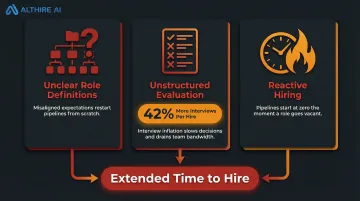
Slow hiring stems from three interconnected root causes: unclear role definitions, unstructured evaluation, and scheduling friction.
Three patterns show up repeatedly in slow hiring processes:
- Unclear role definitions stall pipelines mid-stream. When hiring managers and recruiters discover misalignment on must-haves, nice-to-haves, or seniority level after candidates are already in play, the process restarts from scratch.
- Unstructured evaluation criteria extend deliberation. Without predefined scorecards, interview panels debate subjective impressions instead of comparing candidates against consistent standards. Hiring teams now conduct 42% more interviews per hire than in 2021 (20 vs. 14) — a direct consequence of this "interview inflation."
- Reactive hiring burns days before sourcing even begins. Opening requisitions only after a role goes vacant means the pipeline starts at zero. Organizations that maintain warm pools of pre-qualified candidates can move the moment a need appears.
Technology gaps compound all three. Teams relying on manual screening, email-based scheduling, and disconnected tools naturally take longer than those with integrated, automated workflows. 46% of candidates abandon applications simply because they're forced to manually re-enter information from their resumes — demonstrating how process friction at the top of the funnel slows everything downstream.
8 Ways to Reduce Time to Hire Effectively
The strategies below are organized by when they create impact—some reduce time by changing decisions made before a role opens, others by improving the active hiring process, and others by leveraging technology to remove friction at scale.
Strategies That Front-Load the Hiring Process
Way 1 — Build and Maintain a Proactive Talent Pipeline
Starting candidate outreach from zero every time a role opens is one of the largest single contributors to slow time to hire. Organizations that maintain warm pipelines of pre-qualified candidates—including past applicants, employee referrals, and alumni—compress sourcing time significantly.
Candidates who were proactively sourced had an average time-to-hire of 17 days, compared to 23 days overall—a 25% reduction. Referrals receive a 43% faster response time than cold applicants, demonstrating the tangible speed advantage of pipeline candidates.
How to build a proactive pipeline:
- Re-engage strong candidates from previous hiring cycles who weren't selected but showed promise
- Create talent communities through newsletters, events, or content that keep passive candidates warm
- Implement employee referral programs that incentivize internal networks
- Maintain relationships with alumni and former contractors who understand your culture
The payoff is shorter sourcing cycles—because the relationship work happens before a role is urgent, not after.
Way 2 — Standardize Job Requirements Before Roles Open
One of the most overlooked time drains is the alignment process that happens after a requisition is approved. Hiring managers and recruiters realign on must-haves, nice-to-haves, and seniority level—often discovering mismatches only after candidates have been screened.
Standardizing intake templates and role scorecards in advance removes this lag and gives screeners clear criteria from day one.
Key elements to standardize:
- Must-have vs. nice-to-have skills — Define non-negotiables versus flexible qualifications
- Experience level and seniority — Clarify years of experience, leadership expectations, and team structure
- Evaluation criteria — Establish scoring rubrics before interviews begin
- Interview panel composition — Identify who will interview and what each person will assess
When these decisions are made proactively, requisitions move from approval to active sourcing in hours rather than days.
Way 3 — Pre-Approve Compensation Ranges
When compensation discussions happen for the first time at the offer stage, approval chains and budget negotiations can add one to two weeks to time to hire. Having salary bands pre-approved by finance and HR before roles open allows teams to move from final interview to offer in hours rather than days.
Steps to pre-approve compensation:
- Work with finance and HR to establish salary bands for common roles before requisitions open
- Document approval authority so recruiters know who can greenlight offers within range
- Build flexibility into bands to accommodate exceptional candidates without restarting approvals
- Communicate ranges transparently during early screening to avoid misalignment later
Pre-approved compensation removes one of the final bottlenecks. Teams can extend offers immediately after final interviews, while candidates are still engaged and before competing offers arrive.
Strategies That Accelerate the Active Hiring Funnel
Way 4 — Speed Up Candidate Screening with Structured Criteria and AI Tools
High application volumes create review bottlenecks when teams manually evaluate each resume against vague criteria. The average number of applications per opening is 21, with volumes tripling between 2021 and 2024 in some sectors.
Using structured checklists, knockout questions in applications, and AI-assisted screening tools to surface the most qualified candidates immediately reduces time spent on review without increasing bias risk.
Effective screening strategies:
- Knockout questions — Add 3-5 must-have criteria as application questions to filter unqualified candidates automatically
- Structured resume review checklists — Define specific skills, experience, and qualifications screeners should look for
- AI-assisted resume screening — Use tools that parse resumes against job requirements and rank candidates by fit
- Skill-based assessments — Replace lengthy resume reviews with short, role-specific tests that reveal actual capability
Teams that combine knockout questions with AI-assisted ranking typically cut time-per-application review in half while producing more consistent decisions.
Way 5 — Compress and Restructure the Interview Process
The interview stage is consistently one of the top contributors to long time-to-hire. 78% of job seekers would drop out of a recruitment process they perceived as being too long or complicated, and 42% of candidates favor just 1-2 interview stages, while another 40% state that 2-4 interviews is the maximum they will accept.
Strategies to compress interviews:
- Consolidate panel interviews — Conduct back-to-back interviews in a single day rather than spreading them over weeks
- Replace redundant stages — Eliminate interviews that assess the same competencies; use skills assessments instead
- Set 24-hour feedback deadlines — Require interviewers to submit feedback within 24 hours so debrief meetings happen faster
- Limit interview rounds — Cap processes at 3-4 stages maximum unless role complexity justifies more
Candidates who receive job-related feedback by the end of the same day are 52% more likely to increase their relationship with that employer, demonstrating the measurable impact of speed on engagement.
Way 6 — Automate Scheduling and Candidate Communication
Manual interview scheduling—emailing candidates, checking calendar availability, and coordinating panels—introduces days of unnecessary delay at every stage. 80% of candidates state that receiving status updates during the application process would improve their experience and perception of the employer, yet poor communication remains a top pain point.
Automated scheduling tools that let candidates self-select interview slots, combined with templated status updates and reminders, keep the process moving without recruiter intervention for routine steps.
Automation opportunities:
- Self-service scheduling links — Send candidates a link to book their own interview time from available slots
- Automated confirmation and reminder emails — Reduce no-shows and eliminate manual follow-up
- Status update workflows — Trigger automatic updates when candidates move between stages
- SMS and text communication — 47% of candidates prefer texting for communication, offering faster response rates than email
The result is fewer dropped candidates and more recruiter time spent on evaluation and relationship-building rather than calendar coordination.
Strategies That Use Technology and Data to Sustain Speed
Way 7 — Deploy AI-Powered Interview Tools
AI interview agents now conduct structured, adaptive interviews 24/7—without waiting for recruiter or hiring manager availability. These tools handle initial screening and technical interviews asynchronously, deliver objective scoring, and feed results directly into the hiring team's workflow.
What previously required two to three weeks of scheduling and evaluation can compress into hours.
How AI interview tools accelerate hiring:
- 24/7 availability — Candidates complete interviews on their schedule, eliminating back-and-forth scheduling
- Instant evaluation — AI generates detailed performance reports immediately after completion
- Structured consistency — Every candidate answers the same core questions with adaptive follow-ups
- Objective scoring — Reduces unconscious bias by evaluating responses against predefined criteria
AltHire AI, for example, combines AI interview agents with real-time proctoring and 20+ ATS integrations. Teams using the platform report 60% reductions in screening interview time and 70% faster overall time-to-hire. Interviews adapt across technical, behavioral, and role-specific competencies, producing instant reports with dimensional performance scores and question-by-question evaluations that feed directly into existing ATS workflows.
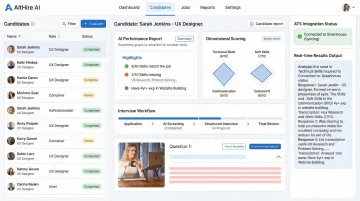
By removing scheduling bottlenecks and delivering immediate, data-backed insights, AI interview tools enable hiring teams to move top candidates forward faster while maintaining rigorous assessment standards.
Way 8 — Track Recruiting Metrics by Stage to Find and Fix Bottlenecks
Most organizations cannot improve what they don't measure. Tracking time spent in each individual hiring stage—not just overall time to hire—reveals exactly where delays cluster and which interventions will have the greatest impact.
Only 20% of organizations track quality of hire, and even fewer measure granular stage-level metrics—leaving most teams guessing at where time is actually lost.
The offer stage is a clear example: candidates who accepted offers did so in approximately 2-3 days, while those who declined took an average of 6 days. Speed at the offer stage directly affects whether top candidates say yes.
Critical stage-level metrics to track:
- Time in stage — Measure days spent in sourcing, screening, interviewing, and offer stages separately
- Stage conversion rates — Track what percentage of candidates advance from each stage to the next
- Time to schedule — Measure how long it takes to book an interview after a candidate is qualified
- Time to feedback — Track how quickly interviewers submit evaluations after interviews
- Time to offer — Measure duration from final interview to offer extended
ATS-integrated reporting dashboards make this data accessible without manual tracking, enabling teams to identify specific bottlenecks and test interventions with measurable outcomes.
Conclusion
The organizations that hire faster aren't cutting corners — they're removing the friction that slows down good decisions. Acting before roles open, structuring evaluation processes in advance, and automating scheduling and screening all add up to a measurable edge in securing top candidates before competitors do.
These 8 strategies work best when applied together and measured consistently. A single change may yield modest gains, but an end-to-end approach to pipeline, process, and technology can compress hiring timelines without sacrificing quality of hire.
In a talent market where 78% of candidates will drop out of slow processes, hiring speed determines whether top candidates reach your offer — or a competitor's.
Frequently Asked Questions
How to reduce time to hire?
Reducing time to hire requires addressing delays across multiple stages: building proactive talent pipelines, standardizing evaluation criteria before roles open, limiting interviews to 2-4 stages, and using automation and AI tools to remove scheduling and screening bottlenecks.
What is a good time to hire benchmark?
Benchmarks vary by role and industry. The median time-to-fill is approximately 45 days, while average time-to-hire across leading platforms is 23 days. High-performing teams typically operate well below these averages—high-performing enterprise customers achieve an average time-to-hire of just 17 days.
How does time to hire differ from time to fill?
Time to fill measures from when a requisition is approved to when an offer is accepted (organization-centric). Time to hire measures from when a candidate enters the pipeline to when they accept (candidate-centric). Tracking both metrics reveals where delays occur — whether in sourcing, internal approvals, or the interview process itself.
What is the 70 30 rule in hiring?
The 70/30 rule suggests that 70% of hiring decisions should be based on skills and competencies, while 30% accounts for culture fit and potential. Pre-defining these criteria before candidates enter the pipeline reduces mid-process realignment and speeds up decisions.
What are the 5 C's of hiring?
The 5 C's of hiring are Competency, Character, Culture, Compensation, and Commitment. Defining these criteria in advance prevents realignment delays mid-process by ensuring hiring managers and recruiters agree on what they're evaluating before candidates enter the pipeline.
What is the hardest month to get hired?
Hiring typically slows during late November through January due to budget cycles, holiday schedules, and decision-maker availability. AI-powered interview tools with 24/7 availability help maintain momentum during this period — candidates can complete assessments on their own schedule, even when hiring teams are offline.