Introduction
The hiring crisis is real and worsening. 90% of U.S. companies missed their hiring goals in 2025, with one in three missing those targets by a wide margin. Meanwhile, average time-to-hire has increased 24% since 2021 to 44 days, yet top candidates accept competing offers within just 10 days. This structural mismatch between lengthy hiring processes and candidate availability creates a critical vulnerability for organizations still relying on manual workflows.
Slow hiring costs more than an empty seat. The downstream effects hit every layer of the organization:
- Top candidates accept competing offers while your team coordinates schedules
- Lost productivity compounds across teams waiting on new hires
- Hiring managers lose confidence in recruitment as backlogs grow
- Recruiters burn out on administrative work that crowds out strategic tasks
AI addresses each of these pressure points directly — automating screening, eliminating scheduling friction, and running interviews around the clock. This article breaks down exactly how those mechanisms work and the results organizations are seeing in practice.
TLDR:
- AI screening processes thousands of resumes in minutes, reducing shortlist time by up to 75%
- Automated scheduling eliminates 8-12 email exchanges per interview, cutting coordination time by 60-80%
- AI interviews operate 24/7, removing interviewer availability as a bottleneck
- Teams using AI cut time-to-hire from 44 days to under 15 days in real deployments
Why Slow Hiring Is Costing Your Business More Than You Think
Recruiters spend 38% of their time scheduling interviews alone. When you add sourcing, screening, and ATS updates, administrative tasks consume up to 92.5% of a 40-hour workweek—leaving just three hours for strategic recruiting work. Traditional hiring processes were never designed for today's talent market speed and volume. The structure itself is the bottleneck.
The Compounding Cost of Prolonged Hiring Cycles
Every day a role remains unfilled carries tangible costs:
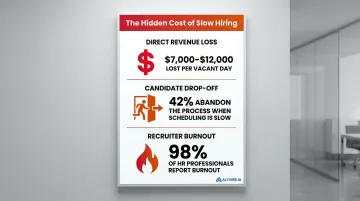
- Direct revenue loss: Key vacancies cost between $7,000 and $12,000 per day in lost productivity and revenue
- Candidate drop-off: 42% of candidates abandon the hiring process when interview scheduling takes too long
- Recruiter burnout: 98% of HR professionals report feeling burned out, with 79% actively considering leaving their jobs
Those burnout numbers point to a deeper issue: manual processes stack friction at every stage. Resume screening takes days. Scheduling requires dozens of back-and-forth emails. Interviewer availability ends up driving the timeline — not candidate quality.
The 4 Ways AI Eliminates Recruitment Bottlenecks
AI removes the structural bottlenecks that slow down every stage of your hiring funnel. Here's where the time savings actually come from.
Automated Resume Screening
Manual resume review is a massive time sink. The average recruiter spends over 17 hours per vacancy screening CVs, entering data, and coordinating next steps. For high-volume roles receiving hundreds of applications, this becomes unsustainable.
AI-powered tools parse thousands of resumes in minutes, applying role-specific criteria to rank candidates based on qualifications, experience, and skills match. These systems handle both structured data (work history, education, certifications) and unstructured inputs (cover letters, project descriptions, skills narratives).
The result: consistent shortlists built on merit rather than reviewer fatigue.
The impact:
- AI screening reduces time-to-shortlist by up to 75%
- Processing time drops from 120 minutes to 36 minutes per 100 resumes
- Consistent evaluation criteria eliminate unconscious bias from initial screening
Human oversight still matters here. Recruiters excel at assessing soft skills and cultural nuances that algorithms miss — AI handles the volume so recruiters can focus where judgment counts.
Automated Interview Scheduling
The traditional scheduling dance is painful for everyone involved. The average meeting requires 8-12 email exchanges, with group interviews escalating to 30+ emails. Multiply this across multiple interview rounds and dozens of candidates, and scheduling alone can add weeks to your hiring timeline.
AI scheduling tools sync with recruiter and hiring manager calendars to surface available slots instantly. Candidates self-book their preferred time — no back-and-forth. The system handles timezone conversions, sends reminders, and reschedules when conflicts arise.
The impact:
- AI-led scheduling reduces coordination time by 60-80% for technical roles
- Time from shortlist to first interview compresses from days to hours
- 57% of candidates prefer automated scheduling over lengthy email exchanges
When candidates can book directly into open slots, the process accelerates without anyone chasing a reply.
AI Chatbots for Candidate Engagement
Silence kills pipelines. 34% of candidates feel ghosted after just one week of no communication following their application. That's enough time for top candidates to accept competing offers.
Conversational AI provides 24/7 responses to candidate questions, guides applicants through next steps, and delivers status updates without delay. This prevents the engagement drop-off that happens when candidates go days without contact.
The impact:
- Application NPS ratings increased 50% when candidates could ask chatbot questions during the application process
- Application completion rates jumped from 50% to 85% with automated engagement
- Faster, consistent communication reduces candidate anxiety and maintains interest
Chatbots handle repetitive questions and status updates, freeing recruiters to focus on high-value conversations with top candidates.
Predictive Analytics for Smarter Decisions
Not all qualified candidates are equally likely to accept your offer or succeed in the role. Predictive analytics uses historical hiring data to identify which candidates are most likely to accept, perform well, and stay long-term.
AI models analyze patterns from past hires — interview performance, background characteristics, application behavior, and post-hire outcomes — to flag high-probability candidates. Recruiters can then prioritize outreach and move faster on the people most likely to convert.
The impact:
- Organizations using predictive analytics achieve 25% higher productivity and 35% lower first-year turnover
- Recruiters focus energy on candidates with the highest likelihood of success
- Data-driven prioritization accelerates decision-making
Critical caveat: AI-plus-human evaluation reduces mis-hires by 29% compared to AI-only processes. Predictive analytics should support recruiter judgment, not replace it.
AI-Powered Interviews: Where Speed Meets Quality
Faster hiring doesn't have to mean shallower hiring. AI-powered interviews handle both speed and rigorous evaluation at the same time—without forcing a trade-off.
How AI Interview Agents Work
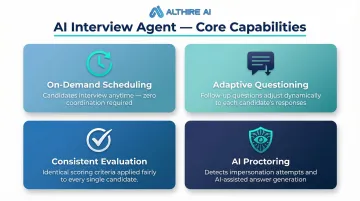
AI interview agents conduct adaptive, conversational interviews around the clock, asking dynamic follow-up questions based on each candidate's responses. This removes the bottleneck of finding human interviewer availability while still delivering substantive candidate assessments.
Here's what makes them effective:
- Candidates interview on their own schedule—no coordination required, compressing time-to-first-interview from days to minutes
- Question depth and topic adjust in real-time based on each candidate's responses, probing relevant experience the way a skilled human interviewer would
- Every candidate answers the same core questions against identical criteria, producing consistent scores that make shortlisting faster and more defensible
- AI proctoring detects impersonation attempts, multiple voices, and AI-assisted responses, protecting pipeline quality at any volume
Real-World Performance
AltHire AI's interview agents demonstrate what's possible when AI handles initial screening interviews. The platform conducts adaptive, human-like interviews 24/7 and has helped organizations achieve up to a 60% reduction in screening interview time. By automating the first round of interviews, recruiters focus their time on final-stage candidates who've already cleared initial screening.
Structured AI interviews also apply uniform evaluation criteria, which reduces unconscious bias. Each completed interview generates detailed performance reports with dimensional scoring, question-by-question analysis, and full video transcripts for human review.
The Real Results: What AI-Driven Hiring Delivers
Real-world implementations show dramatic improvements in both speed and quality — here's what the numbers actually look like.
Case Study: UKG Rapid Hire
NHS Management reduced time-to-hire from 15 days to just 5 days after deploying UKG Rapid Hire's AI-powered recruitment platform. Time-to-interview dropped from 3.5 days to 5 minutes through instant self-scheduling.
The business impact:
- Faster hiring allowed NHS to reopen previously closed facility wings
- Generated $2.2 million in new annual revenue by filling staffing gaps quickly
- Apply-to-hire conversion rates nearly tripled from 7% to 20%
- Candidate experience ratings soared above 90%
Speed gains compounded across every stage: faster screening, fewer scheduling delays, and better candidate experience all pushed conversion rates up together. That end-to-end effect is also where quality improvements enter the picture.
Quality Improvements Alongside Speed
Faster hiring and stronger candidates are not a trade-off. A mid-market financial services firm boosted shortlist accuracy by 25% after integrating AI resume screening against role-specific criteria.
Why does quality improve?
- AI applies the same criteria to every applicant, so strong candidates don't slip through due to reviewer fatigue
- Faster processing enables review of larger candidate pools without adding recruiter time
- Objective scoring removes gut-feel bias that leads to mis-hires
AltHire AI Platform Outcomes
Organizations using AltHire AI's comprehensive interview and assessment platform report:
- 70% faster time-to-hire compared to traditional processes
- $12M in annual savings per 1,000 hires through reduced recruiting costs and faster role fills
- 33+ recruiter hours saved per week by automating screening, interview coordination, and candidate assessment
- 42% improvement in recruiter productivity, allowing teams to handle higher volumes without additional headcount
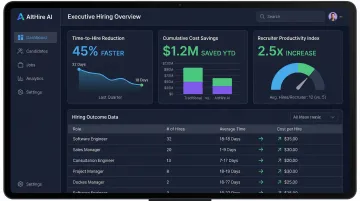
The pattern is consistent: organizations that automate across screening, scheduling, and assessment see compounding returns — not just marginal gains in one area.
How to Start Cutting Your Time-to-Hire with AI
Ready to implement AI in your hiring process? Follow this practical roadmap.
Step 1: Conduct a Bottleneck Audit
Before selecting tools, identify where your process actually breaks down. Track time spent at each stage:
- Sourcing: How long to build a qualified candidate pool?
- Screening: How many hours reviewing resumes per role?
- Scheduling: How many days from shortlist to first interview?
- Interviewing: How long to complete all interview rounds?
- Decision-making: How long from final interview to offer?
Most organizations discover that screening and scheduling consume the most time. Target AI tools at your specific pain points first rather than trying to automate everything simultaneously.
Step 2: Prioritize ATS Integration
Data silos cost organizations $7.8 million annually in lost productivity. When selecting AI hiring tools, ATS integration should be your first filter.
Leading ATS platforms to integrate with:
- Greenhouse, Lever, Workable: Popular with growth companies
- iCIMS, Workday: Enterprise-grade solutions
- BambooHR, JazzHR: Small business-friendly options
86% of ATS users report reduced overall time-to-hire when systems integrate seamlessly. AI platforms that connect natively with your existing ATS eliminate manual data entry and ensure speed gains carry through the full pipeline.
AltHire AI supports 20+ ATS integrations, including all major platforms, with most integrations completed in just a few days. This seamless data flow means candidate information, interview results, and feedback sync automatically—no manual updates required.
Step 3: Redesign Workflows, Don't Just Automate Broken Processes
With integrations in place, the next step is rethinking how work actually flows. Companies that see the largest reductions in time-to-hire restructure their workflows around AI capabilities—they don't just bolt automation onto processes that were already broken.
Workflow redesign checklist:
- Replace sequential interview rounds with parallel AI screening where appropriate
- Shift human interviewers to final-stage conversations with pre-vetted candidates
- Use AI-generated insights to inform interview focus areas rather than starting from scratch
- Establish clear decision criteria upfront so AI can evaluate consistently
Set realistic expectations: meaningful improvements take 60-90 days as teams adapt and refine evaluation criteria. After that window, most teams using AltHire AI report 33+ recruiter hours saved per week and a 40% improvement in time-to-fill.
Frequently Asked Questions
How to decrease time to hire?
Target the biggest bottlenecks first: automate resume screening with AI tools, implement self-scheduling for interviews, deploy chatbots for candidate engagement, and measure each funnel stage to identify delays. Most organizations see the fastest gains by eliminating manual screening and scheduling coordination.
What is the best AI tool for hiring?
The best tool depends on your primary bottleneck. For end-to-end automation—AI interviews, proctoring, and 20+ ATS integrations—platforms like AltHire AI offer comprehensive solutions, while screening-only needs can be met with dedicated resume parsing tools. Evaluate based on your specific pain points and integration requirements.
Will AI reduce work hours for recruiters?
AI handles repetitive tasks—screening resumes, scheduling interviews, sending follow-ups—freeing recruiters for relationship-building and strategic decisions. Most teams see 30-40% time savings on administrative work, which they can reinvest in higher-value activities.
Does AI hiring reduce the quality of candidates?
AI hiring improves quality by applying consistent, criteria-based evaluation to every applicant—ensuring the strongest candidates surface regardless of volume. The best results come from AI-plus-human evaluation, where AI handles screening and humans make the final call.
How does AI reduce bias in the hiring process?
AI applies identical evaluation criteria to every candidate and can anonymize personal identifiers during screening, reducing unconscious bias in shortlisting. That said, AI models must be tested for adverse impact—algorithms can inherit bias from training data if not properly validated.
Can small companies and startups use AI to speed up hiring?
AI hiring tools are increasingly accessible to organizations of all sizes, with many platforms offering scalable pricing. 57% of U.S. small businesses are investing in AI technology, up from 36% in 2023. The productivity gains are often most impactful for lean teams with limited recruiter headcount, as automation allows small teams to compete with enterprise resources.