Introduction
Remote hiring is expanding rapidly—22.9% of U.S. workers teleworked in Q1 2024, representing 35.5 million people. Meanwhile, remote job postings receive 52% of all applications despite representing just 14% of listings, generating application volumes that outpace what traditional recruitment processes can handle.
The operational strain is measurable:
- 57% of HR professionals report working beyond capacity, and 56% lack sufficient staff
- Recruiters at large organizations manage a median of 60 requisitions annually
- Up to 16 hours per week go toward scheduling interviews alone
AI changes that equation. This article covers the specific, quantifiable advantages AI brings to remote hiring—the kind of data recruiters and finance teams can actually act on.
Key Takeaways
- AI automates screening and interviewing, cutting time-to-hire by 40-70%
- Structured evaluation criteria reduce unconscious bias and improve quality-of-hire
- 24/7 AI interviews eliminate scheduling friction across time zones
- Without AI, remote hiring produces inconsistent assessments, recruiter burnout, and high candidate drop-off
- Full-funnel AI integration delivers measurable ROI — lower costs, faster fills, and better hires
What Is AI in Remote Hiring?
AI in remote hiring uses automated tools—intelligent screening, conversational interview agents, and predictive analytics—to evaluate and advance candidates without requiring human presence at every step.
These tools plug into specific stages of the hiring funnel:
- Resume and application screening - Automated parsing and ranking against role criteria
- **Asynchronous or live AI interviews** - Conversational agents that ask adaptive questions and score responses
- Automated scheduling - Calendar coordination without manual back-and-forth
- Proctoring and integrity monitoring - Real-time verification during remote assessments
- Post-interview scoring and reporting - Structured candidate data with analytics
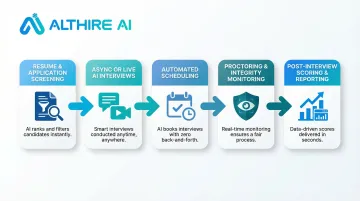
AI handles the repetitive, time-intensive steps so decision-makers receive structured, comparable candidate data before any final call is made. Human judgment stays in the loop where it matters most.
Key Advantages of AI in Remote Hiring
The advantages below map directly to outcomes recruiting teams measure: time-to-hire, cost-per-hire, quality-of-hire, and candidate experience. These gains compound when AI is applied consistently across multiple hiring stages rather than deployed in isolation.
Advantage 1: Dramatically Faster Screening and Time-to-Hire
AI compresses the most labor-intensive early stages of remote hiring — parsing hundreds of applications, filtering for role fit, scheduling interviews, and running first-round assessments — into automated workflows that run without manual intervention.
How AI creates this advantage: Algorithms rank inbound applicants against structured role criteria instantly. AI interview agents conduct and score first-round interviews asynchronously, meaning recruiters wake up to evaluated candidates rather than an inbox of resumes. Platforms like AltHire AI enable 24/7 interview coverage with automated scoring and detailed reporting, eliminating the coordination overhead that typically adds days to the process.
Why this matters:
The speed gap between identifying a qualified remote candidate and extending an offer is where top talent is lost. 42% of candidates dropped out of hiring processes because scheduling took too long, and candidates who accept offers typically do so within 2 to 2.8 days of receiving them. AI shrinks that window significantly.
Time-to-hire reduction also drives down cost-per-hire. Recruiters spend up to 16 hours per week scheduling calls and 10 hours searching for candidates in their ATS. Automating these tasks delivers measurable savings — fewer recruiter hours per role means lower recruiting costs overall.
In global remote hiring, being first to assess and respond has direct impact on offer acceptance rates. When the same candidate interviews with companies across multiple time zones simultaneously, speed becomes a competitive advantage.
KPIs impacted:
- Time-to-hire
- Time-to-fill
- Cost-per-hire
- Recruiter hours per open role
- Offer acceptance rate
When this advantage matters most: Speed gains are critical during high-volume hiring events, when filling roles in competitive talent markets, and when recruiting globally where manual coordination across time zones multiplies delays.
Advantage 2: Bias-Free, Standardized Candidate Assessments
Speed without consistency creates a different problem: faster bad hires. Standardized, bias-free evaluation is what ensures the candidates moving quickly through the pipeline are actually the right ones.
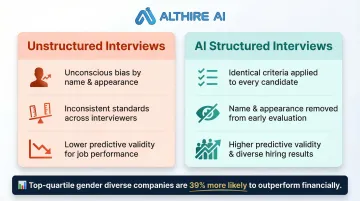
AI applies the same structured evaluation criteria — questions, scoring rubrics, follow-up logic — to every candidate, regardless of when they interview, who reviews them, or where they are located. This removes variability introduced by different human interviewers applying different standards.
How AI creates this advantage: Conversational AI interview platforms adapt questions based on candidate responses while maintaining a consistent scoring framework. Two candidates applying for the same role are assessed on identical dimensions — something particularly difficult to guarantee in distributed remote teams with multiple interviewers. AltHire AI's structured evaluation model ensures every candidate is measured against the same role-specific criteria with objective scoring that focuses purely on skills and potential.
Why this matters:
Unconscious bias in unstructured interviews systematically disadvantages certain candidate groups and increases poor hiring decisions driven by familiarity rather than fit. Structured interviews have higher predictive validity for job performance than unstructured interviews, and resumes with White-sounding names received 50% more callbacks than identical resumes with African-American-sounding names in labor market discrimination studies.
AI removes name, appearance, and interviewer-mood variables from early-stage evaluations. This matters beyond ethics: companies in the top quartile for gender diversity have a 39% greater likelihood of financial outperformance. More diverse, accurately assessed talent pools consistently produce better team performance and lower early-attrition rates.
KPIs impacted:
- Quality-of-hire
- Early attrition rate
- Diversity of candidate pool
- Interview-to-offer ratio
- Hiring manager satisfaction score
When this advantage matters most: Standardization is especially valuable when multiple hiring managers evaluate candidates across different locations, when hiring at scale where reviewer fatigue introduces inconsistency, and when companies have explicit diversity goals requiring demonstrable progress.
Advantage 3: 24/7 Global Candidate Access and Interview Coverage
AI-driven interview platforms operate continuously — candidates in any time zone can complete first or second-round interviews at their convenience, without a recruiter needing to be online. This turns a traditionally synchronous process into an asynchronous, always-on operation.
How AI creates this advantage: AI interview agents conduct adaptive, human-like conversations with candidates, ask contextually relevant follow-up questions based on responses, proctor the session for integrity, and deliver structured evaluation reports — all without human presence. AltHire AI enables candidates to record responses whenever they're ready while recruiters review results on their own schedule, with comprehensive AI proctoring that monitors identity verification, screen activity, audio integrity, and answer authenticity.
Why this matters:
Time zone barriers are among the most significant friction points in remote hiring. Scheduling a live interview between a recruiter in one country and a candidate in another can add days to the process. 80% of candidates want faster response times, and nearly one-third quit applying because of slow responses.
That delay has real consequences. 61% of U.S. job seekers have ghosted employers during hiring processes, often because they received another offer while waiting.
Removing scheduling dependency compresses hiring timelines and improves candidate experience. When interviews can happen anytime, companies are no longer limited to candidates in overlapping business hours — which expands the qualified applicant pool they can realistically evaluate. 45% of UK organizations recruited from much wider geographies compared to the previous year, leveraging remote work to access broader talent pools.
KPIs impacted:
- Interview completion rate
- Candidate experience score (NPS)
- Geographic reach of candidate pool
- Scheduling-to-interview turnaround time
- Volume of interviews conducted per recruiter
When this advantage matters most: 24/7 coverage delivers highest ROI when hiring across multiple time zones, during high-volume periods where recruiter bandwidth is constrained, and for roles where candidate responsiveness varies significantly.
What Happens When AI Is Missing from Remote Hiring
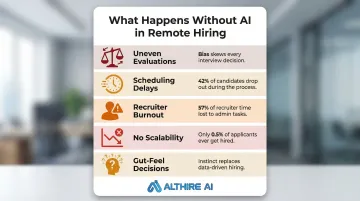
Manual and semi-automated remote hiring creates the same problems, consistently. Here's what teams run into:
Uneven evaluations: Different interviewers apply different standards, making fair candidate comparison nearly impossible. Structured interviews are consistently more reliable and valid than unstructured ones, yet manual processes struggle to maintain that consistency at scale.
Scheduling delays that cost candidates: Manual coordination across time zones stalls pipelines. 42% of candidates drop out because scheduling takes too long — and by then, they've accepted another offer.
Recruiter burnout: HR professionals spend up to 57% of their time on administrative tasks — parsing resumes, chasing calendars, sending follow-ups — leaving little room for the work that actually moves hiring forward.
No scalability without headcount: Only 0.5% of applicants are ultimately hired, which means manual teams absorb enormous candidate volume with no leverage — hiring more requires hiring more recruiters first.
Decisions made on gut feel: Without scoring and analytics, hiring managers work from interviewer notes alone — making it hard to identify what's working or where you're losing top candidates.
How to Get the Most Value from AI in Remote Hiring
AI delivers greater value when applied consistently and integrated into the full hiring workflow—not deployed as a one-off tool for a single stage. The biggest gains come from teams that run AI-assisted screening, interviews, and reporting in sequence rather than in isolation.
Three practices make the difference between marginal and measurable gains:
- Track hiring outcomes, not just activity. Monitor time-to-hire, quality-of-hire, and candidate NPS. Refine AI configurations—question banks, scoring criteria, role-fit thresholds—based on actual results. AltHire AI's detailed analytics reports are built specifically to support this review cycle.
- Use AI outputs as structured inputs, not final decisions. Human judgment still matters for cultural fit, offer negotiation, and final selection—but it should be applied to a better-filtered, more consistently evaluated candidate set.
- Sync AI tools with your ATS. Ensure candidate data, interview results, and feedback flow automatically into your applicant tracking system. This removes manual data entry, reduces errors, and speeds up decisions across distributed teams.
Conclusion
AI in remote hiring gives recruiters sharper tools to manage a process that is inherently distributed, high-volume, and time-sensitive — without sacrificing quality or consistency at any stage.
The three advantages covered—speed, standardization, and global availability—each deliver measurable outcomes that compound over time when AI is applied consistently throughout the hiring funnel. Organizations that integrate AI-powered remote hiring as standard practice gain structural advantage over those still managing remote hiring manually.
Remote work has permanently expanded the talent pool. The teams that act on that now — using AI to run structured, consistent interviews across time zones — are the ones building hiring pipelines their competitors can't match.
Frequently Asked Questions
What are the benefits of using AI in the hiring process?
AI delivers faster screening through automated resume matching and interview scheduling, reduces bias via standardized assessments, lowers cost-per-hire by cutting recruiter hours on administrative tasks, and enables teams to handle higher candidate volumes without adding headcount — all without proportional increases in hiring staff.
What are the benefits of hiring remote workers?
Remote hiring expands talent pools beyond geographic constraints, reduces overhead costs, and opens access to specialized skills unavailable locally. AI makes remote hiring practical at high volume by eliminating scheduling friction and delivering consistent evaluation across distributed candidates.
How does AI reduce bias in remote hiring?
AI applies identical structured questions and scoring rubrics to every candidate, removing variability from different human interviewers. This reduces unconscious bias based on name, appearance, or interviewer mood — evaluation stays grounded in skills and actual responses.
Can AI replace human recruiters in remote hiring?
AI automates early-stage, high-volume tasks like screening and first-round interviews, but human judgment remains essential for final evaluation, offer decisions, and candidate relationship-building. AI improves recruiter output and efficiency—it doesn't replace recruiter judgment.
How much can AI reduce time-to-hire in remote recruitment?
Organizations using AI in recruitment experienced 50% reduction in time-to-hire according to industry research. Results vary by role volume and current process maturity but consistently show significant improvements in screening and scheduling speed.
What should I look for in an AI remote hiring platform?
Key features to evaluate:
- Adaptive interviews that adjust follow-up questions based on each candidate's responses
- Built-in proctoring to verify assessment authenticity and prevent impersonation
- ATS integrations for smooth data flow across your existing hiring stack
- Structured scoring and analytics to support consistent, data-driven decisions
- 24/7 candidate availability to remove scheduling friction entirely