Introduction
Recruitment teams today face mounting pressure: more open roles, tighter budgets, and higher expectations for hire quality. According to SHRM's 2025 benchmarking data, 77% of organizations report difficulty filling positions, while the median time-to-fill hovers around 45 days—a window where top candidates often accept competing offers. AI has emerged as a practical response to these pressures, not just a trend.
This article goes beyond the hype. It focuses on what AI advantages look like in practice—tied to outcomes that matter: time-to-hire, cost-per-hire, quality of hire, and recruiter productivity.
Key Takeaways
- AI automates high-volume tasks like resume screening and scheduling, cutting time-to-hire dramatically
- It applies consistent, structured criteria across all candidates, reducing unconscious bias
- 24/7 hiring operations enable candidate engagement at scale without adding headcount
- Companies using AI in hiring report up to 50% lower recruiting costs alongside measurable gains in hire quality
- AI works best augmenting human judgment, not replacing it
What Is AI in Recruitment?
AI in recruitment refers to the use of machine learning, natural language processing, and automation to handle candidate sourcing, screening, interviewing, and evaluation tasks that would otherwise require manual recruiter effort.
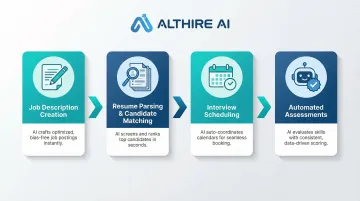
AI typically enters the hiring process at multiple stages across the funnel:
- Job description creation — generating role-specific language from minimal input
- Resume parsing and candidate matching — ranking applicants against defined criteria at scale
- Interview scheduling — eliminating back-and-forth coordination
- Automated assessments — conducting structured evaluations without requiring human presence
Platforms like AltHire AI use conversational AI to conduct adaptive interviews that analyze candidate responses in real time, providing consistent, structured evaluation at any hour.
AI compresses the time and error rate in the parts of hiring that don't require human intuition, freeing recruiters to focus where their judgment matters: cultural fit assessment, offer conversations, and relationship building.
Key Advantages of AI in Recruitment
Each advantage below maps to metrics HR and business leaders track: time-to-hire, cost-per-hire, recruiter utilization, and quality of hire.
Speed and Efficiency in Candidate Screening
AI can parse and rank hundreds or thousands of applications in minutes, eliminating the manual bottleneck that traditionally delays early-stage screening by days or weeks.
How it works in practice:
AI tools analyze application materials beyond keyword matching—looking at experience patterns, skill alignment, and role fit signals—and surface the strongest candidates automatically. For example, a clinical trial study published in JAMA found that AI-assisted prescreening identified 99% of eligible candidates within 15 days, while manual review took 50 days. The context differs from hiring, but the pattern is consistent: AI accelerates high-volume screening against defined criteria at a pace manual review cannot match.
AltHire AI's platform demonstrates this in commercial settings, reporting a 60% reduction in screening interview time and 70% faster time-to-hire compared to traditional methods.
Why this is an advantage:
Slow screening creates real business cost. A Cronofy survey of 12,000 candidates found that 42% abandoned a recruitment process because it took too long to schedule an interview. Roles left open longer reduce team productivity, and top candidates accept offers from faster-moving competitors.
The speed advantage connects directly to cost. With SHRM reporting a median cost-per-hire of approximately $1,200 for non-executive roles, every additional day a position remains open compounds lost productivity and recruitment expenses. AI-driven screening compresses that window significantly.
KPIs impacted:
- Time-to-hire
- Time-to-fill
- Recruiter hours per requisition
- Cost-per-hire
- Candidate drop-off rate during early stages
When this advantage matters most:
- High-volume hiring cycles (seasonal, expansion phases)
- Companies filling multiple roles simultaneously
- Organizations experiencing recruiter bandwidth constraints
- Any scenario where speed-to-offer is a competitive differentiator
Bias-Free, Consistent Candidate Evaluation
Traditional hiring relies heavily on individual recruiter judgment, which introduces variability: two recruiters reviewing the same resume may reach different conclusions, and unconscious bias around demographics, educational background, or resume formatting can systematically disadvantage qualified candidates.
A landmark study by Bertrand & Mullainathan found that resumes with stereotypically White-sounding names received 50% more callbacks than identical resumes with African American-sounding names. Similarly, research by Correll, Benard, & Paik showed that childless women received 2.1 times as many callbacks as equally qualified mothers.
How AI creates consistency:
Structured evaluation models score every applicant against the same pre-defined, role-relevant criteria—removing variance from reviewer fatigue, personal preferences, or incomplete review. AltHire AI's platform employs a 360° performance breakdown across customizable dimensions, evaluating responses, behavior, and consistency to generate multidimensional scores reflecting true performance.
Why this is an advantage:
Inconsistent evaluation is not just a fairness issue—it's a quality-of-hire issue. When criteria drift between reviewers or interviews, the wrong candidates advance. A meta-analysis by McDaniel et al. found that structured interviews have substantially higher predictive validity (p ≈ .44) compared to unstructured interviews (p ≈ .33).
McKinsey's 2020 research found that companies in the top quartile for gender diversity on executive teams were 25% more likely to have above-average profitability. AI-driven structured evaluation is one mechanism for achieving that consistently.
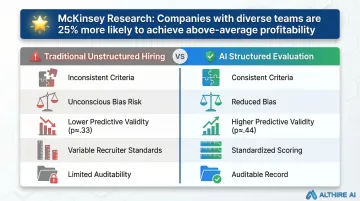
There's also a risk angle: companies face legal and reputational exposure from discriminatory hiring patterns. Structured, auditable AI evaluation creates a defensible record.
KPIs impacted:
- Quality-of-hire
- Diversity metrics
- Offer acceptance rate
- Interview-to-hire ratio
- Recruiter-to-candidate consistency scores
When this advantage matters most:
- High-stakes roles where a bad hire is costly
- Organizations with DEI hiring goals
- Companies using multiple interviewers or recruiters across geographies
- Regulated industries where documented evaluation criteria are required
24/7 Availability and Hiring at Scale
Traditional recruitment operates within business hours: candidates apply outside of 9-to-5, but assessment and engagement only happens when a recruiter is available—creating lag and drop-off.
How AI eliminates this constraint:
AI-powered interview agents (like those used in AltHire AI's platform) can conduct adaptive, conversational interviews at any hour, meaning candidates get assessed the same day they apply, regardless of time zone or recruiter availability. Candidates initiate interviews via a shared link and complete the full assessment independently, with AI generating comprehensive reports instantly upon completion.
Why this is an advantage:
Candidate engagement drops sharply with response delay. Separate research indicates that 33% of candidates drop off due to slow response times, and nearly 58% expect to hear back within one week of applying.
24/7 AI availability directly reduces that attrition—candidates who apply at midnight on a Friday don't wait until Monday to start the process.
As hiring volume grows, traditional models require proportionally more recruiters. AI decouples hiring capacity from headcount—a case study in seasonal hiring showed that implementing an AI interview agent increased application completion rates from roughly 50% to 85%, without adding a single recruiter.
With SHRM data showing that the median recruiter handles 20 requisitions per year, and 54% of recruiters reporting increased stress levels, the ability to scale without adding headcount becomes critical.
KPIs impacted:
- Candidate conversion rate
- Pipeline volume per recruiter
- Time-to-first-interview
- Recruiter-to-hire ratio
- Geographic reach of talent sourcing
When this advantage matters most:
- Global organizations hiring across time zones
- High-growth startups scaling rapidly
- Seasonal employers with predictable volume spikes
- Remote-first companies where candidates may apply from anywhere
What Happens When AI Is Missing or Ignored
Skip AI in your hiring process and the gaps show up fast. Here's what organizations consistently run into:
Manual screening backlogs push time-to-hire past 30–60 days. With median time-to-fill at 45 days and climbing, top candidates accept competing offers before they ever reach your interview stage.
Inconsistent evaluation means different interviewers apply different standards — and mis-hires follow. Studies put replacement costs at 20–25% of annual salary, with typical figures landing between $15,000 and $17,000 per bad hire.
Recruiter burnout sets in when most of the workday goes to high-volume, repetitive screening. Relationship building, employer branding, and quality interviewing get squeezed out — and the hiring function shifts from strategic to purely reactive.
Scaling limits hit hard when headcount needs spike. Without AI, recruiting capacity can't keep pace with business growth, forcing teams into deferred hires or costly agency dependency.
How to Get the Most Value from AI in Recruitment
AI in recruitment delivers its strongest results when applied consistently across the pipeline—not selectively used for one stage and abandoned in others. Partial implementation creates gaps where manual inconsistency reintroduces the problems AI was meant to solve.
Connect AI to Your Existing Workflow
AI tools that connect with ATS platforms keep AI-generated insights inside the existing workflow, avoiding parallel data silos and extra manual steps for recruiters. For example, AltHire AI integrates with 20+ ATS platforms — including Greenhouse, Lever, BambooHR, Workable, and Ashby — so candidate data moves automatically without duplicate entry.
Keep Humans in the Loop
AI handles the volume, consistency, and availability challenges — but hiring decisions, offer conversations, and cultural fit assessments still benefit from human judgment. Organizations that treat AI as augmentation rather than full automation tend to see stronger, more defensible outcomes.
Implementation Recommendations
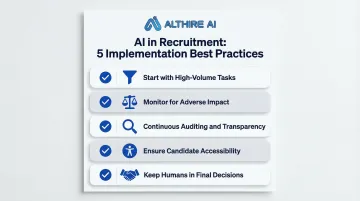
Start with these practices to maximize impact and reduce risk:
- Start with high-volume, well-defined tasks (resume screening, interview scheduling)
- Monitor for adverse impact using the four-fifths rule as a guideline
- Maintain continuous auditing and transparency
- Ensure accessibility and reasonable accommodations for candidates with disabilities
- Keep humans in the loop for final selection decisions
Conclusion
The advantages of AI in recruitment are measurable and operational — reflected in lower cost-per-hire, better quality candidates, and more productive recruiting teams.
These gains compound when applied consistently:
- Faster screening keeps strong candidates engaged before they accept competing offers
- Bias-free evaluation improves quality of hire by assessing skills over assumptions
- 24/7 availability eliminates drop-off caused by slow response times
Together, they shift hiring from a reactive scramble into a repeatable, self-improving process.
Frequently Asked Questions
What are the advantages of AI in recruitment?
AI in recruitment cuts time-to-hire by up to 70%, reduces unconscious bias through consistent evaluation, and lowers cost-per-hire via automation. It also enables 24/7 candidate engagement and frees recruiters to focus on relationship building and cultural fit assessment.
What is the main benefit of responsible AI in recruitment?
Responsible AI—designed with structured, auditable evaluation criteria and human oversight—delivers bias-reduced, defensible hiring decisions that improve both fairness and quality-of-hire at once. It produces a reviewable record that reduces legal exposure by applying job-relevant criteria consistently across every candidate.
Can AI eliminate bias in the recruitment process?
AI doesn't eliminate bias entirely — it can inherit biases from training data — but structured evaluation models significantly reduce the inconsistency of manual review. Well-designed systems are also more auditable than human-only processes, making it easier to detect and correct for adverse impact.
How does AI reduce hiring costs for companies?
AI reduces costs through three mechanisms: fewer recruiter hours spent on manual screening, faster time-to-fill reducing lost productivity from open roles, and reduced reliance on external agencies when internal AI tools can handle volume hiring. Cost savings can reach $12M annually per 1,000 hires.
Is AI in recruitment suitable for small businesses or startups?
Yes. AI recruitment tools are increasingly accessible to smaller organizations, and the ROI is particularly high for fast-growing teams that need to scale hiring quickly without building large internal recruiting functions. Platforms integrate with startup-focused ATS systems like Ashby and budget-friendly options like JazzHR.
What role does human oversight play when using AI in recruitment?
Human oversight remains essential for final hiring decisions, cultural fit assessment, and monitoring AI outputs for accuracy. AI handles volume and consistency; humans supply contextual judgment. Together, they outperform either approach on its own while keeping the process fair and compliant.