Introduction
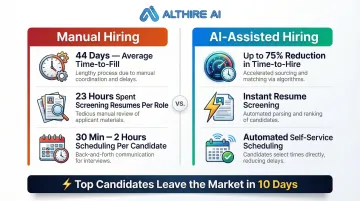
Recruiting teams today are under pressure from three directions simultaneously: shrinking timelines to fill roles, tighter hiring budgets, and rising expectations for candidate quality. The average time-to-fill sits at 44 days, yet top candidates disappear from the market in just 10 days. Manual screening consumes 23 hours per opening, while the cost of a bad hire reaches 30% of first-year earnings. The status quo is unsustainable.
AI is changing how recruiting teams operate — not in theory, but in measurable ways: faster shortlisting, reduced screening hours, and more consistent hiring decisions. This article breaks down the specific benefits of AI in talent acquisition, from time-to-hire reductions to cost savings, with concrete numbers recruiting leaders actually use to evaluate ROI.
Key Takeaways
- AI automates high-volume tasks like resume screening and interview scheduling, freeing recruiters for strategic work
- Key benefits include faster time-to-hire, significant cost reduction, improved hire quality, and reduced unconscious bias
- 62% of employers already use AI in talent acquisition — and the market is on track to reach $1.1 billion by 2030
- Recruiters get the best results treating AI as an augmentation tool: it handles volume and consistency, humans handle judgment and relationships
- ROI grows over time as hiring data accumulates, patterns sharpen, and each decision informs the next
What Is AI in Talent Acquisition?
AI in talent acquisition refers to intelligent software that automates, assists, or enhances steps in the hiring process—from sourcing and screening to interviewing and reporting. It covers a wide range of hiring functions, including:
- Resume parsing and candidate ranking
- Proactive candidate sourcing
- Automated interview scheduling
- AI-conducted screening interviews
- Bias detection and structured evaluation
- Post-hire analytics and reporting
AI is a means to an outcome—not a replacement for recruiters, but a way to let recruiting teams operate at scale without sacrificing quality or fairness. When 62% of employers have adopted AI in some capacity but only 6% have achieved deep workflow automation, that gap represents a real competitive advantage for organizations willing to move beyond surface-level adoption.
Key Advantages of AI in Talent Acquisition
The advantages below focus on measurable, operational impact—each tied to outcomes organizations actively track, such as time-to-fill, cost-per-hire, quality-of-hire, and recruiter utilization.
Faster Screening and Dramatically Reduced Time-to-Hire
One of AI's most immediate advantages is compressing the time between job posting and offer by automating resume screening, candidate ranking, and early-stage interviews that previously required weeks of manual effort.
How AI Creates This Advantage:
Algorithms evaluate hundreds of applications in minutes against defined criteria. AI interview agents—like those offered by AltHire AI—conduct structured screening interviews 24/7 without scheduling delays, delivering ranked candidates directly to recruiters.
The impact on manual work is stark:
- Resume screening that once consumed 23 hours per opening now happens instantly
- Interview coordination that took 30 minutes to 2 hours per candidate becomes automated self-service booking
Why This Matters:
86.1% of recruiters using AI report it speeds up hiring, and AI recruitment automation can reduce time-to-hire by up to 75%. Every day a critical role sits open carries real cost—delayed projects, overloaded team members, lost revenue in customer-facing roles. Speed also affects candidate experience: top candidates are off the market within 10 days, and slow processes result in losing the best talent to competitors.
KPIs Impacted:
- Time-to-fill
- Time-to-hire
- Offer acceptance rate
- Candidate drop-off rate during the interview process
When This Advantage Matters Most:
High-volume hiring scenarios (seasonal, bulk hiring, or rapid scale-up), roles with large applicant pools, and companies operating across multiple time zones where 24/7 interview availability removes logistical bottlenecks.
Reduced Bias and Consistently Higher Quality of Hire
When designed correctly, AI evaluates candidates on structured criteria—skills, demonstrated competencies, and role-relevant responses—rather than the inconsistent, subjective impressions that drive unconscious bias in traditional hiring.
How AI Creates This Advantage:
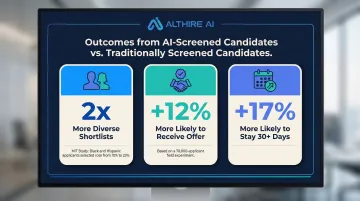
Structured interview scoring, standardized evaluation rubrics applied uniformly across all candidates, and algorithm-based shortlisting remove name, appearance, and demographic signals from early screening stages. Research from MIT demonstrated that a properly designed algorithm more than doubled the share of Black and Hispanic applicants selected for interviews—from 10% to 23%—without sacrificing candidate quality.
AI applies the same scoring logic to candidate #1 and candidate #500, which eliminates the fatigue and drift that affects human reviewers during high-volume cycles. Platforms like AltHire AI use adaptive dialogue that evaluates responses objectively while maintaining engagement, creating what researchers call "controlled variance": structured consistency that remains responsive.
Why This Matters:
The average cost-per-hire is $5,475 for non-executive roles and $35,879 for executive roles, while a bad hire costs at least 30% of first-year earnings. Inconsistent evaluation contributes directly to poor quality-of-hire decisions. Organizations that reduce bias in screening see measurably more diverse candidate pipelines, which is both a business performance and compliance priority.
In a massive randomized field experiment involving 70,000 job applicants, candidates interviewed by AI were 12% more likely to receive a job offer, 18% more likely to start the job, and 17% more likely to stay for at least 30 days.
KPIs Impacted:
- Quality-of-hire scores
- 90-day retention rates
- Diversity of shortlisted candidates
- Hiring manager satisfaction scores
- Performance ratings of AI-screened hires vs. traditionally screened hires
When This Advantage Matters Most:
Organizations with documented diversity gaps, companies hiring at scale where evaluator fatigue is a real risk, and industries with compliance-sensitive hiring requirements (finance, healthcare, government).
Lower Recruiting Costs and Significantly Higher Recruiter Productivity
AI reduces the cost of recruiting in two ways: by cutting the volume of labor-intensive manual tasks and by improving the accuracy of shortlists—meaning fewer wasted interviews and fewer costly mis-hires.
How AI Creates This Advantage:
Automated sourcing, screening, and scheduling cut the hours recruiters spend on administrative work, while better candidate matching reduces downstream costs from bad hires. Fewer agency fees are needed when AI surfaces qualified candidates proactively. Manual recruiting processes currently consume 20 to 30 hours per week (up to 75% of a recruiter's working time) on repetitive tasks alone.
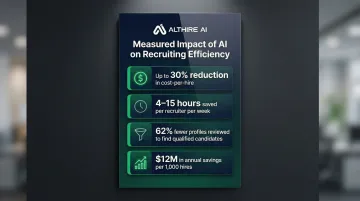
AI recruitment tools can reduce cost-per-hire by as much as 30%. LinkedIn's Hiring Assistant saves users an average of 4 hours per role and requires reviewing 62% fewer profiles to find qualified candidates. Other implementations report saving recruiters up to 15 hours per week.
The Business Case:
When AI handles screening volume, recruiters can manage more open roles without sacrificing quality. The cost savings extend beyond hourly efficiency: avoided costs include prolonged vacancies, repeat hiring cycles for bad hires, and recruiter burnout from repetitive work. AltHire AI customers report $12M in annual savings per 1,000 hires, with a 42% improvement in recruiter productivity and 33+ hours saved per week.
KPIs Impacted:
- Cost-per-hire
- Recruiter-to-open-role ratio
- Time spent on administrative vs. strategic tasks
- Cost of a mis-hire as a multiple of annual salary
When This Advantage Matters Most:
Lean recruiting teams managing high volumes, startups and scale-ups without large HR budgets, and recruitment agencies where margin pressure makes efficiency a survival factor.
What Happens When AI Is Missing from Your Recruiting Process
Manual recruiting processes don't just slow you down — they create problems that multiply as hiring volume grows. Here's what that looks like in practice.
Screening standards vary by recruiter, not by role:
Without structured, AI-enforced evaluation criteria, shortlists reflect individual judgment rather than job requirements. The same resume reviewed by three different recruiters can receive three different assessments — making quality-of-hire outcomes hard to predict or improve.
Hiring teams become the bottleneck, not the engine:
Manual workflows can't absorb sudden hiring surges. Roles take longer to fill, and the recruiting team — not lack of talent — becomes the constraint. At large enterprises where recruiters manage 50 to 60 open requisitions at once, that constraint is costly.
Costs are real, even when they're not tracked:
Time spent manually reviewing resumes, coordinating schedules, and re-screening candidates rarely shows up on a budget line — but it adds up fast. Unfilled roles cost companies an average of $500 per day in lost productivity, with total monthly impact ranging from $3,800 to $9,300 depending on the function.
Scaling means hiring more recruiters, not hiring better:
A process built for 10 hires per quarter breaks down at 50 or 100. Without AI, the only lever is headcount — a slow, expensive fix that still leaves you behind demand.
How to Get the Most Value from AI in Recruiting
AI in recruiting delivers the most value when implemented as part of a consistent, end-to-end process—not as a point solution that automates one step in isolation. Platforms that combine AI-powered screening, proctoring, ATS integrations, and detailed analytics allow recruiting teams to connect every stage and measure outcomes throughout.
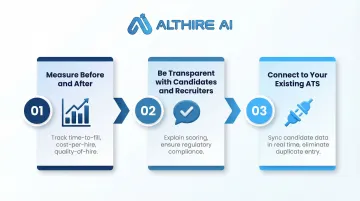
Three practices determine whether that value compounds or stalls:
Measure before and after adoption — Track KPIs like time-to-fill, cost-per-hire, and quality-of-hire at each stage. AI improves only when teams review outputs and adjust accordingly. AltHire AI's instant reports include dimensional performance scores, question-by-question evaluations, and full video recordings to make that calibration straightforward.
Be transparent with candidates and recruiters — Explain how AI scores and rankings are produced. Regulations like NYC Local Law 144 (bias audits) and the EU AI Act (high-risk classification for hiring AI) make proactive governance a legal necessity, not just a best practice.
Connect to your existing ATS — Disconnected tools create data gaps and manual rework. AltHire AI supports 20+ ATS integrations — including Greenhouse, Lever, Ashby, Workable, and BambooHR — so candidate data syncs in real time without duplicate entry.
Conclusion
AI in talent acquisition delivers specific, measurable outcomes: faster time-to-hire, lower cost-per-hire, more consistent candidate evaluation, and better quality hires at scale. These gains compound over time. As AI tools are calibrated against real hiring outcomes, shortlist accuracy improves, recruiters spend less time on screening, and the overall cost of hiring drops.
These benefits only materialize when AI is treated as an ongoing practice, not a one-time implementation. Organizations that integrate AI deeply into their hiring workflows — from sourcing through offer — see the strongest returns. Platforms like AltHire AI are built for exactly that: embedding AI at every stage so hiring teams move faster, evaluate more consistently, and make better decisions at scale.
Frequently Asked Questions
Can AI fully replace human recruiters?
AI automates high-volume, repetitive tasks (screening, scheduling, initial interviews), but human judgment remains essential for evaluating culture fit, making final decisions, and building candidate relationships. The most effective model is AI augmentation—not replacement—where each handles what it does best.
How does AI reduce bias in the hiring process?
AI applies standardized evaluation criteria uniformly across all candidates, removing subjective signals like name, appearance, or interview rapport from early screening. However, AI trained on biased historical data can replicate bias, so ongoing audits and diverse training data are essential for maintaining fairness.
What is the measurable ROI of AI in talent acquisition?
Key metrics include cost-per-hire reduction (up to 30%), time-to-fill improvement (up to 75%), and recruiter hours saved per week (4-15 hours). ROI varies by company size and hiring volume but delivers the strongest returns for teams conducting high-volume or frequent hiring cycles.
What types of roles is AI recruiting most effective for?
AI performs best for roles with well-defined skill criteria and moderate-to-high application volume: technical, customer service, sales, and operational positions. Senior leadership and creative roles still benefit from AI screening, but require closer human involvement in evaluation.
How does AI in recruiting affect the candidate experience?
AI improves candidate experience through faster responses, 24/7 interview scheduling, and more consistent evaluation. The key is transparency—candidates who understand how AI is assessing them report significantly better impressions of the hiring process.
What should companies look for when evaluating AI recruiting tools?
Prioritize these criteria when comparing platforms:
- ATS integration with your existing stack
- Transparent scoring methodology and bias audit practices
- Analytics depth and reporting quality
- Full-funnel coverage vs. single-stage tools
- Compliance with EEOC guidance and local automated employment decision laws