Introduction
Recruiting teams face a critical squeeze: hiring volumes are climbing while top candidates leave the market in as few as 10 days. Many HR teams still wrestle with manual resume screening, endless scheduling chains, and inconsistent interview processes.
According to SHRM's 2024 research, the average time-to-hire now stands at 44 days, and over 75% of organizations report difficulty filling roles quickly enough to stay competitive.
AI is helping teams compress weeks of work into hours by automating repetitive tasks and surfacing better candidate information at every stage. This post covers where AI delivers the biggest impact in hiring, how quality improves alongside speed, and what to watch for when adopting these tools.
Key Takeaways
- AI automates resume screening, scheduling, and candidate communications, freeing recruiters for higher-value conversations and strategic decisions
- Machine learning surfaces stronger candidates faster through skills-based matching, not just keyword filtering
- 24/7 AI-powered interviews assess candidates consistently and eliminate scheduling bottlenecks
- Real-time analytics give HR leaders visibility into funnel performance and quality-of-hire metrics
- Success depends on thoughtful implementation: picking the right tools, training your team, and keeping humans in the decision loop
Why Traditional Hiring Struggles to Keep Up
The volume problem is crushing recruiters. With applications per role averaging 244 and manual resume review taking just 7.4 seconds per candidate, recruiters spend up to 35% of their week on administrative tasks rather than strategic hiring work. This leaves little time for the high-value activities that actually improve hiring outcomes.
Speed and quality pull in opposite directions. Moving quickly to fill roles leads to mis-hires that cost between six to nine months of an employee's salary, according to SHRM. But moving slowly means losing top candidates to competitors—high performers are available for an average of just 10 days before accepting offers elsewhere.
Consistency is the third pressure point. Without structured processes, different interviewers evaluate candidates on entirely different criteria—one prioritizing cultural fit, another focused purely on technical skills—making fair comparisons nearly impossible and letting bias quietly shape decisions.
How AI Tools Speed Up Each Stage of Hiring
Automated Resume Screening
AI parsing tools scan and rank hundreds of resumes in seconds by analyzing skills, experience, and job-fit signals. Where manual screening of 244 applications might consume 30+ minutes of focused recruiter time, AI completes the same task in under a minute while maintaining consistent evaluation criteria.
Modern AI goes beyond keyword matching. Semantic understanding identifies candidates who have the right capabilities even when their resume doesn't mirror job description language exactly. This surfaces qualified candidates who would otherwise be filtered out by rigid keyword systems, expanding your talent pool by up to 6.1 times according to LinkedIn research.
Intelligent Interview Scheduling
AI scheduling tools eliminate the back-and-forth email chains that typically delay interviews by days. Calendar integrations, self-scheduling links, and automatic reminders compress what used to take 5-7 email exchanges into a single automated workflow.
Interviewer load balancing ensures no interviewer gets overloaded while no candidate waits unnecessarily. The AI matches candidates to available interviewers based on role requirements and calendar availability, distributing interview load evenly across your hiring team.
AI-Powered Interviews
Conversational AI interview agents conduct structured, adaptive interviews at any hour. Candidates answer questions in their own time, and the AI follows up dynamically based on responses rather than following a rigid script.
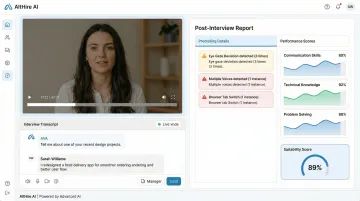
AltHire AI exemplifies this with interview agents that run adaptive, structured interviews around the clock. The platform's AI proctoring monitors for multiple faces, external assistance, AI-generated answers, and suspicious behavior, then generates detailed post-interview reports automatically. Teams evaluate more candidates without adding recruiter hours — early adopters report 95% completion rates for AI phone screens.
Automated Candidate Communications
AI chatbots and automated messaging keep candidates informed throughout the process, answering FAQs, sending status updates, and nudging candidates toward next steps without recruiter intervention. This consistency matters: research shows that 61% of candidates report being ghosted by employers, and 75% of applications receive no response whatsoever.
That silence has a real cost. Closing that gap with automated follow-ups reduces drop-off and builds goodwill: when recruiters provide clear next steps and follow up post-interview, candidates' willingness to refer others increases by 112%, according to the 2023 Global CandE Benchmark Research Report.
Key communication touchpoints AI handles automatically:
- Application received confirmations and timeline expectations
- Interview reminders and self-scheduling links
- Post-interview status updates and next-step nudges
- FAQ responses without recruiter involvement
How AI Improves Hiring Quality, Not Just Speed
Speed matters, but a faster bad hire is still a bad hire. Here's how AI lifts quality across every stage of the process:
Skills-based and predictive matching cuts mis-hire risk by evaluating true capability and cultural fit signals — not just resume titles. Machine learning models trained on historical hiring outcomes show a predictive validity of 0.24 (on a 0–1 scale where higher scores indicate stronger predictive power), compared to near-zero for unstructured resume screening.
Consistent, bias-reduced evaluation removes the subjectivity that creeps in when the same role gets scored differently by different interviewers. AI enforces the same criteria for every candidate. Structured interviews carry a predictive validity of 0.42 — more than double the 0.19 validity of unstructured interviews, according to research by Sackett, Zhang, Berry, and Lievens (2022).
Interview intelligence and richer reporting replace a recruiter's paraphrased notes with objective, multi-dimensional assessments. AltHire AI's reports include:
- Dimensional performance scores across key competencies
- Question-by-question evaluation with AI-generated commentary
- Complete transcripts with video playback
- Comprehensive proctoring details for integrity verification
Those individual-level insights feed into something larger: organization-wide pattern recognition. AI analytics surface where candidates drop out of the funnel, which sourcing channels consistently produce strong hires, and which roles repeatedly stall in the pipeline. HR leaders can fix what's broken based on evidence, not gut feeling.
Finally, AI handles candidate communication at a scale no recruiting team can match manually. Dynamic job recommendations, personalized follow-up sequences, and 24/7 availability keep applicants engaged across hundreds of open roles — without adding headcount.
Real Numbers: What AI-Driven Hiring Looks Like in Practice
AltHire AI provides a concrete reference point for what well-implemented AI hiring delivers:
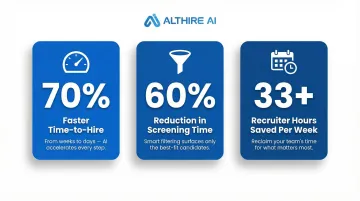
- 70% faster time-to-hire compared to traditional manual processes
- 60% reduction in screening interview time through automated initial assessments
- 33+ recruiter hours saved per week by eliminating repetitive administrative work
Organizations using the platform report reducing hiring timelines from days to hours while maintaining or improving candidate quality. Customers across enterprise and high-growth companies have achieved up to a 75% reduction in hiring time without sacrificing the quality of hires.
The financial case is direct. Each unfilled position costs companies an average of $4,129 over a 42-day vacancy period, according to Forbes citing SHRM data. Faster hiring cuts that opportunity cost immediately. Better candidate matching also reduces bad-hire risk—SHRM estimates those failures cost six to nine months of salary for most roles, and three to four times salary for specialized positions.
Those savings extend beyond the interview stage. McKinsey's HR Monitor 2025 found that generative AI could cut job description costs by up to 70%, and high-performing organizations using automation have stretched HR team capacity from one staff per 70 employees to one per 200—a near-threefold efficiency gain across the full hiring function.
Common Challenges and How to Address Them
Data quality and inherited bias are the most common place AI implementation goes wrong. AI learns from historical hiring data—if that data reflects past biases, the system will perpetuate them. To reduce this risk:
- Audit training data before deployment for demographic skew
- Use structured, objective scoring models rather than subjective signals
- Monitor outcomes by demographic group on an ongoing basis to catch drift early
The EEOC's Four-Fifths Rule provides a standard method for identifying adverse impact.
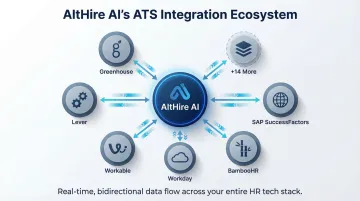
Integration friction slows adoption when AI tools don't connect with existing ATS platforms. Evaluate tools for native integrations—prioritize platforms supporting 15+ ATS connections, including Greenhouse, Lever, Workable, BambooHR, Workday, and SAP SuccessFactors. AltHire AI integrates with 20+ major ATS platforms, enabling real-time data flow without manual entry. Start with one workflow bottleneck before expanding.
Recruiter resistance is a change management problem, not a technology one. Recruiters often worry automation threatens their role. The more effective internal message: AI handles resume screening and scheduling so recruiters can spend more time on relationship-building, negotiation, and the candidate moments that genuinely require human judgment.
Frequently Asked Questions
How can AI tools speed up the hiring process?
AI automates the most time-intensive stages—resume screening, scheduling, and initial interviews—compressing a process that once took weeks into days. By handling repetitive tasks, AI frees recruiters to focus on high-value candidate interactions without sacrificing quality.
Does AI in recruitment reduce bias?
AI can reduce human subjectivity through structured scoring and consistent evaluation criteria, but it's not automatically bias-free. Outcomes depend on training data quality, tool design, and ongoing monitoring to catch scoring inconsistencies or patterns inherited from historical hiring decisions.
Can AI replace recruiters entirely?
No. AI handles repetitive and data-intensive tasks but cannot replace the human judgment, empathy, and relationship-building that define great recruiting. It amplifies what recruiters do well — it doesn't replace the experience, instinct, and cultural awareness they bring to final decisions.
How do AI interview tools work?
AI interview platforms use conversational AI to ask structured questions, adapt based on candidate responses, and generate scored reports. This enables assessment at scale — hundreds of candidates evaluated consistently — without requiring a human interviewer at every initial stage.
What should companies look for when choosing an AI hiring tool?
Key criteria to evaluate:
- ATS integration compatibility and ease of setup
- Bias mitigation features with structured, objective scoring
- Quality of the candidate-facing experience
- Transparent reporting with explainable scoring decisions
- Human-in-the-loop oversight and documented audit processes
Is AI in recruitment suitable for small businesses or just large enterprises?
AI hiring tools are increasingly accessible to businesses of all sizes, with many platforms offering tiered pricing and scalable implementations. Even small teams managing a handful of open roles see real gains from automated screening and scheduling — and for leaner teams, the time savings typically translate to ROI faster than at larger organizations.