Introduction
Hiring in 2025 is slower, more expensive, and more competitive than ever. Recruiters are managing application volumes that have surged by hundreds of candidates per role, time-to-fill targets that demand faster decisions, and candidate drop-off rates that drain qualified talent before anyone reaches the interview stage.
The bias problem compounds things further. Research shows that identical resumes receive 50% fewer callbacks based solely on name-based racial assumptions — a structural flaw that no amount of recruiter training has reliably fixed.
This guide covers the full picture of AI in recruitment: how it works across hiring stages, measurable benefits, real risks, and steps to get started. Whether you're an HR leader at a growing startup, a talent acquisition professional at an enterprise, or a hiring manager looking to modernize your process, you'll find concrete strategies to deploy AI effectively while avoiding common pitfalls.
TLDR: Key Takeaways
- Resume screening, interview scheduling, and candidate communication can all be automated — giving recruiters more time for relationship-building and strategic decisions
- AI-powered interviews assess skills, behavior, and culture fit using adaptive questioning and structured scoring
- Well-implemented AI delivers 70% faster time-to-hire, lower recruiting costs, and more consistent candidate screening
- Successful adoption depends on clear goals, ethical guardrails, and tools that fit your existing HR tech stack
- AI reduces some forms of bias, but it isn't inherently fair — regular audits and human oversight are non-negotiable
What Is AI in Recruitment?
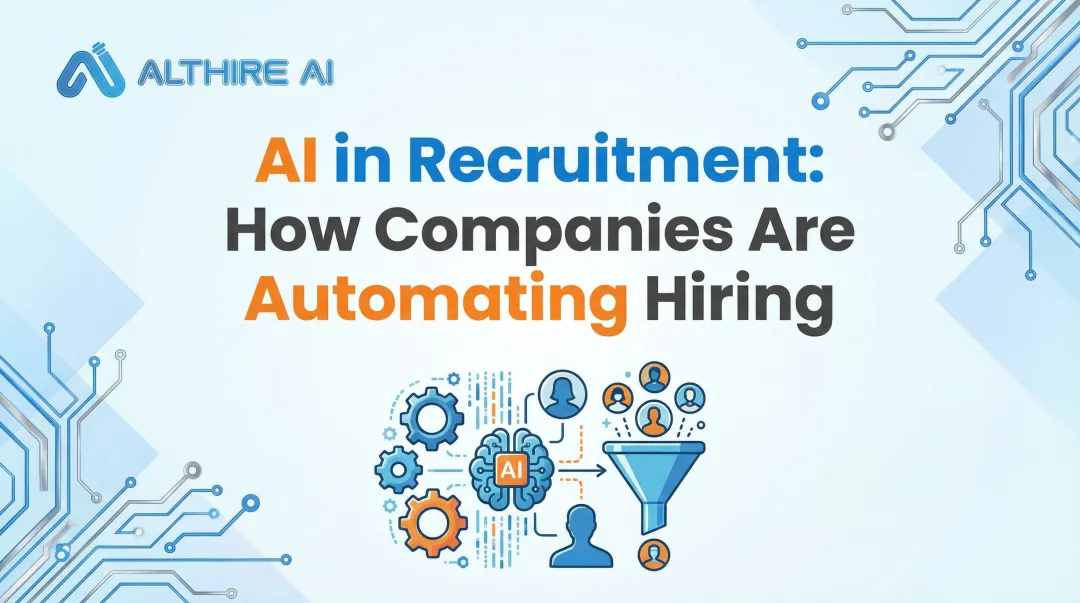
AI in recruitment refers to the use of machine learning, natural language processing, and automation to assist or replace manual steps in the hiring process—from job posting to final offer. Rather than a single tool, it's intelligence embedded throughout the talent acquisition pipeline to reduce time, cost, and inconsistency.
Early recruitment AI consisted of basic resume-parsing tools and keyword filters embedded in Applicant Tracking Systems (ATS). The technology has moved well beyond that.
Today's platforms feature conversational AI interviewers that conduct adaptive dialogues, predictive analytics that forecast candidate success, and agentic AI that handles entire workflow stages autonomously: sourcing candidates, scheduling interviews, and generating detailed assessment reports.
That evolution makes one distinction especially important when evaluating tools:
- Augmentation AI supports human decisions by surfacing insights, ranking candidates, or flagging inconsistencies — humans retain final authority
- Automation AI handles entire processes independently, such as conducting screening interviews or verifying credentials without human involvement
The difference isn't just philosophical. Regulatory frameworks increasingly require human oversight for high-risk employment decisions, meaning fully automated hiring workflows can expose organizations to legal liability.
How AI Is Used Across the Hiring Process
AI doesn't slot into a single step of hiring — it runs through every stage, from the first sourcing search to the final interview scorecard. Here's how it works at each phase.
Sourcing and Candidate Screening
AI scans job boards, LinkedIn, internal databases, and passive candidate pools to identify qualified candidates at scale. Unlike keyword filters that simply match terms on a resume, modern AI uses skills-based matching to surface candidates who meet the role's deeper requirements — even if they describe their experience differently than the job description.
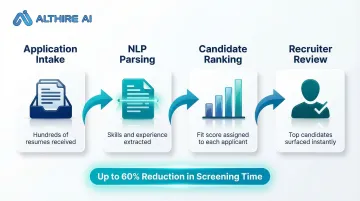
AI-powered resume screening uses natural language processing (NLP) to parse applications, rank candidates by fit, and flag experience gaps. Research shows that AI-assisted screening can reduce processing time by up to 60%. That frees recruiters to spend time on actual candidate conversations — not administrative sorting through hundreds of submissions.
AI-Powered Interviews
AI interview agents conduct adaptive, conversational interviews autonomously — asking follow-up questions based on candidate responses, evaluating answers in real time, and generating structured scorecards. Platforms like AltHire AI run these interviews 24/7, eliminating scheduling delays and enabling candidates to interview on their own time.
The asynchronous format reduces candidate anxiety, and every interview is scored against the same objective criteria — so evaluation stays consistent regardless of who's hiring.
AI proctoring works during video interviews to ensure assessment integrity through:
- Identity verification and camera monitoring to detect spoofing attempts
- Behavioral monitoring that flags multiple faces, suspicious eye movements, or coaching attempts
- Audio analysis that catches multiple voices or AI-generated responses
- Screen monitoring for tab switches, external tools, or copy-paste behavior
All flagged events are compiled with timestamps and evidence, with human analysts reviewing context to ensure fair outcomes.
Scheduling and Communication
AI automates interview scheduling through calendar integrations, cutting the back-and-forth between recruiters, candidates, and hiring managers. On average, that saves 3-5 hours per open role compared to manual coordination.
Candidate communication gets the same treatment:
- Chatbots answer FAQs around the clock and send real-time status updates
- Automated nudges keep candidates engaged between stages
- Passive candidates — who are quickest to disengage — stay informed without recruiter follow-up
Fewer delays mean fewer drop-offs, which matters most in competitive talent markets where candidates are weighing multiple offers at once.
The Real Benefits of Using AI in Recruitment
Speed
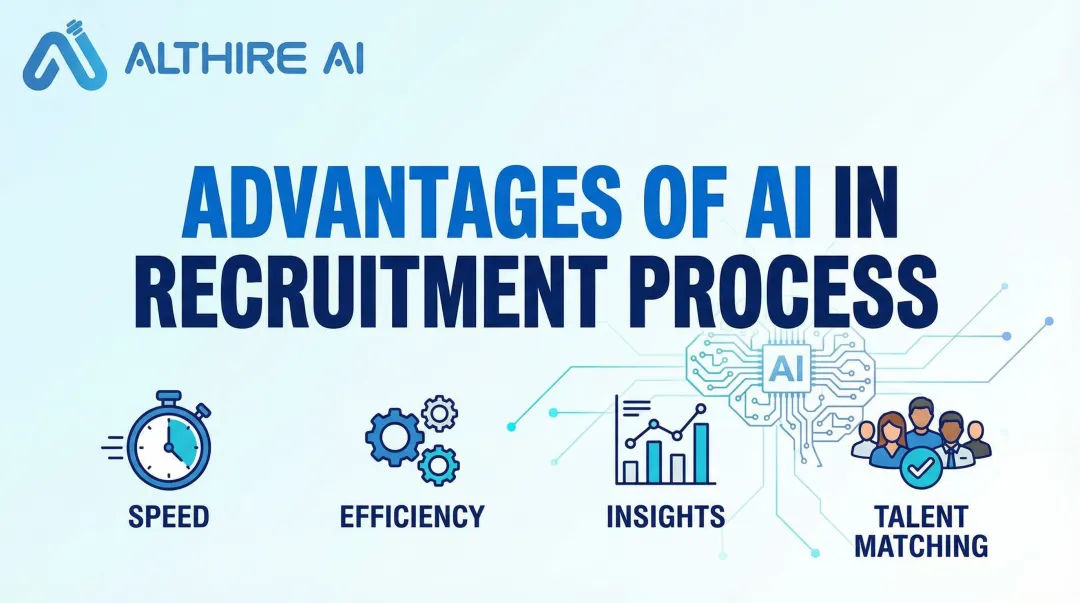
AI compresses time-to-hire by automating the slowest stages of recruitment—screening, scheduling, and initial assessment. Organizations using AI-powered screening and interviews report time-to-hire reductions of 70% or more, with some customers achieving 75% faster hiring while simultaneously improving candidate quality.
Cost Reduction
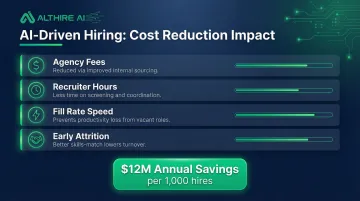
AI reduces cost-per-hire across multiple dimensions:
- Fewer agency fees by improving internal sourcing efficiency
- Reduced recruiter hours on manual screening and coordination tasks
- Faster fill rates that prevent business disruption and lost productivity
- Lower early attrition through better skills-based matching
AltHire AI reports that organizations can achieve $12M in annual savings per 1,000 hires when deploying AI-powered hiring at scale, primarily through reduced recruiter hours and improved quality-of-hire metrics.
Quality of Hire
AI assesses candidates against structured, objective criteria—skills, competencies, and behavioral signals—rather than gut feel. This leads to better-fit hires and lower early attrition. Research from Unilever's AI implementation showed a 50% reduction in time-to-hire while simultaneously enhancing candidate diversity through structured, skills-based assessments.
Bias Reduction
Structured AI assessments, when designed correctly, reduce the influence of unconscious bias by eliminating variables like name, appearance, or accent from initial screening. The system applies consistent evaluation criteria to every candidate, removing the fatigue-induced inconsistency that affects human reviewers.
That said, AI is only as fair as the data it's trained on. Amazon's scrapped resume screening tool systematically downgraded resumes containing female-associated terms because it was trained on historical hiring data from a male-dominated engineering workforce. Organizations must demand transparency about training data and conduct regular bias audits.
Recruiter Productivity
AI handles high-volume, low-judgment work so recruiters can concentrate on relationship-building, assessment interpretation, and strategic hiring decisions. Organizations report reclaiming 33+ recruiter hours per week with AI in place, redirecting that time toward candidate experience and hiring manager consultation.
Challenges and Risks to Watch For
Algorithmic Bias
AI trained on historical hiring data can perpetuate existing biases, especially if past hiring patterns were not diverse. Algorithms may use proxy variables for protected attributes—zip codes, speech patterns, or extracurricular activities—that unintentionally correlate with race, ethnicity, or socioeconomic status.
When evaluating vendors, teams should demand:
- Require transparent documentation of training data sources
- Conduct regular independent bias audits following recognized standards
- Require explainability features that show how decisions are made
- Demand demographic impact reporting across protected classes
Candidate Experience and Transparency
AI can feel impersonal or opaque to candidates, particularly in AI-conducted interviews. HireVue discontinued its facial analysis features after audits revealed the tool disadvantaged candidates from ethnic minorities and individuals with disabilities.
Best practices include:
- Clearly communicate when AI is involved in the hiring process
- Offer human fallback options for candidates who request them
- Ensure the process feels fair, respectful, and transparent
- Provide candidates with feedback on their assessment results
Integration and Change Management
Even the best AI recruitment tools fall short without proper integration into existing ATS/HRIS systems and genuine buy-in from hiring teams. Addressing the human side of implementation is just as critical as the technical setup.
Successful deployments typically include:
- Pilot programs to test workflows before full rollout
- Recruiter training on how to interpret and act on AI outputs
- Candidate communication templates explaining AI involvement
- Clear escalation paths for edge cases requiring human judgment
How to Implement AI in Your Recruitment Process
Step 1: Audit Your Current Process
Before choosing tools, map your existing recruitment funnel and identify where time is being lost, where quality is inconsistent, and where candidates are dropping off. This tells you which AI applications will have the highest ROI for your context. Document baseline metrics like time-to-fill, cost-per-hire, offer acceptance rate, and recruiter hours spent on screening.
Step 2: Define Your Goals and Success Metrics
Vague AI adoption fails. Set measurable goals tied to your baseline data, such as:
- Reduce time-to-fill by 40%
- Cut screening hours by 20 hours per week per recruiter
- Improve offer acceptance rate by 15%
- Increase diversity representation in final candidate pools by 25%
Without these benchmarks in place before launch, you won't be able to prove the impact — or spot what isn't working.
Step 3: Choose the Right AI Recruitment Tools
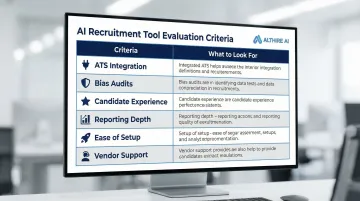
Use this evaluation framework when comparing AI recruitment platforms:
| Criteria | What to Look For |
|---|---|
| ATS Integration | Compatibility with your existing stack (Greenhouse, Lever, Ashby, Workable, BambooHR). AltHire AI supports 20+ integrations, most live within days. |
| Bias Audits | Transparent training data, independent audits, and demographic impact reports. Check compliance with laws like NYC Local Law 144, which mandates annual audits and public reporting. |
| Candidate Experience | Test the interface yourself. Is it mobile-friendly? Does it feel fair and transparent to candidates? |
| Reporting Depth | Look for question-by-question scores, dimensional breakdowns, and full interview records — not just pass/fail. |
| Ease of Setup | How quickly can your team go live? AltHire AI lets teams build and launch AI-powered interviews in under 10 minutes, with no dedicated HR tech staff required. |
| Vendor Support | Assess responsiveness, implementation help, and ongoing training before you sign. |
Step 4: Pilot, Measure, and Iterate
Don't overhaul everything at once. Start with a single stage — screening interviews are a natural first choice — and run a pilot on a subset of roles. Then:
- Compare results against your baseline metrics
- Gather feedback from both recruiters and candidates
- Identify gaps or friction points before scaling
- Expand to additional roles and stages once the process is validated
This phased approach limits risk and gives you real data to refine your rollout before committing fully.
Frequently Asked Questions
How is AI used in recruitment?
AI supports hiring across resume screening, candidate sourcing, interview scheduling, AI-conducted interviews, and post-interview analytics. It uses machine learning and natural language processing to automate repetitive tasks while keeping evaluation standards consistent.
What does an AI recruiter do?
An AI recruiter (or AI interview agent) independently screens candidates, conducts structured interviews with adaptive follow-up questions, evaluates responses against job-relevant criteria, and generates detailed scorecards. This enables hiring teams to assess more candidates faster without sacrificing quality or consistency.
Which AI tool is best for recruitment?
The best tool depends on your team's needs. Prioritize ATS compatibility, bias mitigation practices, reporting depth, and ease of implementation — then validate choices through pilot programs and customer references rather than marketing claims alone.
What is an ATS vs CRM?
An ATS (Applicant Tracking System) manages active applications and the hiring workflow, tracking candidates from application to offer. A CRM (Candidate Relationship Management) system handles proactive outreach and long-term engagement for passive candidates — two distinct tools that often work together in modern hiring stacks.
Can AI eliminate bias in hiring?
AI can reduce certain forms of unconscious bias by applying consistent, structured criteria across all candidates—but it is not inherently bias-free. AI tools must be trained on diverse data and regularly audited to ensure equitable outcomes. The EEOC applies Title VII disparate impact analysis to algorithmic tools, holding employers liable for discrimination even if caused by third-party software.
Is it legal to use AI in recruitment?
AI in hiring is legal but increasingly regulated. New York City's Local Law 144 requires bias audits for AI hiring tools. The EU AI Act classifies recruitment AI as "high-risk", mandating risk management and human oversight. Choose vendors transparent about their compliance practices and audit results.