
Introduction
Recruiting teams collect more hiring data than ever — application volumes, interview feedback, time-to-fill metrics, sourcing channel performance — but collecting data isn't the same as understanding it. According to SHRM's 2025 Recruiting Benchmarking Report, most companies still operate with low people analytics maturity, unable to turn raw hiring data into strategic decisions.
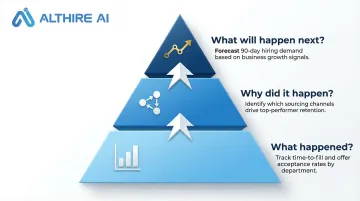
Talent acquisition analytics is the practice of collecting and interpreting hiring data to improve decisions — moving beyond simple reporting ("what happened") to explain "why" and predict "what's next."
This article covers what TA analytics is, why it matters to hiring outcomes and business performance, and the concrete steps to build a functioning analytics program — whether you're starting from scratch or maturing an existing approach.
Key Takeaways
- TA analytics transforms hiring data into strategic decisions — explaining why pipelines stall and predicting where they'll go next
- Organizations using analytics hire faster, reduce costs, and improve quality and retention
- Track time-to-fill, cost-per-hire, source of hire, quality of hire, and pipeline conversion rates
- Build your program with clean data, defined KPIs, integrated tooling, and regular reporting
- AI accelerates analytics by automating data collection, flagging patterns early, and generating interview-level candidate insights
What Is Talent Acquisition Analytics?
Talent acquisition analytics is the structured collection and interpretation of data across the recruiting lifecycle—from sourcing to onboarding—to uncover patterns, evaluate performance, and guide hiring strategy.
The key distinction from basic reporting: reporting tells you what happened (300 applications received last month), while analytics explains why it happened (job board X delivers 60% more qualified candidates than board Y) and what to do next (shift 40% of budget from Y to X).
TA analytics fits within the broader umbrella of HR analytics but focuses specifically on the hiring process, not employee lifecycle management. While HR analytics might track retention or engagement across the entire workforce, TA analytics zeroes in on sourcing effectiveness, interview quality, offer acceptance rates, and early new-hire performance.
From Reporting to Prediction: The Three Tiers
TA analytics operates at three progressive levels:
Operational/Descriptive — Applicant volume, time-to-fill, cost-per-hire pulled from an ATS. Most organizations still operate here, which means they can describe problems but not solve them.
Advanced/Analytical — Cross-source synthesis that answers questions like why offer acceptance rates drop in Q3 or why 90-day retention differs by department. Requires connecting ATS data with HRIS and performance systems.
Predictive — Historical modeling to forecast staffing needs, assess candidate success likelihood, and identify optimal sourcing channels before a role even opens. This is where TA shifts from firefighting to planning.
Why Your Organization Needs Talent Acquisition Analytics
Poor hiring decisions carry measurable financial and operational consequences. Unfilled roles slow business output, bad hires incur replacement costs averaging 50-60% of an employee's annual salary, and slow processes lose top candidates to competitors. SHRM's 2025 Recruiting Benchmarking Report found that extra-large organizations (5,000+ employees) average 60+ days to fill roles—20 days longer than smaller firms—due to complex approval layers and recruiter workloads averaging 60 requisitions per person.
Data-driven TA delivers strategic advantages:
- Faster time-to-fill by pinpointing bottlenecks in your approval workflows or interview scheduling
- Improved hire quality through evidence-based candidate evaluation rather than gut instinct
- Fairer hiring through bias detection in sourcing and screening data
- Better workforce planning through proactive talent pipeline management
Each of these advantages compounds over time. Companies using analytics identify their highest-performing sourcing channels, cut wasted spend, and build candidate experiences that lift offer acceptance rates. Organizations that act on hiring data consistently outpace those still making decisions by intuition alone.
Key Metrics to Track in Talent Acquisition Analytics
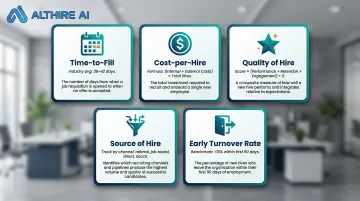
Time-to-Fill vs. Time-to-Hire
These metrics measure different parts of your hiring process:
- Time-to-Fill: Requisition approval to offer acceptance. Measures internal process efficiency.
- Time-to-Hire: Candidate enters pipeline to offer acceptance. Measures candidate experience and how quickly your team responds.
According to iCIMS, organizations frequently conflate these metrics, making it impossible to isolate internal bottlenecks from candidate-facing delays. Track both using ATS timestamps to diagnose whether your problem is slow approvals, extended interview loops, or candidate drop-off.
Benchmark: The median time-to-fill is 44-45 days across executive and non-executive roles, but technical roles consistently take 10-20 days longer, averaging 88 days for technical positions.
Cost-Per-Hire
Calculate cost-per-hire by dividing total recruiting costs by number of hires in a given period. It covers:
- Advertising spend and job board fees
- Recruiter time and agency fees
- Assessment tools and onboarding costs
A high cost-per-hire signals inefficiency in sourcing or process length. Track it by department and role type to pinpoint where you're overspending. If your engineering cost-per-hire is 3x your sales cost-per-hire, investigate whether technical sourcing channels are overpriced or whether extended interview loops are driving up recruiter hours.
Quality of Hire and Offer Acceptance Rate
Quality of hire is a composite metric measured at 90 days or one year using:
- Performance ratings from managers
- Hiring manager satisfaction scores
- New hire retention rate
Quantifying it is difficult precisely because it requires linking ATS data with performance management systems — two tools that rarely talk to each other by default.
Offer acceptance rate measures the percentage of offers accepted. A declining rate signals compensation misalignment, slow processes, or weak employer brand. If your acceptance rate drops from 85% to 70%, investigate whether competitors are moving faster or offering better packages.
Source of Hire and Pipeline Conversion Rate
Source of hire identifies which channels—job boards, referrals, LinkedIn, agencies—produce the best candidates per dollar spent. Track both volume and quality by source. If referrals generate 30% of your hires but only 10% of your applications, they're your highest-converting channel.
Pipeline conversion rate measures the percentage of candidates advancing through each stage. Use it to identify where candidates disengage or where evaluators create drag. If 60% of candidates drop off between phone screen and technical interview, your process may be too slow or your technical bar unclear.
Diversity Hiring Metrics and Early Turnover Rate
Diversity data tracks the demographics of applicants, candidates, and hires to surface bias in the funnel. If your applicant pool is 40% women but only 20% reach final interviews, investigate whether screening criteria introduce bias.
Early turnover rate (90-day or one-year) is a lagging indicator of sourcing, screening, and onboarding quality. High early turnover points to misaligned expectations or poor cultural fit — problems that start in the hiring funnel, not on day 30. Tracking both metrics together gives you the full picture: who you're bringing in, and whether they're staying.
Best Practices to Build Your TA Analytics Program
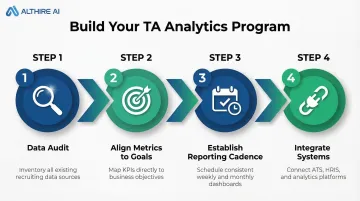
Start with a Data Audit Before Buying Tools
Map what data you already have, where it lives (ATS, HRIS, payroll, surveys), who owns it, and whether it's clean and consistently structured. Incomplete or inconsistent data produces misleading conclusions—bad data is worse than no data.
Check whether your ATS captures consistent timestamps for each hiring stage, whether job requisition data includes department and role type, and whether offer data includes compensation details. If half your roles lack department tags, your cost-per-hire by department analysis will be meaningless.
Align Metrics to Business Goals, Not Vanity Tracking
The right KPIs depend entirely on what the business is trying to achieve:
- A scaling startup prioritizes time-to-fill and cost efficiency
- An enterprise may focus on quality of hire and workforce planning
- A company facing retention issues tracks early turnover and hiring manager satisfaction
Involve hiring managers and business leaders in metric selection so analytics answers questions decision-makers actually have. Don't track metrics just because they're easy to pull from your ATS.
Establish a Reporting Cadence and Assign Ownership
Structure your reporting rhythm:
- Weekly operational checks: Open roles, pipeline velocity, bottlenecks
- Monthly trend analysis: Source performance, conversion rates, cost trends
- Quarterly strategic reviews: Quality of hire, DEI progress, workforce planning
Without clear ownership, dashboards go unread and insights go unacted upon. Assign a TA analyst or recruiting operations lead to own reporting, interpret trends, and present recommendations to stakeholders.
Invest in Data Integration Across Systems
Leading organizations pull data from ATS, HRIS, CRM, performance management, and operational systems to build a full picture of TA's impact. Manual exports create friction that causes most analytics programs to stall.
AltHire AI, for example, integrates with 20+ ATS platforms including Greenhouse, Lever, Ashby, Workable, and BambooHR, consolidating candidate journey data automatically. When interview results, feedback, and proctoring data sync directly into your ATS, you eliminate manual data entry and cut the errors that corrupt analytics.
Iterate and Build Toward Predictive Capability
Your analytics program should evolve in stages. Start with operational metrics, build the discipline to act on insights, then layer in advanced and predictive analytics as data quality and team fluency improve.
The most common mistake is deploying a sophisticated predictive model before the foundational reporting layer is reliable. If your team doesn't trust basic time-to-fill data, they won't trust a machine learning model forecasting hiring needs six months out.
How AI Is Elevating Talent Acquisition Analytics
AI compresses the gap between data collection and insight generation. Where traditional reporting required manual data pulls and analyst interpretation, AI-powered tools automatically surface anomalies, flag bottlenecks, and generate recommendations in real time.
Interview-Level Analytics Traditional ATS Can't Capture
AI interview platforms generate structured scoring data, sentiment and competency signals, and comparative candidate evaluations at scale—turning what was historically a subjective, undocumented process into a rich data source.
AltHire AI's platform, for example, captures:
- Multidimensional performance scores across customizable evaluation criteria
- Question-by-question scoring with AI flags for suspicious activity
- Behavioral analysis based on response patterns
This creates structured, auditable insights from every interview — extending analytics beyond the pipeline into the actual assessment stage. With 350+ weekly interviews and 100% AI proctoring, the platform generates comparable data across all candidates that traditional processes cannot match.
Predictive Analytics Enabled by AI
Machine learning models trained on historical hiring data can:
- Predict future staffing needs based on business growth patterns
- Flag high-risk attrition in the new hire cohort
- Recommend sourcing channels most likely to yield high performers for specific roles
- Score candidates by predicted on-the-job performance, ranked by role-fit probability
The practical shift is significant. Rather than scrambling to fill open roles, TA teams can anticipate needs and build pipelines before requisitions open.
Auditing for Bias at Scale with Structured Evaluation
AI-driven, structured evaluation models create consistent scoring criteria across all candidates, making it possible to audit for bias at scale—something manual hiring processes cannot do. When every candidate for a role is evaluated against identical criteria with consistent scoring methodology, you can identify whether certain demographic groups are systematically scored lower and investigate why.
The key is choosing tools designed with bias-mitigation guardrails, not just AI for automation's sake. AltHire AI's structured evaluation model scores every candidate against the same defined criteria — skill demonstration, role-specific competencies, and response quality — with transparent, auditable scoring that gives hiring teams a defensible record of how decisions were made.
Frequently Asked Questions
What is the role of analytics in talent acquisition?
Analytics transforms raw hiring data into decisions TA teams can act on—helping them identify inefficiencies, measure effectiveness, plan workforce needs ahead of demand, and demonstrate recruiting's business value.
What does a talent acquisition analyst do?
A TA analyst collects, manages, and interprets recruiting data to identify trends and track KPIs. They build dashboards and translate findings into strategic recommendations for recruiting leaders and business stakeholders.
What are the 5 pillars of talent acquisition?
The five pillars are:
- Sourcing
- Recruitment marketing
- Candidate assessment and selection
- Employer branding
- Onboarding
Analytics cuts across all five to measure and improve performance in each area.
What is the difference between an ATS and a CRM?
An ATS (Applicant Tracking System) manages active applicants through the hiring pipeline, while a CRM (Candidate Relationship Management) system manages passive talent and long-term pipeline relationships. Both generate valuable TA analytics data.
What metrics should I start with if I'm new to talent acquisition analytics?
Start with three foundational metrics—time-to-fill, cost-per-hire, and source of hire. These are measurable from most ATS systems right away and create the baseline needed to spot where your process is losing time or money.
How do you measure quality of hire?
Quality of hire is typically measured at 90 days or one year using a composite of new hire performance ratings, hiring manager satisfaction scores, and retention rate. It requires connecting ATS data with performance management data.