Introduction
AI adoption in recruitment has crossed a tipping point. According to SHRM's 2025 survey, 51% of organizations now use AI in their recruiting efforts, primarily for administrative tasks like writing job descriptions and screening resumes. The question is no longer whether to use AI, but how the roles around it are evolving.
Many fear AI will replace recruiters entirely. The reality is more specific: AI is rewriting what recruiters actually do and creating entirely new responsibilities. While automation handles high-volume, repetitive tasks, the recruiter's role is shifting toward strategy, relationship management, and AI oversight. This article examines what those shifts look like — and what they mean for talent teams in 2026.
Key Takeaways
- AI handles high-volume screening and scheduling; recruiters focus on strategy and judgment
- Recruiter roles now center on relationship management, strategic decisions, and AI oversight
- Skills-first hiring is replacing resume-centric evaluation through AI-powered assessments
- Candidate trust and transparency have become competitive differentiators
- Pairing AI efficiency with human judgment consistently outperforms full automation
The 5 Key AI and Recruitment Trends Defining 2026
2026 marks a shift from AI experimentation to operational deployment. These five trends are shaping that transition across the talent acquisition landscape.
Trend 1: Autonomous AI Agents Are Taking Over the Top of the Funnel
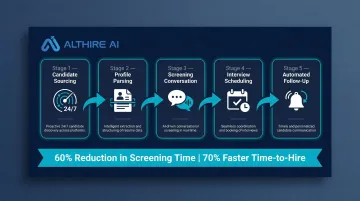
Unlike single-purpose tools, autonomous AI agents act independently: sourcing candidates 24/7, parsing profiles, running structured screening conversations, scheduling interviews, and sending follow-ups without constant human prompts. The vendor market reflects the demand — by late 2025, CB Insights tracked over 1,700 AI agent companies, and G2 established a dedicated "AI Recruiting" category with 114 product listings by early 2026.
Real-world adoption proves the value. Unilever's widely cited case study reported saving 100,000 recruiter hours annually using AI automation, cutting approximately $1 million in recruitment costs. Platforms like AltHire AI exemplify this shift, delivering AI-powered interview agents that conduct adaptive, human-like screening interviews around the clock and removing the bottleneck at the top of the funnel. AltHire's customers report 60% reduction in screening interview time and 70% faster time-to-hire.
According to Korn Ferry's TA Trends 2026 report, 52% of talent leaders plan to add autonomous or agentic AI to their teams in 2026. The driver is practical: lower cost-per-hire, faster time-to-fill, and recruiter bandwidth redirected toward higher-value work.
Trend 2: The Recruiter Role Is Being Promoted, Not Eliminated
What's actually disappearing is the administrative, transactional version of the recruiter's job: manual CV screening, inbox chasing, repetitive scheduling. Recruiters aren't being replaced; they're being freed from busywork.
The recruiter's role is shifting toward higher-order work. Today's talent professionals are expected to interpret AI outputs, advise hiring managers, manage complex candidate negotiations, and own AI governance decisions. Korn Ferry's research found that 73% of talent leaders say the skill they need most in 2026 is critical thinking and problem-solving — not AI certification.
When automation absorbs throughput work, recruiter value shifts from volume to quality of judgment. LinkedIn's Future of Recruiting 2025 survey found that recruiting teams integrating generative AI save approximately 20% of their work week — roughly one full business day. This creates strategic capacity that didn't exist before.
Trend 3: Skills-First Hiring Is Displacing the Resume
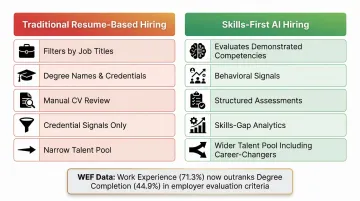
AI is enabling a structural shift in evaluation. Instead of filtering on job titles and degree names, AI can assess demonstrated skills, behavioral signals, and role-specific competencies at scale.
A 2023 World Economic Forum survey of 803 companies found that employers now prioritize evaluating work experience (71.3%) and proprietary skill assessments (46.9%) over university degree completion (44.9%). Employer confidence in traditional credentials as capability indicators has been eroding for years.
Structured AI-led assessments, competency-based screening rubrics, and skills-gap analytics are replacing resume review as the primary shortlisting tool in high-volume and early-career hiring. Analysis by Lightcast of over 51 million job postings found that between 2017 and 2019, 46% of middle-skill occupations and 37% of high-skill occupations saw reductions in stated educational requirements.
Skills-first hiring widens the talent pool and surfaces candidates who would previously have been screened out — particularly career-changers, nontraditional learners, and return-to-work candidates.
Trend 4: Candidate Trust and Transparency Have Become Competitive Differentiators
A trust crisis exists. Pew Research Center's 2023 survey of 11,004 U.S. adults found that 66% of candidates would not want to apply for a job that uses AI to help make hiring decisions. This represents a significant barrier to AI adoption.
Leading companies are responding proactively:
- Communicating clearly how AI is used at each hiring stage
- Delivering personalized feedback at scale
- Keeping humans visibly accountable for final decisions
- Publishing evaluation criteria so candidates understand how they're assessed
Greenhouse's 2025 survey found that 87% of U.S. job seekers consider it important for employers to be transparent about their use of AI. Organizations that provide this transparency are building competitive advantage in talent markets.
Trend 5: AI Governance and Regulatory Compliance Are Now Operational Priorities
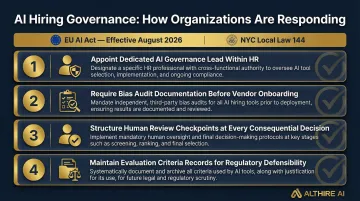
Key legislation is forcing organizations to document, audit, and justify automated hiring decisions. The EU AI Act classifies hiring AI as "high-risk," with rules coming into full force by August 2, 2026. NYC Local Law 144 requires bias audits, with enforcement that began July 5, 2023.
Organizations are responding by:
- Appointing dedicated AI governance leads within HR
- Requiring bias audit documentation before onboarding new vendors
- Structuring human review checkpoints at every consequential hiring decision
- Maintaining clear records of evaluation criteria for regulatory defensibility
Aptitude Research's 2025 study found that 27% of organizations using AI are specifically using it to address bias, with regular audits becoming common practice.
What's Driving These AI Recruitment Trends
Technology Maturation
Conversational AI, voice AI, and large language models have crossed a capability threshold. They can now handle structured screening conversations, follow up on ambiguous answers, and produce evaluator-ready candidate summaries—tasks that required humans just two years ago. Multiple vendor and industry forecasts project that by 2026–2027, voice AI could handle 60% to 80% of initial screens in high-volume recruiting.
Volume and Cost Pressure
AI usage in recruiting has roughly doubled in adoption rate in a short period, driven by hiring teams needing to handle more applicants with flat or shrinking headcount. SHRM's 2025 Recruiting Executives Benchmarking report found that median cost-per-hire for executive roles reached $10,625 in 2025—a 21% increase from 2022. That trajectory gives talent acquisition leaders little choice but to pursue efficiency gains through automation.
The Candidate AI Arms Race
Candidates now use AI to draft resumes, cover letters, and interview responses at scale. ResumeBuilder research found that 18% of applicants use AI-generated application materials. Traditional screening signals become less reliable as a result, pushing employers toward AI-driven assessment methods that evaluate actual skills rather than polished documents.
Competitive Urgency
Organizations that hire faster win better talent in tight markets. The data on candidate drop-off is clear. According to the 2023 Talent Board/CandE Benchmark Research, the top two reasons candidates withdraw are:
- Their time was not respected during the process
- The hiring process took too long
SmartRecruiters' 2025 benchmarks found that companies using AI in recruiting were 26% faster, saving an average of 11 days in time-to-hire.
How These Trends Are Reshaping Recruitment
The combined effect of these trends is measurable across three dimensions: operations, business outcomes, and workforce structure.
Operational Impact
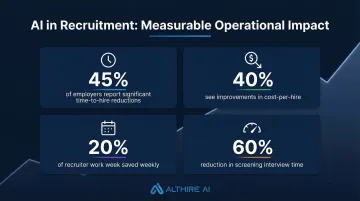
Efficiency gains are real — but only when AI is paired with workflow redesign:
- Faster hiring cycles: 45% of employers using AI report significant reductions in time-to-hire
- Cost improvements: 40% see improvements in cost-per-hire
- Recruiter time savings: Approximately 20% of a recruiter's work week saved (one full business day)
- Screening efficiency: AltHire AI, for example, reports a 60% reduction in screening interview time, 33+ recruiter hours saved weekly, and 70% faster time-to-hire
Adding AI without restructuring how work gets done often increases costs and complexity rather than reducing them. Aptitude Research found that 72% of organizations reported reducing investment in HR technology because of an inability to demonstrate measurable ROI.
Business Impact
AI is shifting talent acquisition from a support function to a strategic capability. Predictive analytics on pipeline health, skill gap forecasting, and quality-of-hire tracking are now achievable at scale, which changes how TA leaders make the case to executive stakeholders.
Most organizations aren't there yet. Phenom's research found that 83% of organizations remain in the lowest tiers of AI maturity — so the competitive advantage for those who execute well is still wide open.
Workforce Impact
The recruiter job description is being rewritten in real time:
- Digital fluency and data interpretation
- AI supervision and output evaluation
- Candidate advisory and relationship management
- Workforce planning and strategic consultation
Korn Ferry's TA Trends 2026 flags a looming "Pipeline Crisis," noting that 37% of companies replacing roles with AI are targeting entry-level positions. When those early-career recruiting roles disappear, so do the internal pathways that develop future HR and TA leaders. That's a structural risk most organizations haven't factored in yet.
Risks and Realities Organizations Can't Afford to Ignore
AI Doesn't Remove Bias — It Can Amplify It
When models train on historically skewed hiring data, they encode — and often amplify — the same biases organizations are trying to eliminate. Responsible AI deployment requires structured rubrics, consistent questioning, diverse training data, and human review at every decision point.
The legal stakes are real. The EEOC's 2023 settlement with iTutorGroup for $365,000 came after the company's recruiting software automatically rejected applicants above certain ages, affecting over 200 candidates.
Most Executives Aren't Ready to Govern AI in HR
Buying the tools is the easy part. According to Mercer's Global Talent Trends research, more than half of executives and managers lack a clear, measurable AI vision — and only a quarter of HR processes are simple or digital enough to support AI integration.
That gap between tool investment and governance readiness leads to failed rollouts and wasted budget, not transformation.
Removing Human Touchpoints Costs You Candidates
Each of these risks compounds the last. Even when bias and governance are handled well, over-automating the candidate experience introduces a third failure mode.
Korn Ferry research found that 40% of talent specialists worry AI makes hiring feel cold and impersonal. Top candidates — the ones with options — disengage quickly when a process feels purely transactional. Preserving human touchpoints at key moments isn't sentiment; it's competitive strategy.
Future Signals for AI in Recruitment
The trends covered here will continue to compound. Organizations should watch these developments in the next 1–3 years:
Voice AI Moving from Pilot to Mainstream
Expert forecasts point to the majority of high-volume hiring starting with an AI-powered voice screen in the near term. Candidate acceptance is the variable to track — currently, only 8% of candidates believe AI makes hiring fairer, with trust especially low among Gen Z.
Acceptance improves significantly when organizations follow three practices:
- Disclose AI involvement upfront and clearly
- Keep AI-led screens under 15 minutes
- Guarantee a human touchpoint later in the process
AI maturity is becoming a talent brand signal. As candidates grow more sophisticated about how hiring AI works, organizations with transparent, well-governed processes will attract stronger applicants. Expect AI governance — think job postings that disclose which tools are used and how decisions are made — to appear in employer value propositions within the next two years.
Regulation will tighten globally. New jurisdictions are moving toward bias audit requirements and AI transparency mandates, following the lead of early movers like New York City's Local Law 144. Organizations that build governance infrastructure now will face lower compliance costs and reputational risk in 2027 and beyond.
Conclusion
In 2026, AI has fundamentally changed what recruiting work looks like. The administrative throughput that once defined the role — screening hundreds of résumés, scheduling rounds, chasing feedback — is largely automated. What remains is higher-stakes work: advising hiring managers, reading candidate intent, and making judgment calls that no model can reliably replicate.
The organizations pulling ahead aren't necessarily the ones with the most AI in their stack. They're the ones that know where human judgment matters most and protect space for it.
Winning the talent market in 2026 comes down to a deliberate choice: use AI to eliminate friction, then trust your recruiters to do the rest. That means:
- Clear governance over where AI decisions require human review
- Recruiters focused on advisory and relationship work, not process management
- Hiring outcomes measured on quality and fit, not just speed
The technology is ready. The question is whether the people and processes around it are.
Frequently Asked Questions
Are recruiters going to be replaced with AI?
AI automates specific tasks—not the recruiter role itself. The recruiters being displaced are those who refuse to evolve, not those who learn to work alongside AI tools effectively. The role is being elevated, not eliminated.
What tasks can AI currently automate in the recruitment process?
AI handles the high-volume, repetitive work — freeing recruiters for strategy and relationship management:
- Resume parsing and triage
- Structured screening interviews
- Interview scheduling
- Candidate communication and follow-up
- Pipeline analytics
How do companies prevent AI from introducing bias into hiring decisions?
Four safeguards make the biggest difference:
- Use job-related structured rubrics for evaluation
- Audit outcomes regularly for demographic disparities
- Keep humans accountable for final hiring decisions
- Work only with vendors who provide explainability and audit trails
What skills do recruiters need to stay relevant in an AI-first hiring environment?
Judgment and strategy matter more than technical AI knowledge. The skills that keep recruiters indispensable:
- Evaluating and challenging AI outputs critically
- Managing candidate relationships with nuance
- Advising on talent strategy and workforce planning
- Knowing when to override AI recommendations
Is AI-powered interviewing fair to candidates?
Fairness depends on implementation. Structured AI interviews using consistent, role-relevant questions can reduce human bias, but only when paired with clear rubrics, transparency about the process, and accessible alternatives for candidates who need them.
How should a company get started with AI in recruitment without overwhelming their team?
Start with a focused pilot: identify the single biggest time drain (scheduling, screening, or triage), automate that workflow end-to-end for one role family, measure the impact, and expand only when outcomes are clear.