Introduction
The enterprise talent landscape in 2026 is defined by severe scarcity and escalating costs. 72% of employers globally report difficulty finding the talent they need — a figure that has more than doubled since 2015.
The financial burden has intensified alongside it: executive cost-per-hire reached $10,625 in 2025 (a 113% increase from 2017), while every open position costs organizations between $4,000 and $9,000 monthly in lost productivity.
Manual recruitment processes are breaking under this pressure. Enterprises managing hundreds of requisitions across multiple geographies face extended vacancy periods, recruiter burnout, and mounting agency fees. Systematic automation is how leading teams are cutting through the backlog.
This guide delivers a practical roadmap for enterprise talent acquisition automation in 2026: defining the concept, identifying which stages to automate first, building an integrated tech stack, implementing a phased rollout, and measuring ROI with precision.
Key Takeaways
- Talent acquisition automation uses AI and software to eliminate manual steps across sourcing, screening, interviewing, and onboarding
- Enterprise teams report up to 50% reductions in time-to-hire when AI automates screening and scheduling
- AI interview automation now handles 24/7 candidate evaluation without scheduling friction — cutting time-to-hire by up to 50% and cost-per-hire by 20–40%
- Phased implementation starting with high-volume, low-complexity tasks reduces risk and accelerates adoption
What Is Enterprise Talent Acquisition Automation — and Why 2026 Is the Tipping Point
Enterprise talent acquisition automation uses AI, machine learning, and integrated software to handle repetitive, high-volume hiring tasks across the full funnel — from sourcing and screening through to onboarding. At enterprise scale, that scope demands a fundamentally different approach than what most organizations built even two years ago.
The 2026 Shift: From ATS Workflows to Agentic AI
What makes 2026 different is the shift from single-point ATS automation to full-funnel agentic AI. Rather than tracking applications and scheduling interviews, autonomous systems now conduct interviews, evaluate candidates against structured rubrics, and generate hiring recommendations with minimal human intervention at each step.
The adoption numbers reflect this shift: AI usage in HR surged from 26% to 43% in a single year, with 78% of enterprise organizations now deploying AI in recruitment. That's not incremental adoption — it's a structural change in how large organizations hire.
Why Enterprises Need Automation More Than SMBs
The complexity that makes automation critical for enterprises versus small businesses includes:
- High hiring volumes across multiple locations and business units
- Stringent compliance requirements including EEOC, GDPR, and the EU AI Act's high-risk classification for recruitment AI
- Complex ATS ecosystems requiring multiple integrations and bidirectional data sync
- High cost of failure — a single mis-hire or delayed executive placement can run into hundreds of thousands in lost productivity and re-hiring costs
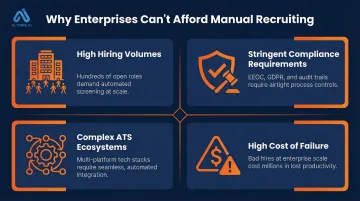
At enterprise scale, manual processes amplify every one of these risks. Delays that a small business absorbs become recruiting backlogs that stall product launches, customer commitments, and revenue targets.
The Key Stages of Enterprise Talent Acquisition to Automate
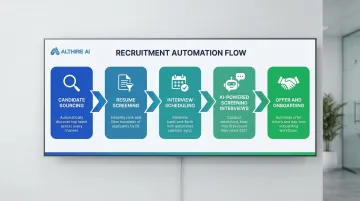
Candidate Sourcing and Pipeline Building
AI-powered sourcing tools automatically scan job boards, LinkedIn, and internal talent pools to match candidate profiles to job descriptions based on skills, experience, and cultural signals. This eliminates manual Boolean searches and reduces sourcing time by up to 75%.
CRM-based automation extends this capability through:
- Automated outreach sequences with personalized messaging at scale
- Re-engagement of silver-medal candidates from prior pipelines
- Passive candidate nurturing without recruiter intervention
Resume Screening and Application Management
Applicant Tracking Systems automate resume parsing and candidate shortlisting based on pre-defined criteria, reducing manual review time while standardizing screening across roles and geographies.
The limitation: ATS keyword screening can miss strong candidates whose resumes don't match exact terminology. AI-layered screening that evaluates context, transferable skills, and potential—not just keyword matches—is becoming the preferred enterprise approach because it surfaces overlooked talent.
Interview Scheduling Automation
Automated scheduling tools remove the coordination overhead of manual interview booking by letting candidates self-select from available time slots that sync directly with recruiter and hiring manager calendars. Recruiters spend 38% of their time on interview scheduling, taking an average of 243 minutes per candidate manually versus 27 minutes with AI—a 9x speed improvement.
These tools integrate directly with the ATS to advance candidates through pipeline stages automatically.
AI-Powered Screening Interviews at Scale
Asynchronous and AI-driven interview tools conduct first-round screening interviews—asking adaptive, role-specific questions and evaluating responses—around the clock, enabling 24/7 hiring across time zones. That availability frees recruiters from the first-round scheduling burden that typically consumes more than a third of their working week.
Offer and Onboarding Automation
Automation carries momentum beyond the hire decision. Post-offer workflows typically cut manual HR administrative burden by 50% or more. Key capabilities include:
- Auto-generated conditional offer letters triggered by hiring manager approval
- E-signature workflows and digital document collection
- Compliance checks embedded into the offer process
- Structured onboarding task sequences for new hires and HR teams
AI-Powered Interview Automation: The Enterprise Efficiency Multiplier
The Interview Bottleneck
The interview stage is the single biggest bottleneck in enterprise hiring. Recruiters spend 38% of their time on interview coordination, with 46% of a recruiting coordinator's time consumed by admin-related scheduling tasks. An AI-enabled coordinator can handle approximately 158 interviews per week compared to roughly 30 manually—a 5x capacity multiplier.
How AI Interview Agents Work
Conversational AI conducts adaptive, human-like interviews by generating follow-up questions based on each candidate's responses, evaluating answers against structured rubrics, and scoring candidates objectively—available 24/7 without scheduling constraints.
AltHire AI delivers this capability at scale, conducting 350+ weekly AI-powered interviews with adaptive questioning across technical, functional, and creative roles. The platform converts job descriptions into role-specific questions and evaluation criteria in under 10 minutes.
That speed and scale only holds up if the process stays fair and tamper-resistant. That's where AI proctoring comes in.
AI Proctoring: Ensuring Interview Integrity at Enterprise Scale
AI proctoring maintains assessment fairness through:
- Biometric verification using real-time face comparison and spoof detection
- Behavior monitoring including eye movement analysis, audio anomaly detection, and multi-screen flagging
- Impersonation prevention via continuous identity verification and random photo captures
- Audit trails with timestamp-specific incident logging and evidence compilation
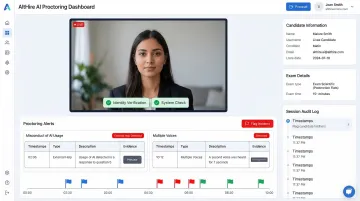
Every interview produces a defensible record — a practical requirement for enterprises managing legal and regulatory compliance at scale.
Structured Scorecards That Drive Faster Decisions
AI-generated reports replace inconsistent recruiter notes with structured scorecards featuring:
- Dimensional performance scores across customizable criteria
- Question-by-question evaluation with precise scores
- Skill matching metrics showing required versus demonstrated competencies
- Complete video recordings and time-stamped transcripts
- Comprehensive proctoring details and integrity flags
That consistency matters most when hiring managers are comparing 20+ candidates across multiple interviewers — objective data replaces gut feel.
Bias Reduction and DEI Support
Structured AI evaluation models and objective scoring eliminate unconscious bias that enters human-led interviews—including affinity bias, halo effect, and confirmation bias. Research shows unstructured human interviews carry high bias (effect size d=0.59), while structured interviews reduce this to d=0.23.
When AI focuses on job-relevant skills rather than demographic signals, diversity outcomes improve. Unilever saw a 16% increase in diversity hires after deploying AI assessments, while also saving 50,000 recruiter hours and £1 million annually.
Building Your Enterprise TA Automation Tech Stack
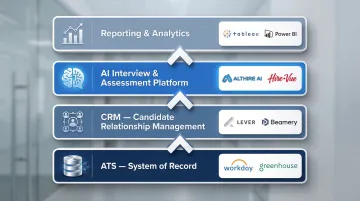
The Four Core Technology Layers
Every enterprise TA automation stack requires:
| Layer | Purpose | Example Tools |
|---|---|---|
| ATS (System of Record) | Application tracking, pipeline management, compliance documentation | Workday, iCIMS, Greenhouse, SmartRecruiters |
| CRM (Candidate Relationship Management) | Passive candidate nurturing, talent pool engagement, outreach automation | Lever, SmartRecruiters CRM, Beamery |
| AI Interview & Assessment Platform | Structured evaluation, adaptive interviews, objective scoring | AltHire AI, HireVue |
| Reporting & Analytics Layer | Funnel visibility, KPI tracking, decision intelligence | Built-in ATS analytics, Tableau, Power BI |
Enterprise-Grade Integration Requirements
When evaluating any TA automation tool, apply these integration criteria:
- Native ATS integrations with 20+ platforms including Greenhouse, Lever, Ashby, Workable, BambooHR
- Bidirectional data sync ensuring candidate data, interview scores, and reports flow automatically
- Webhook support for real-time event triggers and workflow automation
- SSO/SAML authentication for secure, centralized access management
- Role-based access controls enabling granular permissions across departments
AltHire AI covers all five of these criteria natively, with most ATS integrations live within a few days.
Compliance and Security Criteria
Integration capability alone isn't enough — verify these compliance and security requirements before committing to any platform:
- Audited security controls confirmed by SOC 2 certification
- Documented GDPR/CCPA compliance covering data handling and privacy
- Multi-region deployment support for global hiring operations
- Complete audit logging for activity trails and compliance reviews
A Phased Implementation Roadmap for Enterprise Teams
Phase 1 — Audit and Map (Weeks 1-2)
Conduct a full audit of your current recruitment workflow:
- Document every manual touchpoint and handoff between systems
- Measure average time spent per stage
- Quantify volume handled at each step
- Identify the highest-friction stages consuming the most recruiter time
This baseline measures automation ROI and pinpoints exactly where to focus first.
Phase 2 — Start with High-Volume, Low-Complexity Automation (Weeks 3-6)
Begin with resume screening (ATS configuration) and interview scheduling automation—changes that deliver immediate time savings with minimal disruption to existing workflows.
Proving ROI at this stage builds internal stakeholder buy-in for more advanced AI adoption. Companies using AI recruiting tools report 26% faster hiring cycles, saving approximately 11 days on average.
Phase 3 — Layer in AI Interview Automation (Weeks 7-12)
With Phase 2 ROI validated, you have the internal momentum to go further. Introduce AI-powered screening interviews at the top of the funnel, replacing or supplementing first-round recruiter phone screens.
Platforms like AltHire AI enable interview creation in under 10 minutes, lowering the barrier to deployment. Set clear candidate communication norms and feedback loops during rollout to maintain candidate experience quality.
Phase 4 — Measure, Optimize, and Expand (Ongoing)
After initial automation is live, run a 30-60-90 day review of key metrics:
- Time-to-fill reduction
- Cost-per-hire savings
- Recruiter capacity gains
- Candidate satisfaction scores
Use these results to identify remaining bottlenecks and expand automation into offer and onboarding workflows. Keep human judgment at final-stage decisions—automation handles volume; people handle relationships.
Measuring ROI: KPIs Every Enterprise TA Team Should Track
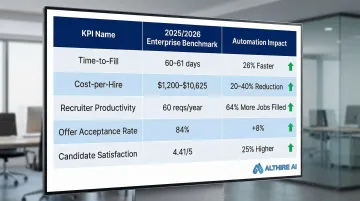
Tracking the right metrics is what separates automation investments that get renewed from ones that get cut. Here are the benchmarks enterprise TA teams are measuring against in 2025–2026 — and what automation actually moves.
Core Hiring Metrics That Quantify Automation Impact
| KPI | 2025/2026 Enterprise Benchmark | Automation Impact |
|---|---|---|
| Time-to-Fill | 60-61 days for extra-large orgs (SHRM, 2025) | 26% faster hiring cycles (saving ~11 days) |
| Cost-per-Hire | $1,200 non-exec / $10,625 exec (SHRM, 2025) | 20-40% lower cost-per-hire when AI automates screening and scheduling |
| Recruiter Productivity | 60 requisitions per recruiter annually in extra-large orgs (SHRM, 2025) | 64% more jobs filled and 33% more candidates submitted per recruiter |
| Offer Acceptance Rate | ~84% average (Gem, 2025) | 8% increase due to faster, structured processes |
| Candidate Satisfaction | 4.41/5 average pulse score (Candidate.fyi, 2026) | 25% higher satisfaction for companies using recruitment automation |
Once you have your baseline numbers, translating them into a business case for leadership is straightforward. Use this framework to put a dollar figure on your automation investment:
Building an Automation ROI Business Case
- Time saved per recruiter per week (for example, 33 hours saved from interview automation)
- Multiply by hourly cost (average recruiter salary ÷ 2,080 annual hours)
- Add cost-per-hire reduction (20-40% savings × number of annual hires)
- Compare against platform licensing cost
The numbers from early adopters validate this math. Emirates NBD saved 8,000 recruiter hours and $400,000 while cutting time-to-offer by 80%. Hipages reduced time-to-hire by 38% and saved $1.9M USD in agency fees across two fiscal years.
Frequently Asked Questions
What is enterprise talent acquisition automation?
Enterprise talent acquisition automation uses AI and integrated software to handle repetitive, high-volume hiring tasks across the full recruitment funnel—sourcing, screening, interviewing, and onboarding. It's built for the scale and complexity of large organizations managing hundreds of roles across multiple locations simultaneously.
How does AI reduce bias in the enterprise hiring process?
Structured AI evaluation models apply identical scoring criteria to every candidate, eliminating common biases like affinity bias and halo effect that creep into human-led processes. Built-in audit trails also document that evaluations were based on job-relevant skills, supporting DEI compliance requirements.
What is the difference between ATS automation and AI interview automation?
ATS automation manages applications, tracks pipeline stages, and schedules interviews. AI interview automation conducts adaptive, intelligent conversations with candidates, evaluates responses against structured rubrics, and generates objective scorecards. They are complementary layers: the ATS tracks workflow, while AI interview platforms deliver evaluation intelligence.
How long does it take to implement talent acquisition automation at an enterprise level?
A phased rollout typically takes 3-6 months from audit to full deployment. Basic scheduling and screening automation can go live in weeks, while comprehensive AI interview integration generally requires 8-12 weeks for enterprise-wide adoption.
What ROI can enterprises realistically expect from talent acquisition automation?
Documented outcomes include up to 50% reductions in time-to-hire, 20-40% cost-per-hire savings, and 64% more jobs filled per recruiter. AI recruitment tools generate an average ROI of 340% within 18 months. For organizations hiring 1,000+ roles annually, those figures typically translate to seven-figure cost savings.
How do AI interview platforms integrate with existing ATS systems?
Modern AI interview platforms use native ATS connectors and APIs to push candidate data, interview scores, and reports directly into the ATS. This eliminates manual data transfer—recruiters never leave their existing workflow. Most integrations complete in just a few days with no custom development required.