Introduction
Recruiters spend 80% of their time on administrative work—37 hours out of a 40-hour week—leaving just three hours for actual recruiting. Meanwhile, applications per recruiter have surged 93% since 2021, yet only 24% of organizations plan to add recruiter headcount in 2026. Something has to give.
That pressure shows up in the numbers: time-to-fill averages 44 days, costing organizations roughly $500 per day in lost productivity per open role. Meanwhile, 60% of candidates abandon lengthy applications, and 52% decline offers because of poor communication during the process.
This guide covers what automated recruiting actually is, which tasks deliver the highest ROI when automated, how the technology reduces bias rather than amplifying it, and how to know when your team is ready to make the shift.
Key Takeaways
- Automated recruiting handles sourcing, screening, scheduling, and interviewing — freeing recruiters to focus on relationships and final decisions
- Organizations using AI report 31% faster hiring times, with screening completing 75% faster and scheduling speeding up by 60%
- Companies achieve 30% lower cost-per-hire by cutting vacancy costs and reducing agency dependency
- Automation removes tedious work so recruiters can handle more requisitions without sacrificing quality
- Invest when your team misses hiring targets, drowns in open requisitions, or spends time on tasks automation handles faster
What Is Automated Recruiting?
Automated recruiting uses technology—from rule-based workflow tools to AI-powered platforms—to automate or eliminate manual steps across sourcing, screening, interviewing, and onboarding.
The spectrum ranges from basic automation (auto-reply emails, ATS keyword filters) to modern AI-driven systems. Legacy ATS platforms rely on keyword matching, while modern AI platforms use semantic context to match candidates based on qualifications not explicitly listed on resumes.
Today's tools don't just filter—they analyze, adapt, and generate insights.
What recruiting automation does NOT do:
- Make final hiring decisions
- Eliminate human judgment in relationship-intensive moments
- Fix broken hiring strategy through technology alone
Automation expands what recruiters can do—it doesn't replace what only they can do.
Automated Recruiting vs. Traditional Recruiting
Traditional recruiting is linear, manually intensive, and constrained by individual recruiter bandwidth. One recruiter can only screen so many resumes, conduct so many phone screens, and coordinate so many interview schedules in a day.
Automated recruiting works in parallel and scales without adding headcount. The same system can screen 500 resumes simultaneously, run initial interviews overnight, and coordinate scheduling across an entire candidate pipeline—all without human intervention.

The shift reallocates human effort:
- Less time on scheduling, resume sorting, and status updates
- More time on candidate relationships, employer branding, and hiring strategy
Recruiters become talent advisors rather than administrative coordinators.
Key Recruiting Tasks You Can Automate
Job Posting and Candidate Sourcing
Automation cuts manual posting from 15-20 minutes per job to under three minutes. Platforms distribute postings across multiple job boards simultaneously, parse inbound resumes, and surface passive candidates from talent databases.
Job boards and sourcing sites account for 50% of applications, so automated distribution ensures consistent visibility without manual effort. U.S. SMBs average approximately 180 applicants per hire—volume that demands automated intake.
Resume Screening and Candidate Ranking
Recruiters spend 30-90 seconds manually reviewing each resume, with an average first glance lasting 6-8 seconds. At 180 applicants per role, that's 5-9 hours of screening per position.
AI-powered screening analyzes resumes against job requirements and ranks candidates objectively. The technology addresses two problems: recruiters overwhelmed by application volume and inconsistent manual screening. A study of 80,000 resumes found applicants with white-sounding names got 50% more callbacks than those with Black-sounding names—bias that structured AI screening helps eliminate.
Interview Scheduling
Talent teams report spending 38% of their time scheduling interviews, with recruiting coordinators dedicating 46% of their hiring time to scheduling or fixing interviews. This administrative burden directly compresses hiring timelines: 60% of companies reported increased time-to-hire in 2024, with scheduling delays cited as a top bottleneck.
Automated scheduling tools eliminate calendar coordination by letting candidates self-select time slots. The result: 67% fewer candidates drop out when the process moves quickly.
AI-Powered Interviews
AI interview platforms conduct adaptive, structured interviews available 24/7. They ask role-specific questions, follow up based on responses, and generate evaluation reports—replacing screening calls that average 20-30 minutes each.
AltHire AI, for example, delivers conversational interviews that adapt in real time and produce detailed candidate analytics. Key capabilities include:
- Dimensional scoring and question-by-question evaluation
- Integrity monitoring with 100% AI proctoring
- Direct data flow into 20+ ATS platforms including Greenhouse, Lever, Ashby, Workable, and BambooHR
Candidate Communication and Status Updates
Automated messaging handles acknowledgments, status updates, and nurture sequences. This prevents the "black hole" candidate experience where applicants hear nothing after applying—a problem that causes 62% of candidates to lose interest after two weeks with no update.
Benefits and ROI of Automated Recruiting
Faster Time-to-Hire
The median time-to-fill is 44 days for nonexecutive positions, with extra-large organizations averaging 61 days. Every day a role sits vacant costs approximately $500 in lost productivity.
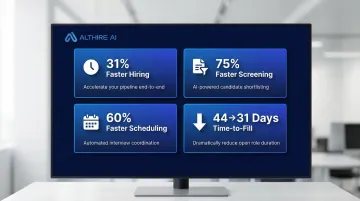
Organizations using AI report 31% faster hiring times, with interview scheduling speeding up by 60% and resume screening completing 75% faster. This compression happens at every stage: sourcing finds candidates faster, screening processes them instantly, scheduling eliminates delays, and AI interviews run 24/7.
Cost-per-Hire Reduction
The average cost-per-hire in the U.S. is $4,700 for nonexecutive roles. This includes agency fees, advertising, job board subscriptions, travel, relocation, recruiter salaries and benefits, and ATS costs.
AI recruiting tools reduce cost-per-hire by an average of 30% by cutting vacancy costs through faster sourcing and reducing agency dependency. When time-to-hire drops from 44 days to 31 days, you save $6,500 per role in vacancy costs alone—before counting reduced agency fees or recruiter time savings.
Higher Quality of Hire
Speed improvements matter less if you're hiring the wrong people faster. Structured interviews have higher validity than unstructured interviews, with research showing structured scoring increases predictive validity by more than 50%.
AI-scored interviews reduce unconscious bias and inconsistent evaluation. Each candidate faces the same core questions, scored against the same rubric—so the process identifies genuinely strong fits rather than the most familiar-seeming ones.
Recruiter Productivity Gains
AI saves recruiters an average of 2.5 hours per week, with some implementations reaching seven hours weekly. That recovered time compounds quickly across a full team.
The median requisition load is 20 per recruiter, ranging from 6 at small organizations to 60 at extra-large companies. Automation lets recruiters handle higher loads without sacrificing quality by redirecting saved time toward:
- Building stronger candidate relationships
- Collaborating with hiring managers on role strategy
- Improving offer conversion through personalized outreach
Improved Candidate Experience
Speed and communication consistency—both byproducts of automation—directly shape whether candidates accept or walk away. The drop-off data is stark:
- 60% of candidates abandon applications due to lengthy or complex processes
- 52% decline offers because of poor communication during hiring
The upside is equally clear. 66% of recent hires accepted offers because of an exceptional recruitment experience, and 76% say a positive hiring process directly influenced their decision to accept. Automation delivers that experience through instant acknowledgments, transparent timelines, and faster decisions.
Common Misconceptions About Recruiting Automation
"Automation Will Eliminate Recruiting Jobs"
Sales automation didn't eliminate salespeople. Marketing automation didn't eliminate marketers. AI will augment 20% of jobs over the next five years rather than eliminating roles, making upskilling essential.
Automation takes over low-skill, repetitive tasks—allowing recruiters to focus on strategic, relationship-driven work requiring human judgment. In marketing and sales, a fifth of current functions could be automated, freeing capacity to spend more time with customers. The same principle applies to recruiting: automation frees recruiters to focus on people.
"Automated Systems Will Reinforce Hiring Bias"
Poorly designed automation can amplify bias: AI tools learn from existing data, which can be incomplete or shaped by inequality, leading to algorithms that disadvantage certain groups or penalize employment gaps.
Well-built AI recruiting tools actually reduce bias through:
- Consistent evaluation criteria applied equally to every candidate
- Skills-focused scoring that deprioritizes demographic signals
- Flagging inconsistencies in how different candidates are assessed
- Structured evaluations that minimize unconscious bias from unstructured interviews
That said, the tool is only as fair as its design. Audit your automation systems, understand what criteria they apply, and confirm they assess candidates on job-relevant competencies rather than proxies for characteristics like race, gender, or age.
"Recruiting Automation Is Only for Large Enterprises"
Modern platforms are modular and accessible to companies of all sizes. Startups and growing teams often benefit most since they lack the recruiter headcount to manually process high volumes.
A 10-person company hiring five roles simultaneously faces the same screening and scheduling bottlenecks as a 1,000-person company—but with fewer resources to handle them. Automation gives small teams the throughput of a full recruiting department, without the headcount cost to match.

Is Your Team Ready for Recruiting Automation?
Most teams don't lack the will to automate — they lack a clear trigger to start. These signals suggest your process is ready:
Signs your team is ready:
- Open reqs sitting unfilled beyond 44 days (the industry benchmark)
- Recruiters consistently overwhelmed by requisition load above 20-30 per person
- High dependency on agencies or RPOs to fill roles
- Inability to scale a proven hiring process due to bandwidth constraints
- Candidate complaints about slow communication or lack of updates
- Scheduling delays regularly extending time-to-hire
Once you've confirmed the need, the next question is which platform fits. When evaluating options, prioritize:
Evaluation Criteria for Choosing a Tool
- ATS compatibility: Integrates with your existing system — Greenhouse, Lever, Workable, BambooHR, Ashby — so candidate data flows automatically
- Role coverage: Handles your specific hiring mix, whether technical roles needing coding assessments or non-technical positions requiring behavioral evaluation
- Reporting depth: Provides question-by-question scoring, dimensional performance breakdowns, and candidate-level insights — not just pass/fail flags
- Structured evaluation: Uses consistent, objective scoring criteria rather than opaque ranking algorithms that introduce bias
Practical Starting Point
With the right platform identified, resist the temptation to automate everything at once. Identify the two or three slowest steps in your current process and start there.
Common first moves:
- Resume screening for high-volume roles
- Interview scheduling across all positions
- Initial phone screens for standard roles
Start small, measure impact, then expand to additional stages once results are clear.
Frequently Asked Questions
What is recruiting automation?
Recruiting automation uses technology to handle repetitive hiring tasks—from sourcing and screening to scheduling and interviewing—enabling faster, more consistent, and scalable hiring. The technology ranges from basic workflow tools to AI-powered platforms that adapt to candidate responses and generate detailed evaluation reports.
How can technology be used in the recruitment process?
Technology automates job posting, resume screening, interview scheduling, and candidate communications—while AI agents handle initial interviews and ATS platforms track pipeline progress. Together, these tools reduce time-to-hire while improving evaluation consistency across every stage.
What ATS is most commonly used?
Widely-used ATS platforms include Greenhouse, Lever, Workable, BambooHR, and Ashby, among others. The best recruiting automation tools integrate with multiple ATS platforms so companies aren't locked into a single ecosystem—platforms like AltHire AI support 20+ ATS integrations for maximum flexibility.
Does recruiting automation replace human recruiters?
No. Automation handles repetitive tasks like resume sorting, scheduling, and status updates, while human recruiters remain essential for building candidate relationships, making final decisions, and shaping hiring strategy. It handles the volume work so recruiters can focus where human judgment matters most.
What recruiting tasks can be automated?
Commonly automated tasks include job distribution, resume screening, interview scheduling, AI-conducted initial interviews, and candidate status communications. The highest ROI typically comes from automating screening, scheduling, and initial interviews.
How do I get started with recruiting automation?
Identify your biggest bottleneck—usually screening or scheduling—then choose a tool that integrates with your existing ATS (Greenhouse, Lever, and Workable are common starting points). Pilot on one role type before scaling to prove value and refine your workflow.