This guide is for HR leaders, recruiters, and hiring managers at companies of all sizes who want to understand how recruitment automation works, where it adds value, and how to implement it without losing the human touch. You'll learn what recruitment automation covers, the benefits it delivers, must-have features to look for, and practical steps to adopt it successfully.
TLDR:
- Recruitment automation uses AI and software to handle repetitive hiring tasks like sourcing, screening, scheduling, and communication
- It reduces time-to-hire, cuts costs, and improves the candidate experience simultaneously
- Automation covers multiple stages—not just resume screening—including AI-powered interviews and onboarding
- The goal isn't to replace recruiters but to free them for higher-judgment decisions
- 43% of organizations now use AI in HR tasks, up from 26% in 2024, with recruiting as the leading use case
What Is Recruitment Automation?
Recruitment automation is the use of AI, machine learning, and software tools to accelerate and standardize the talent acquisition process, from the moment a role opens to the day a new hire signs their offer letter.
Traditional manual recruiting is fragmented, slow, and prone to inconsistency. Consider the difference between manually scheduling 20 interviews over email—coordinating availability across multiple calendars, sending confirmation messages, and chasing down responses—versus candidates self-scheduling in seconds through an automated link. The first approach consumes hours of recruiter time and introduces delays; the second eliminates friction entirely.
Recruitment automation is not a single tool but an ecosystem. It may include:
- An applicant tracking system (ATS) to manage candidate data
- A sourcing platform to surface qualified candidates
- An AI interview tool to conduct first-round assessments
- A scheduling system to eliminate calendar coordination
- Analytics dashboards to track performance metrics
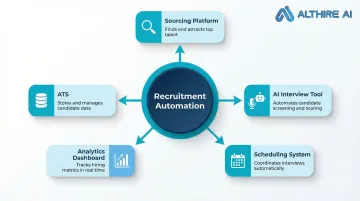
These tools work together or independently to reduce manual effort and improve hiring outcomes.
Recruitment automation preserves human judgment — it redirects recruiter attention toward the decisions that actually require it. Research from IDC shows that CEOs believe 40% of time spent on hiring is inefficient. Automation absorbs the administrative load so recruiters can focus on relationship-building, culture assessment, and strategic hiring decisions.
The level of automation a company adopts can range from simple email templates to fully AI-driven interview agents, making this a scalable concept for startups through enterprise organizations.
Key Stages of the Hiring Process That Recruitment Automation Covers
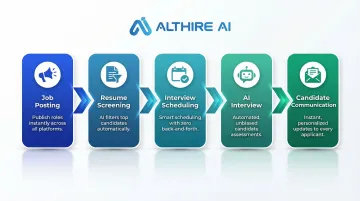
Job posting and candidate sourcing
Automation tools distribute job listings across multiple boards simultaneously—LinkedIn, Indeed, niche industry sites—without manual posting to each platform. Algorithmic matching surfaces candidates from LinkedIn, GitHub, job boards, and internal talent pools based on skills, experience, and job requirements. This expands the top-of-funnel while reducing time spent on manual outreach.
Resume screening and shortlisting
AI-powered screening uses natural language processing (NLP) to parse resumes, rank candidates against job requirements, and flag top matches. This helps teams move quickly through high-volume applicant pools without subjective bias creeping in. Instead of manually reviewing hundreds of resumes, recruiters receive a shortlist of candidates who meet objective criteria.
Interview scheduling and coordination
Scheduling consumes 38% of recruiter time, and 67% of recruiters spend between 30 minutes and 2 hours scheduling a single interview. Self-scheduling tools, calendar syncing, and automated reminders eliminate this "calendar Tetris" problem. Candidates select available time slots, the system sends confirmations automatically, and reminders cut no-shows.
Automated interview execution
The interview itself is now an automation stage. AI interview agents—like AltHire AI—conduct adaptive, structured conversations 24/7 and generate detailed evaluation reports for recruiters to review.
This frees recruiters from first-round screening calls while keeping every candidate experience consistent and fair. Instead of running 20 phone screens manually, recruiters work from AI-generated reports that:
- Highlight candidate strengths and flag skill gaps
- Provide adaptive follow-up questions based on each response
- Include video recordings for deeper review when needed
Candidate communication and status updates
Automated emails, SMS, and chatbot responses keep candidates informed at every stage—application received, interview scheduled, decision made. This reduces ghosting and drop-off. 50% of US candidates have ghosted employers during the hiring process, up 14 percentage points since 2023. Automated touchpoints at each decision point give candidates a reason to stay engaged rather than go silent.
Key Benefits of Recruitment Automation
Faster time-to-hire
Automating sourcing, screening, scheduling, and first-round interviews compounds speed gains across every stage of the funnel. Companies using automation for sourcing, interview scheduling, and screening report up to 30% faster time-to-hire metrics.
AltHire AI delivers 70% faster time-to-hire and 40% improvement in time-to-fill by eliminating scheduling friction, conducting AI-powered interviews 24/7, and generating instant candidate reports. That kind of end-to-end acceleration is what separates automation-first teams from those still managing each stage manually.
Significant cost savings
Replacing manual, labor-intensive work with automation reduces recruiter hours spent on administrative tasks, lowers dependency on staffing agencies, and scales hiring capacity without adding headcount.
Companies save 30% on cost-per-hire through AI recruitment augmentation, according to Deloitte. Organizations using Greenhouse saw average savings of $121,000 per recruiter per year, based on IDC research.
AltHire AI's platform delivers $12M annual savings per 1,000 hires by automating screening, interviews, and reporting. That cuts dependency on costly agency partnerships while freeing recruiters to manage higher volumes without adding headcount.
Improved candidate experience
Faster responses, self-scheduling, instant confirmations, and consistent communication make candidates feel respected and informed—directly influencing offer acceptance rates.
Candidates satisfied with their candidate experience are 38% more likely to accept a job offer, according to IBM research. When specific feedback was given to candidates, their willingness to refer others increased by 46%, per Talent Board's 2023 research.
Automation enables these positive experiences by ensuring every candidate receives timely updates, clear next steps, and transparent feedback—regardless of hiring volume.
Reduced unconscious bias and more equitable hiring
Structured automation—consistent scoring rubrics, anonymized screening, and standardized interview questions—reduces the variability introduced by human snap judgments, supporting DEI goals.
Structured interviews emerged as the top-ranked selection procedure in meta-analytic research published in the Journal of Applied Psychology. SHRM research confirms that structured interviews powered by AI act as a powerful bias mitigation mechanism.
However, this only works when the automation is properly designed and regularly audited for bias. Responsible adoption includes diverse training data, transparent criteria, and ongoing monitoring—not a "set it and forget it" approach.
Data-driven hiring decisions and continuous improvement
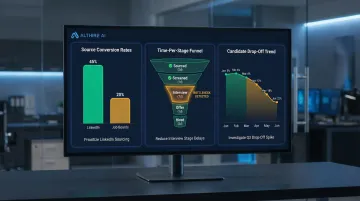
Automation tools capture metrics across the full funnel—source quality, time-per-stage, drop-off rates, interviewer feedback times—and surface them in dashboards. This enables TA leaders to identify bottlenecks, benchmark performance, and make evidence-based decisions rather than relying on gut feel.
In practice, that data creates clear, actionable signals:
- If LinkedIn candidates convert at twice the rate of job board applicants, you reallocate sourcing budget accordingly
- If time-to-hire spikes at the interview stage, you target that bottleneck specifically
- If drop-off rates climb after the screening step, you audit the process for friction points
Must-Have Features in a Recruitment Automation Tool
Core automation capabilities
Look for tools that cover:
- Automated job posting distribution across multiple boards simultaneously
- AI-powered resume screening and candidate matching to surface top candidates quickly
- Interview scheduling with self-scheduling for candidates to eliminate coordination friction
- Automated candidate communication including email/SMS templates and status updates
These form the baseline any credible tool should cover. A platform missing even one of these will create bottlenecks that undercut the efficiency gains automation is supposed to deliver.
Analytics and reporting
The best tools go beyond collecting data — they visualize it in real time. Look for platforms that track KPIs such as:
- Time-to-hire and cost-per-hire
- Candidate satisfaction scores
- Source effectiveness and drop-off rates
Dashboards should be intuitive, customizable, and tied to benchmarks your team actually uses. Without that visibility, you're flying blind on which parts of the funnel are working.
ATS and tech stack integrations
Most organizations already use an ATS or HRIS, so any new automation tool must integrate cleanly with existing systems to avoid creating data silos or duplicate workflows.
Gartner's Market Guide for Talent Acquisition Technologies notes that there is no all-in-one recruiting platform — integration capabilities and partner ecosystems are critical to meeting buyers' evolving needs. Top platforms like Greenhouse offer over 400 pre-built integrations, a useful benchmark when evaluating any new tool.
AltHire AI supports 20+ ATS integrations including Greenhouse, Lever, Ashby, Workable, BambooHR, iCIMS, and Jobvite, with automatic data synchronization that reduces manual work and prevents errors.
How to Implement Recruitment Automation: A Step-by-Step Approach
Map your current hiring workflow first
Before selecting any tool, document every step of your current recruitment process—who does what, which systems are involved, and where time is lost or quality slips.
This surfaces the highest-impact automation opportunities and ensures you're solving real problems. For example, if scheduling consumes 10 hours per week but resume screening takes 30 hours, prioritize screening automation first.
Start with high-volume, rules-based tasks
Prioritize automating the stages that consume the most recruiter time and involve the least nuanced judgment—job posting, resume screening, and interview scheduling.
Prove value here before expanding automation to more complex stages like assessments or offer management. Early results build internal support and make it easier to secure budget for broader rollout.
Invest in team training and change management
Getting the tools right is only half the work. Automation only delivers results if your team uses it correctly—and that requires active change management.
Start by connecting new processes to tangible recruiter benefits: fewer repetitive tasks, faster workflows, more time for high-value work. Then ensure everyone knows their role:
- Hiring managers understand where human judgment is still required
- Recruiters receive hands-on training with the specific tools they'll use daily
- Clear documentation stays accessible well after initial onboarding
- Ongoing support is available to resolve adoption issues as they arise
Common Pitfalls to Avoid With Recruitment Automation
Over-automating at the expense of candidate experience
Excessive automation can make the process feel transactional and cold—especially if candidates never interact with a human before receiving a rejection.
The goal is to enhance the candidate journey, not eliminate every human touchpoint. AI handles initial screening and scheduling well—but a human recruiter should still conduct final interviews and deliver offers. Knowing where to draw that line is what separates good automation from a bad candidate experience.
Automating a broken process
Automation amplifies whatever process it's applied to—if your screening criteria are flawed or your job descriptions are unclear, automation will just find bad candidates faster.
Audit your process before automating it. Fix broken workflows, clarify job requirements, and confirm your criteria actually predict on-the-job success. Automation won't repair a flawed foundation—it'll just expose the cracks faster.
Ignoring bias risks in AI systems
AI-driven screening and matching tools can perpetuate or even amplify historical hiring biases if the underlying models are trained on non-representative data.
Responsible adoption requires ongoing oversight—not a one-time configuration. The EEOC warns that illegal employment discrimination can occur when a seemingly neutral employment practice has an unjustifiable disparate impact. The stakes are real: in 2023, iTutorGroup settled EEOC charges for $365,000 after its software automatically rejected older applicants.
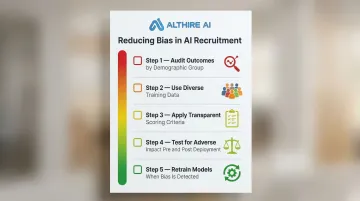
To reduce bias risk in your AI systems:
- Audit outcomes regularly by demographic group
- Use diverse, representative training data
- Apply transparent, documented scoring criteria
- Test for adverse impact before and after deployment
- Adjust or retrain models when bias is detected
Frequently Asked Questions
What is recruitment automation?
Recruitment automation is the use of AI, machine learning, and software tools to automate repetitive hiring tasks—from job posting and resume screening to interview scheduling and candidate communication—making the process faster, more consistent, and scalable.
What parts of the recruitment process can be automated?
Most stages can be automated: job posting, candidate sourcing, resume screening, interview scheduling, AI-led first-round interviews, status communications, and onboarding workflows. Final hiring decisions remain in human hands.
How is recruitment automation different from an ATS?
An ATS is one tool within the broader recruitment automation ecosystem—it tracks applications and candidate data. Recruitment automation refers to the wider use of AI and software to actively execute tasks like screening, scheduling, and interviewing, rather than just tracking them.
What are the biggest benefits of recruitment automation?
Faster time-to-hire, lower cost-per-hire, improved candidate experience, reduced bias through standardization, and better data for decision-making. The more stages you automate, the more pronounced these gains become.
Does recruitment automation replace human recruiters?
No. Automation handles repetitive, rules-based tasks—not judgment-heavy decisions. Recruiters remain essential for evaluating culture fit, managing relationships, and making final hiring calls. Automation gives them the time to do all three well.
What should I look for when choosing a recruitment automation tool?
Focus on ATS integration depth, core automation coverage (sourcing, screening, scheduling, interviews), and reporting quality. Ease of use and vendor support matter too—a tool your team won't adopt won't deliver results.