Introduction
The average time to fill an open role now stretches to 44 days in the United States, according to SHRM's 2025 benchmarking data. That number barely captures the real disruption. Every day a position stays vacant, your business absorbs compounding losses: productivity gaps from understaffed teams, revenue leakage from unfilled client-facing roles, overtime costs as existing employees shoulder extra work, and top candidates lost to competing offers.
The operational cost shows up in missed opportunities, team burnout, and compromised hiring quality when urgency forces you to settle.
This post covers seven concrete, actionable strategies for reducing time to fill—from decisions made before a role even opens to how teams manage and accelerate the candidate journey once it's underway. Each one addresses a structural cause of delay: reactive sourcing, unstructured processes, screening bottlenecks, and misaligned hiring managers.
Key Takeaways
- Time to fill carries measurable costs in productivity, revenue, and team morale—not just scheduling inconvenience
- Biggest delays stem from reactive sourcing, poorly defined criteria, manual screening bottlenecks, and stakeholders who aren't aligned before the process starts
- Reducing time to fill requires upstream decisions—pipeline building, job design, process structure—before a role even opens
- In-flight execution matters too: scheduling speed, feedback loops, and AI-assisted screening all drive faster closes
- Teams addressing these systematically see faster hires without sacrificing quality—gains that build on each other over time
What Prolonged Time to Fill Really Costs Your Business
Time-to-fill costs accumulate across multiple dimensions at once. Direct recruiting spend is visible — job board fees, agency commissions, recruiter salaries — but the indirect losses hit harder. Every open seat creates:
- Lost productivity from work that simply doesn't get done
- Revenue leakage when client-facing roles stay vacant
- Team strain as colleagues absorb the extra workload
- Overtime costs and burnout that drive up turnover
Understaffed teams produce lower output, and the pressure compounds the longer a role sits open.
Many of these costs are deferred or hidden, which is why the full financial damage rarely shows up on a single report. When hiring urgency forces a compromise candidate — someone who's "good enough" — you pay for that decision for months or years through lower performance, higher training costs, and eventual replacement expenses. The downstream quality hit from a rushed hire can easily exceed the cost of the delay itself.
That quality problem extends beyond internal costs. Slow processes signal organizational dysfunction to top candidates, who read delays as indecision or disrespect for their time. They drop off, accept competing offers, and share those experiences — damaging your employer brand well before the role is ever filled.
Why Time to Fill Keeps Stretching: The Root Causes
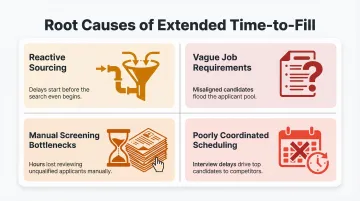
Long time-to-fill rarely results from a single failure. It's typically the accumulation of several process gaps working together:
- Reactive sourcing: Starting from zero when a position opens instead of maintaining a warm candidate pipeline
- Vague job requirements: Generic descriptions that attract high-volume, low-relevance applications
- Manual screening bottlenecks: Resume review and phone screens that consume 23 hours of recruiter time per hire
- Poorly coordinated scheduling: Back-and-forth email chains between candidates, recruiters, and hiring managers
Misalignment between HR and hiring managers is a particularly costly driver. Without an agreed-upon candidate definition or a shared interview rubric, decision cycles stretch as stakeholders debate subjective impressions rather than evaluate against clear criteria.
Every stage takes longer because consensus has to be rebuilt from scratch at each step.
Those same coordination failures extend into the final stretch, where approval and administrative delays—offer sign-offs, background check queues, salary negotiation loops—quietly stall momentum. None of these touch the actual hiring decision, but each one risks losing candidates who've already accepted competing offers.
7 Ways to Reduce Time to Fill in Recruitment
These seven strategies address time-to-fill at every stage of the funnel—from how talent is sourced before a role opens to how quickly and confidently offers are extended.
Build a Proactive Talent Pipeline Before Roles Open
The most effective way to cut time to fill is to not start from zero when a position opens. Teams that maintain a "warm candidate" database with pre-qualified prospects for high-turnover or recurring roles can move straight to outreach rather than sourcing from scratch.
Research shows that proactive pipelining reduces time-to-fill by 30-50% compared to reactive posting—because you're engaging candidates who've already been vetted and expressed interest in your organization.
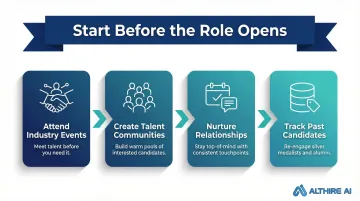
Roughly 70-75% of the workforce isn't actively job searching. Relying solely on inbound applications means missing most of the qualified talent pool. Build relationships with potential candidates before you need them:
- Attend industry events and maintain contact with promising candidates
- Create talent communities for high-demand roles (engineering, sales, specialized functions)
- Nurture relationships through periodic check-ins, content sharing, and networking
- Track candidates who were strong but not selected for previous roles
Standardize and Structure the Hiring Process
Without documented workflows, every hire becomes a custom project. Creating a repeatable, stage-by-stage hiring template for each role type eliminates the decision fatigue and confusion that quietly adds days to every hire. Define timelines for each step—screening, assessment, panel interview, offer—and hold teams accountable to them.
Key elements of a structured process:
- Documented workflow with defined stages and timelines
- Clear decision criteria and approval authority at each stage
- Standardized interview questions and scoring rubrics
- Designated process owner responsible for moving candidates forward
Parallel processing is the single fastest structural fix most teams overlook. Running reference checks, background screening, and final panel preparation simultaneously—rather than sequentially—can compress a multi-week process into days. Most teams default to sequential steps out of habit, but there's rarely a technical reason these activities can't overlap.
Write Job Descriptions That Attract the Right Candidates Faster
Poorly written or generic job descriptions generate high-volume, low-relevance applications—forcing recruiters to spend more time screening out misfits. A clear, specific description that leads with the opportunity (not just requirements) helps qualified candidates self-select in and unqualified ones self-select out, shrinking the funnel without shrinking candidate quality.
Best practices for high-performing job descriptions:
- Use job titles that match how candidates actually search, not internal jargon
- Lead with the opportunity and impact, not just a laundry list of requirements
- Be specific about must-have vs. nice-to-have qualifications
- Include salary ranges and benefits to filter out mismatched expectations
- Keep it concise—300-700 words is ideal
Writing the right description matters—but where and how fast you post it matters just as much. Waiting to see if one channel produces results before trying another adds unnecessary days to time-to-first-qualified-applicant. Go multi-channel from day one: your careers page, LinkedIn, niche job boards, employee referrals, and passive candidate outreach.
Automate Initial Screening with AI-Powered Interviews
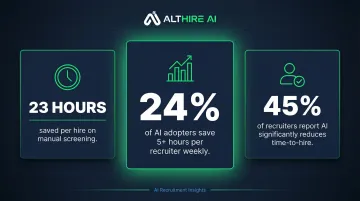
Manual resume review and phone screening are the most time-intensive steps in early-stage screening. Recruiters spend an estimated 23 hours per hire on screening activities alone—10-15 hours on resume review and 16-17 hours on phone screens. Replacing them with AI-powered asynchronous interviews allows candidates to complete structured screening on their own schedule (24/7), eliminating back-and-forth scheduling and letting recruiters review structured, comparable evaluations in a fraction of the time.
According to the iCIMS August 2025 Workforce Report, 24% of AI adopters save more than five hours per recruiter each week, with 64% saving over two hours weekly. These time savings directly accelerate hiring velocity—45% of recruiters report that AI significantly reduces time-to-hire.
AltHire AI's interview agents conduct adaptive, human-like interviews around the clock—delivering AI-generated reports and dimensional scoring so hiring teams can shortlist faster. The platform delivers 350+ weekly interviews across its customer base, enabling a 60% reduction in screening time and 40% improvement in time to fill.
Candidates record responses whenever they're ready, with no scheduling constraints. Recruiters review structured evaluations with question-by-question analysis, performance scores, and AI flags for suspicious activity.
Eliminate Scheduling Bottlenecks with Automation
Coordinating interview schedules between candidates, recruiters, and multiple hiring managers is one of the most friction-heavy parts of the process. Back-and-forth email chains, last-minute cancellations, and calendar mismatches can easily add a week or more to a hiring cycle. Automated scheduling tools that let candidates book directly into interviewers' calendars based on live availability can eliminate this entirely.
Benefits of scheduling automation:
- Reduces coordination time from days to minutes
- Eliminates email back-and-forth for availability
- Automatically reschedules conflicts without human intervention
- Sequences different interview types based on candidate progression
Scheduling automation is especially valuable for panel or multi-stage interviews. Tools that sequence different interview types and auto-reschedule conflicts keep momentum without requiring human coordination at every step. When a candidate completes their first-round interview, the system automatically sends a link to book the second round—no recruiter intervention needed.
Align Hiring Managers Early to Accelerate Decisions
Poor alignment between HR and hiring managers is one of the most underestimated drivers of delay. When hiring managers haven't agreed on must-have criteria, interview scorecards, or decision timelines before the process starts, every stage stalls. Consensus gets rebuilt from scratch at each step instead of moving forward.
Conduct structured intake meetings before posting a role to align on:
- The ideal candidate profile and must-have qualifications
- Evaluation rubric and scoring criteria
- Interview format and question sets
- Decision timelines and approval process
- Salary range and offer parameters
Train hiring managers on efficient interviewing techniques and the business cost of slow decisions to build urgency around timely feedback. Make it clear that a 44-day time-to-fill isn't just an HR problem—it's a business problem that affects team productivity, project timelines, and competitive positioning.
Use Data to Make Faster, More Confident Decisions
Gut-feel hiring decisions take longer and are harder to defend. Teams that use structured interview rubrics, standardized scoring, and real-time feedback tools can consolidate post-interview deliberation from days to hours, because decision-makers are comparing data points rather than reconciling vague impressions.
Data-driven decision practices:
- Use structured scorecards with defined criteria for every interview
- Require interviewers to submit feedback within 24 hours
- Hold debrief meetings immediately after final interviews
- Make decisions based on objective scores, not subjective impressions
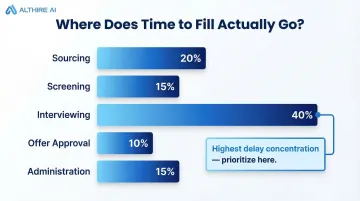
Track time-to-fill by stage (not just as a total) to identify exactly where delays concentrate—whether that's in sourcing, screening, or offer approval. These stage-level insights allow teams to make targeted process improvements rather than guessing at systemic fixes. If 60% of your time-to-fill comes from the screening stage, that's where automation pays off. If delays concentrate in offer approval, that workflow gets simplified first.
Conclusion
Reducing time to fill comes down to removing the friction, reactive behaviors, and misalignments that slow hiring down in the first place. When the process is designed well, speed and quality reinforce each other. The teams that hire fastest tend to treat time-to-fill as a strategic signal — one that exposes where their process breaks, not just how long it takes.
Even adopting two or three of these strategies in sequence can produce measurable improvements in both hiring speed and candidate quality. Identify the single biggest source of delay in your current process and fix that first. Compounding small improvements across the pipeline adds up faster than overhauling everything at once.
Frequently Asked Questions
How to reduce time to fill in recruitment?
Three steps move the needle most: building a proactive talent pipeline before roles open, standardizing hiring stages with defined timelines, and automating early screening with AI-powered interviews. These eliminate reactive sourcing, process confusion, and manual screening bottlenecks — the three biggest sources of delay.
What is a good time to fill in recruitment?
According to SHRM's 2025 benchmarking data, the average time to fill in the US is 36-44 days. "Good" varies by role complexity, seniority, and industry—technical or senior roles typically take longer than high-volume or entry-level positions. Aim for 20-30 days for standard roles, 30-45 days for specialized positions.
What is the difference between time to fill and time to hire?
Time to fill measures from when a role is officially opened to when an offer is accepted. Time to hire measures from when a specific candidate enters the pipeline to that same offer acceptance. The distinction matters: time to fill reflects overall process speed; time to hire reflects how efficiently you move a specific candidate.
What causes long time to fill in recruitment?
The most common culprits are reactive sourcing (starting from zero when a role opens), vague candidate criteria that flood the pipeline with irrelevant applicants, and manual screening consuming 23+ hours per hire. Misaligned hiring managers and slow offer approvals compound the problem further.
How does AI help reduce time to fill?
AI accelerates the most time-intensive stages—screening, scheduling, and feedback consolidation—by automating tasks that previously required significant recruiter hours. Research shows that 24% of AI adopters save more than five hours per recruiter weekly, allowing teams to move qualified candidates through the pipeline faster and with more consistency.
What metrics should I track alongside time to fill?
Track time-to-fill broken down by stage (sourcing, screening, interviewing, offer), alongside offer acceptance rate and candidate drop-off rate. Together these reveal where delays and candidate losses are actually occurring, allowing you to make targeted improvements rather than guessing at the problem.