Introduction
The cost of a slow hiring process is climbing. The average time-to-hire now sits at 44 days, and every extra week a role remains vacant drains productivity, revenue, and team morale. Meanwhile, top candidates are off the market within just 10 days—long before most companies even schedule a first interview.
Moving too fast risks bringing in the wrong person, which carries its own steep price tag. Moving too slowly guarantees you'll lose the best candidates to faster-moving competitors. The goal is a hiring process disciplined enough to filter well and fast enough to close before the competition does.
This guide covers 7 actionable ways to cut time-to-hire without cutting corners, from writing sharper job descriptions to using AI-powered screening tools that work around the clock.
Key Takeaways
- Top candidates are off the market within 10 days, so every delay hands them to a faster competitor
- Targeted job descriptions filter out unqualified applicants before they clog your pipeline
- Cutting interview rounds and setting 24-hour response SLAs are the fastest structural fixes
- AI screening tools eliminate scheduling bottlenecks and run assessments 24/7
- Consistent candidate communication reduces drop-off and keeps your pipeline moving
Why Most Hiring Processes Take Too Long
Slow hiring is rarely caused by one catastrophic failure. It's the compounding effect of several inefficiencies: bloated interview stages, poor internal coordination, vague job descriptions that attract the wrong applicants, and delayed decision-making. Three structural culprits show up most often:
- Too many interview rounds — each additional stage multiplies coordination overhead. When 8 people need to weigh in before an offer goes out, the process stalls.
- Reactive sourcing — most timelines start slow because sourcing begins at zero the day a role opens. Teams can't move fast when they're starting from scratch.
- No defined deadlines — without clear SLAs (internal response targets for each stage), hiring drifts. Application reviews slip a week. Scheduling takes another. Feedback loops stretch indefinitely.
The result? Candidates don't wait around. 92% of job seekers abandon long applications, and 34% feel "ghosted" after just 7 days of silence. By the time your team schedules a second-round interview, your top candidates have already accepted offers elsewhere.
7 Ways to Speed Up the Hiring Process
Way 1: Write a Job Description That Filters, Not Just Attracts
A vague or over-specced job description is the root cause of a bloated applicant funnel. It either attracts hundreds of unqualified candidates or scares away qualified ones. The fix is specificity.
List only the 4–5 truly essential skills. Cut the wish list. Every "nice to have" requirement you include expands your review time and narrows your qualified pool unnecessarily.
Provide a realistic breakdown of day-to-day responsibilities. Candidates need to self-assess before applying. If the job description reads like a generic template, you'll get generic applicants.
Include success markers. What does success look like in the first 90 days? What outcomes define strong performance? This helps candidates evaluate fit before they click "apply."
One more benefit: Research shows men apply when they meet 60% of qualifications, while women often need to feel 100% qualified. Trimming unnecessary requirements widens your qualified pool and reduces screening time.
Way 2: Eliminate Unnecessary Interview Stages
Every additional interview round multiplies both turnaround time and coordination overhead. Audit your current process and ask: what decision does each round actually enable? If two rounds can be consolidated, they should be.
A lean process looks like this:
- Initial screening (automated or brief phone screen)
- One structured interview panel (all decision-makers present)
- Final decision debrief (internal only, no candidate involvement)
Reducing steps can make a hiring pipeline 2–4x more effective. The goal isn't to rush judgment—it's to eliminate redundant conversations that don't add new information.
Way 3: Automate Screening With AI-Powered Interview Tools
One of the biggest time drains is scheduling and conducting initial screening calls. Recruiters spend hours coordinating calendars for interviews that often last 20–30 minutes and yield minimal new information.
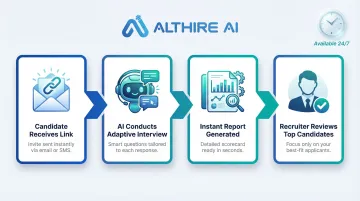
AI interview platforms let candidates complete structured screening interviews on their own schedule, 24/7. AltHire AI, for example, conducts adaptive interviews around the clock, delivers detailed candidate reports automatically, and cuts screening interview time by 60%.
How it works:
- Candidates receive an interview link and complete it whenever they're ready
- The AI asks role-specific questions and adapts follow-up questions based on responses
- Reports are generated instantly, including dimensional performance scores, question-by-question evaluation, complete video recordings, and proctoring details
- Recruiters review only the most promising candidates, focusing their time where it matters most
With 20+ ATS integrations (including Greenhouse, Lever, Ashby, Workable, and BambooHR), teams don't have to break their existing workflows. The platform syncs candidate data and interview results automatically.
Way 4: Set SLAs and Response Deadlines for Your Hiring Team
A hiring SLA is a team-wide commitment that every candidate touchpoint—application acknowledgment, interview scheduling, post-interview feedback—happens within a defined window. Ideally, that window is 24 hours.
Most companies take 5–7+ days to respond to candidates. Cutting this to 24 hours alone can compress the total hiring timeline considerably. Candidates who are ultimately hired are contacted in 3.6 days, while average applicants wait 6.1 days—proving that speed in early outreach correlates directly with better hiring outcomes.
Build a shared hiring calendar with milestone deadlines:
- Job post date
- Application review cutoff
- Interview completion target
- Offer target date
Teams that document these milestones report fewer last-minute delays and clearer ownership across hiring stakeholders.
Way 5: Use Structured Interviews With Scorecards
Unstructured interviews—where each interviewer asks different questions and evaluates on gut feel—create two problems:
- Inconsistent data that's hard to compare across candidates
- Lengthy debrief discussions because no one is working from the same framework
Structured interviews with pre-defined questions and numerical scorecards solve both. Every candidate answers the same questions. Every interviewer scores against the same criteria. Decisions become faster and more confident.
Additional benefits:
- Reduced unconscious bias, which improves diversity outcomes
- Standardized evaluation makes it easier to avoid the "we need one more round" instinct
- Clear scoring reveals top candidates immediately, eliminating drawn-out deliberation
Way 6: Keep Candidates Informed at Every Step
Candidate drop-off is a silent killer of hiring speed. Companies often assume their pipeline is intact when candidates have quietly moved on due to radio silence. Proactive communication—even just "we're still reviewing, here's the expected timeline"—cuts this significantly.
Automate status update emails at key stages:
- Application received
- Under review
- Interview scheduled
- Post-interview next steps
- Final decision
Transparency creates goodwill and keeps strong candidates engaged even if your process takes slightly longer than ideal. 21% of candidates expect interviews to be scheduled within 2–6 days, and 29% expect it within a week. Meeting or beating these expectations prevents drop-off.
Way 7: Build a Pre-Qualified Talent Pipeline Before You Need to Hire
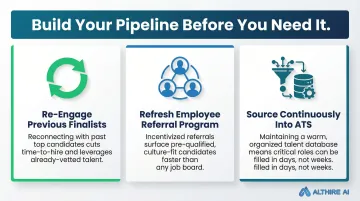
Most hiring timelines start slow because sourcing begins at zero the day a role opens. A maintained talent pipeline—including past silver-medal candidates, employee referrals, and engaged passive candidates—can cut days or weeks off the front end of hiring.
Three practical pipeline-building tactics:
- Re-engage previous finalists. Candidates who reached final rounds are already vetted — many companies never follow up with them for future roles, which is a missed shortcut.
- Refresh your employee referral program. Your team knows talented people. Make referrals easy and keep those contacts warm even when no roles are open.
- Source into your ATS continuously. Proactive sourcing means you're never starting from zero — when a role opens, qualified candidates are already in the system.
Key Variables That Affect How Fast You See Results
Implementing these tactics won't produce the same speed gains for every organization. The impact depends on several contextual variables that teams should assess before setting timeline expectations.
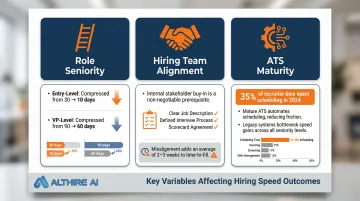
Three variables tend to determine how much ground you can realistically recover:
- Role seniority and specialization — Entry-level and high-volume roles compress fastest. A retail associate role might drop from 30 days to 10; a VP of Engineering role might only move from 90 days to 60. Senior and niche roles have a longer natural floor that process improvements can only partially close.
- Hiring team alignment — Even the best process stalls if hiring managers are slow to give feedback or disagree on candidate criteria. Internal buy-in is a prerequisite. If your team isn't aligned on what "good" looks like, no tooling change will fix that.
- ATS maturity and tooling — Teams on modern, integrated platforms see faster gains than those still working from spreadsheets or disconnected email threads. In 2024, recruiters spent 35% of their time on interview scheduling alone — a task that automation handles in seconds.
Common Mistakes That Slow Down Hiring (Even When You're Trying to Move Fast)
Most hiring slowdowns aren't caused by hard problems. They're caused by four fixable habits:
- Too many decision-makers, too late. Getting 8 stakeholders to align on a final candidate stalls offers. Gather broad input early — during job description creation — then narrow to 2–3 actual decision-makers for interviews and the offer stage.
- Sourcing that starts only when a role opens. Starting from scratch the day someone resigns is a guaranteed delay. Teams that build pipeline continuously — not reactively — cut days off every search.
- Sitting on the offer after a decision is made. Every day of delay after identifying a top candidate increases the chance they accept elsewhere. Companies making offers within 48 hours of the final interview are 50% more likely to have those offers accepted. Meanwhile, 71% of employers who lost candidates to competing offers said the competitor simply moved faster.
- Confusing slow with thorough. "We're being careful" is the most common rationalization for a slow process. A structured, fast process — with clear criteria and consistent evaluation — actually produces better decisions than a drawn-out, unstructured one.
Conclusion
Hiring speed is a competitive advantage, not just an operational metric. The 7 ways outlined—from sharper job descriptions to AI-powered screening to proactive communication—work together as a system, not as isolated fixes.
The biggest gains come from eliminating structural drag: too many rounds, slow response times, reactive sourcing. Speed and quality improve together when the process is well-designed. A structured, automated, accountable hiring process doesn't just fill roles faster—it fills them with better candidates.
Teams that invest in smarter hiring infrastructure now—AI interview automation, structured assessments, integrated ATS workflows—don't just solve today's bottleneck. They reduce time-to-hire by 70% or more while improving candidate quality. Platforms like AltHire AI are built for exactly this: running structured, unbiased interviews at scale, around the clock, so hiring teams spend their time on decisions rather than logistics. The sooner the process is redesigned, the sooner results follow.
Frequently Asked Questions
How to speed up the hiring process?
Start with three high-leverage fixes: write a targeted job description that lists only essential skills, reduce interview rounds to eliminate coordination overhead, and set 24-hour internal SLAs for every candidate touchpoint. Automated screening tools that eliminate scheduling bottlenecks deliver the fastest gains.
What is the 30-60-90 rule in interviews?
The 30-60-90 rule is a candidate's plan for what they'll accomplish in their first 30, 60, and 90 days on the job. Interviewers use it to assess strategic thinking and whether the candidate has a realistic grasp of the role.
What is the 80% rule in hiring?
The 80% rule (also called the four-fifths rule) is an EEOC guideline for detecting adverse impact in hiring. If a protected group is selected at less than 80% of the rate of the highest-selected group, it may signal discriminatory screening practices.
What is a good time-to-hire benchmark?
The industry average sits around 44 days, but high-performing teams target 14–21 days for non-executive roles. The right benchmark depends on role complexity, industry, and sourcing maturity. Technical and senior roles naturally take longer, but process improvements can still cut weeks off the timeline.
How does AI help speed up the hiring process?
AI tools automate initial screening interviews, score candidates against defined criteria, and surface the best-fit applicants instantly. This eliminates the scheduling and manual review time that typically makes up the largest share of time-to-hire, freeing recruiters to focus only on the most promising candidates.
What causes delays in the hiring process?
The most common culprits are too many interview rounds, slow internal feedback loops, reactive sourcing, and unclear decision-making authority. Left unaddressed, these delays push timelines out long enough for top candidates to accept competing offers.