Introduction
Recruiters spend an average of 17.7 hours per vacancy on manual administrative tasks — copying candidate data between an ATS, interview tools, payroll systems, and onboarding platforms by hand. This disconnected hiring stack costs approximately $17,000 annually per recruiter in lost productivity, introduces errors that derail compliance, and creates delays that cause 46% of candidates to lose interest after just 10-14 days of silence.
This guide is for HR leaders, talent acquisition teams, and HR tech decision-makers building a hiring process that eliminates manual handoffs and keeps every stakeholder aligned.
ATS integration is what makes your ATS actually work across your entire HR tech stack. Without it, your ATS becomes a data silo — slowing hiring down and frustrating the recruiters who depend on it.
This guide covers:
- What ATS integration is and how it works
- Step-by-step implementation best practices
- Common tools and platforms worth knowing
- Pitfalls teams hit when they treat integration as a one-time project
Key Takeaways
- ATS integration connects your Applicant Tracking System with payroll, HRIS, interview platforms, and onboarding tools so candidate data flows automatically
- Organizations using ATS integrations reduce hiring cycles by 40% and cut manual data entry errors
- Integration runs on APIs using webhooks for real-time sync or polling for scheduled data transfers
- Best practices: start with high-impact use cases, sandbox-test before launch, and build for scalability
- Common pitfall: treating integration as a one-time project rather than an ongoing maintenance commitment
What Is ATS Integration?
ATS integration connects your Applicant Tracking System to other HR and business tools — HRIS, payroll, interview software, assessment platforms, and onboarding tools — so candidate and job data moves automatically between them.
A single action in one system, for example marking a candidate as hired, triggers automatic updates across all connected systems, eliminating manual data re-entry and keeping every stakeholder aligned.
The ATS itself tracks and manages applicants through your hiring pipeline. ATS integration is the connectivity layer that makes this data usable across your HR tech stack. Without integration, the ATS becomes a silo — and the consequences compound fast:
- Recruiters spend hours copying candidate data between systems manually
- Errors accumulate across platforms as information falls out of sync
- Hiring velocity slows as bottlenecks build at every handoff point
Why ATS Integration Matters in Modern Hiring
The £17,000 Cost of Disconnected Systems
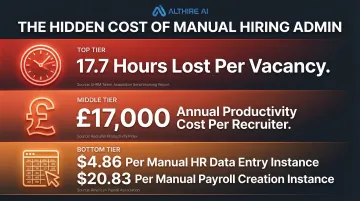
When your ATS doesn't talk to interview tools, payroll, or onboarding platforms, recruiters lose an average of 17.7 hours per vacancy to manual administrative tasks — nearly 850 hours of admin per recruiter per year. This inefficiency costs approximately £17,000 annually per recruiter in lost productivity. Manual HR data entry costs $4.86 per instance, and manual payroll creation costs $20.83 per instance, according to EY research.
40% Faster Time-to-Hire Through Automation
Integration removes delays at each hiring stage by automatically advancing candidate data downstream. Organizations using ATS integrations reduce their hiring cycles by an average of 40% compared to manual recruitment processes. The time savings compound across every handoff:
- Interview results sync automatically to the ATS after each evaluation
- Background check requests trigger the moment an offer is accepted
- New hire records populate payroll without manual re-entry
Each eliminated handoff removes another delay from the hiring timeline.
Accuracy and Compliance Through Automated Sync
Manual handoffs between the ATS and downstream systems introduce errors that affect payroll accuracy, onboarding timelines, and compliance reporting. Payroll errors alone cost large enterprises millions annually in corrections, penalties, and employee remediation. Automated data sync eliminates transcription errors, ensures field consistency, and creates audit trails that manual processes can't match.
Reducing Candidate Drop-Off from Fragmented Processes
Slow and uncoordinated hiring workflows directly cause candidate abandonment. After just 10-14 days without communication, 46% of candidates lose interest completely. Integrated workflows reduce back-and-forth between tools for recruiters and create faster, more consistent communications for candidates. When interview scheduling, feedback collection, and status updates happen automatically, candidates stay engaged.
Strategic Visibility into Hiring Performance
When the ATS is integrated with analytics and workforce planning tools, HR leaders gain real-time visibility into time-to-fill, cost-per-hire, source quality, and pipeline health. Siloed ATS data makes cross-functional reporting impossible: without connected systems, HR leaders are making workforce decisions on incomplete numbers. Integration gives your ATS the context it needs to surface actionable hiring intelligence — not just candidate records.
How ATS Integration Works
ATS integrations communicate via APIs (Application Programming Interfaces). Data is either pushed to connected systems in real time using webhooks (event-triggered) or pulled on a schedule using API polling. Webhooks provide real-time data delivery as changes happen, while API polling introduces delay based on the polling interval. The choice between the two affects data freshness and system load.
Core data objects that flow through an ATS integration:
- Job requisitions — open roles, requirements, hiring team details
- Candidate profiles — personal details, work history, contact information
- Application records — stage, status, timestamps, source
- Interview data — scheduling details, feedback, scores, recordings
- Offers — salary, start date, acceptance status, contract terms
Most ATS APIs use OAuth 2.0 or API key authentication to verify requests. Data should be encrypted in transit (TLS/HTTPS) and at rest to protect sensitive candidate information.
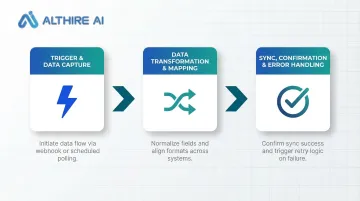
Step 1: Trigger and Data Capture
Every integration begins with a trigger event — a status change in the ATS such as "Interview Scheduled," a completed action in a connected tool like an assessment submission, or a scheduled sync. This event initiates the data transfer to the target system. Webhooks fire immediately when the event occurs; polling checks for changes on a set schedule — every 5 minutes, hourly, or another defined interval.
Step 2: Data Transformation and Mapping
Different platforms use different field names, formats, and data structures. One system might use "candidate_id" while another uses "cand_id." Date formats vary (MM/DD/YYYY vs. DD/MM/YYYY). The integration layer must normalize and map these fields before data can be written into the receiving system without errors or mismatches. Skipping this step causes corrupted records and sync failures.
Step 3: Sync, Confirmation, and Error Handling
Once transformed data is delivered to the target system, a confirmation response closes the loop. If delivery fails due to rate limits, network issues, or validation errors, the integration should automatically retry and log the failure for review. Retry logic, error logging, and alerts are what separate a resilient integration from a brittle one. Without them, failures go unnoticed and create data gaps that are nearly impossible to trace after the fact.
Best Practices for Successful ATS Integration
Start with High-Impact Integrations First
Identify the two or three data handoffs that create the most friction in your current hiring workflow. Typically, these are:
- ATS ↔ interview platform (scheduling, feedback, scores)
- ATS ↔ HRIS/payroll (new hire data transfer)
- ATS ↔ background check services (automated candidate submission)
Solve these before expanding scope. A phased approach reduces complexity and delivers faster ROI.
Audit and Map Your Data Before Building
Before connecting two systems, document which fields exist in each, which are required vs. optional, and which system should be the "source of truth" for each field. Create a mapping table:
| ATS Field | External System Field | Data Type | Required? | Source of Truth |
|---|---|---|---|---|
| candidate_email | email_address | String | Yes | ATS |
| interview_score | assessment_result | Integer | No | Interview Platform |
| hire_date | start_date | Date | Yes | ATS |
Skip this step and you'll spend weeks untangling conflicting records and broken sync logic — usually at the worst possible moment.
Choose ATS Platforms Based on Your User Base
Research which ATS platforms your customers or internal teams use most before deciding which integrations to build or enable. Prioritizing market-common platforms maximizes integration value:
- Greenhouse — leads in enterprise and mid-market segments, well-documented APIs
- Lever — CRM-style contact and opportunity model, strong for relationship-driven recruiting
- Workable — SMB-friendly with broad third-party integration support
- BambooHR — ATS and HRIS combined, good for post-hire data continuity
- Ashby — modern, analytics-first ATS with structured API access
Test in Sandbox Environments Before Going Live
Use the ATS vendor's sandbox or test environment to validate data flows, edge cases, error handling, and field mapping before exposing the integration to production data. Test scenarios should include:
- Successful data sync (happy path)
- Missing required fields (validation errors)
- Duplicate candidate records (conflict resolution)
- Rate limit handling (throttling and retries)
- Authentication token expiration (refresh logic)
A single untested edge case in production can corrupt candidate records across your entire pipeline — and it's rarely obvious until the damage is done.
Design for Scalability and Ongoing Maintenance
Build integration logic that can accommodate new ATS platforms, growing data volumes, and API version changes. Hardcoding field mappings or auth logic creates technical debt — when a vendor updates their API, everything breaks. Practical patterns to build in from the start:
- Use configuration files or database-driven mapping tables (update without code deploys)
- Abstract authentication logic so token refresh and credential rotation are handled centrally
- Version your API calls so future schema changes don't cascade into failures
Implement Continuous Monitoring and Alerting
Set up logging for every API call and data sync event, with automated alerts for failures or unexpected data patterns. Monitor:
- Sync success/failure rates
- API response times
- Authentication errors
- Data validation failures
- Webhook delivery failures
ATS integrations that aren't monitored will silently fail, causing data gaps that are nearly impossible to trace back to the source.
Common Tools and Use Cases for ATS Integration
Key categories of tools commonly integrated with ATS platforms:
- HRIS and payroll systems — Automated new hire record creation post-offer, eliminating manual data entry into payroll
- Assessment platforms — Skills and behavioral test results sync back to candidate profiles for centralized evaluation
- Interview management tools — Scheduling, AI-driven interview results, and scorecards flow directly into the ATS
- Onboarding tools trigger e-signature and provisioning workflows automatically when a candidate is marked as hired
- Background check services handle candidate data submission and results return without manual handoffs
- Job boards — Real-time job posting and applicant import from external sources
Prominent ATS platforms and integration contexts:
| ATS Platform | Integration Strengths |
|---|---|
| Greenhouse | Open, well-documented APIs with modular candidate vs. application data models; OAuth 2.0 support |
| Lever | CRM-style contact and opportunity model; strong for relationship-driven recruiting workflows |
| Workable | SMB-friendly with broad third-party integration support; OAuth 2.0 Authorization Code flow |
| BambooHR | ATS and HRIS combined; good for post-hire data continuity with webhook support |
| Ashby | Modern, analytics-first ATS with structured API access; HTTP Basic Auth for simplicity |
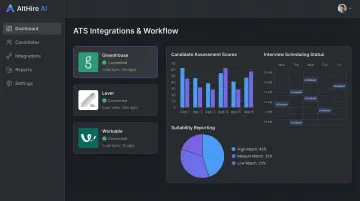
Beyond these established categories, AI interview platforms represent a newer class of ATS-connected tools. AltHire AI, for example, supports 20+ ATS integrations including Greenhouse, Lever, Ashby, Workable, and BambooHR. Interview scheduling, AI-generated candidate assessments, and detailed scoring reports sync directly back into the ATS. Recruiters get immediate access to performance data, proctoring details, and suitability scores — no manual logging required.
Common Challenges and Misconceptions
Data Inconsistency Is the Most Common Failure Point
Many teams assume connecting two systems means data will sync automatically. Field naming differences, format mismatches, and schema variations between ATS platforms all require deliberate mapping and normalization — skipping this step causes corrupted or missing records.
The mismatches are rarely obvious upfront. One system might require "YYYY-MM-DD" date formatting while another expects "MM/DD/YYYY," and phone numbers stored as formatted strings in one platform may break a schema that accepts numeric values only.
Integration Is Not a One-Time Project
ATS vendors regularly update their APIs, deprecate endpoints, and change authentication methods. Greenhouse is deprecating Harvest API v1 and v2 by August 31, 2026, requiring migrations to Harvest v3 (OAuth 2.0). BambooHR deprecated the oidcLogin endpoint for new applications as of April 14, 2025, forcing a transition to standard OAuth 2.0 access tokens. Teams that treat integration as a build-once task will face unexpected failures as vendor changes break unmaintained connectors.
More Integrations Do Not Always Mean Better Hiring Outcomes
Connecting every available tool to the ATS creates maintenance complexity without necessarily improving hiring velocity or quality. Each integration introduces potential failure points, requires ongoing monitoring, and consumes engineering resources. Validate the business case and expected efficiency gain for each integration before building it. Focus on high-impact connections that eliminate manual work or unlock strategic insights.
Underestimating the Build Cost of In-House Integrations
Organizations frequently underestimate how long direct ATS connectors take to build and maintain. A single API integration costs between $50,000 and $150,000 per year — and that figure only covers the basics.
The full cost picture includes:
- 150 hours for initial development per integration
- 300 hours annually for diagnosing and resolving issues
- Additional overhead for API deprecation handling and multi-ATS scaling
For teams managing five or more integrations, those numbers compound fast.
Frequently Asked Questions
What is ATS integration?
ATS integration is the connection between an Applicant Tracking System and other HR or business tools. It enables automated, bidirectional data flow so candidate information moves automatically across systems without manual re-entry.
What is an ATS API?
An ATS API is the programming interface provided by an ATS vendor that allows external software to read from and write to the ATS. It defines how data requests are structured, authenticated, and exchanged between the ATS and connected tools.
What does ATS stand for?
ATS stands for Applicant Tracking System: software used by HR and recruiting teams to post jobs, manage candidate pipelines, and coordinate the end-to-end hiring workflow in one place.
Is an ATS the same as a CRM?
No. An ATS manages active applicants moving through the hiring pipeline, while a CRM (Candidate Relationship Management) system focuses on building and nurturing long-term candidate relationships. Some modern platforms combine both, though each capability remains distinct in practice.
What is an ATS that integrates with ADP?
Platforms like Greenhouse, BambooHR, and Workable offer native or third-party ADP integrations for payroll and HRIS data handoffs. These connections automatically transfer new hire records post-offer, eliminating duplicate data entry.
What tools can integrate with an ATS?
Common ATS integrations span HRIS and payroll systems, AI interview platforms, candidate assessment tools, onboarding and e-signature software, job boards, and sourcing tools. Each automates a specific handoff in the hiring lifecycle.