ATS integration is frequently referenced as a fix, but its real value is often misunderstood. This article focuses on what it actually delivers in day-to-day hiring operations—faster time-to-hire, fewer errors, better recruiter productivity, and a smoother candidate experience—and shows how these benefits compound when integration is applied consistently across the full hiring workflow.
Key Takeaways
- ATS integration connects your applicant tracking system with other hiring tools so candidate data flows automatically, eliminating manual handoffs
- Primary benefits: time-to-hire drops 30–47%, data errors decrease, recruiter productivity rises, and candidates get a smoother experience
- Without ATS integration, teams absorb hidden costs: duplicated effort, slower decisions, and candidates who disengage before hire
- The payoff compounds when integration spans the full hiring funnel — from job posting to onboarding — not just one or two steps
What Is ATS Integration?
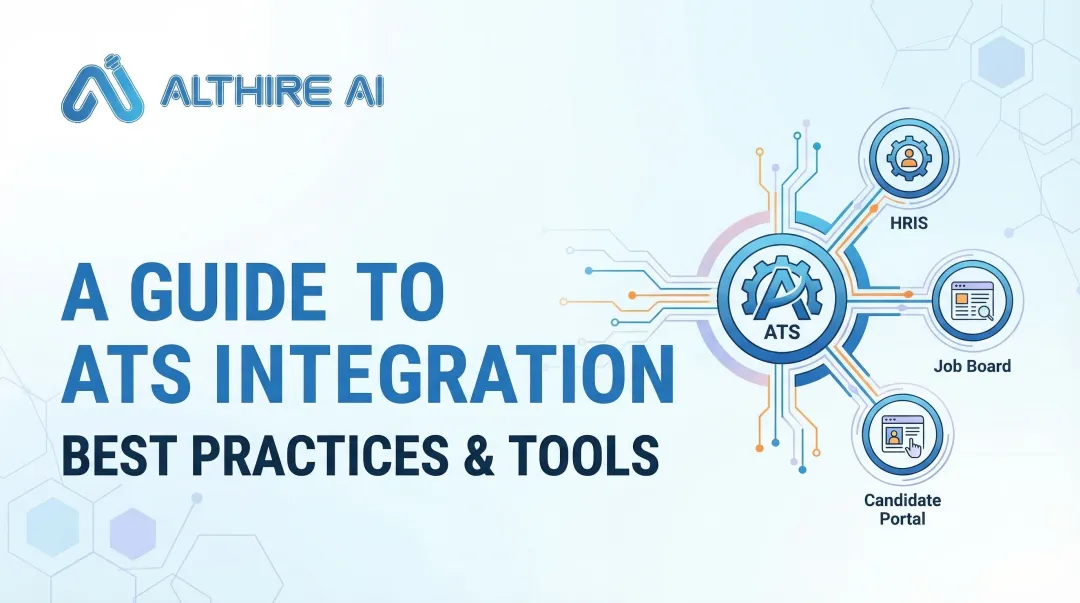
ATS integration is the process of connecting an applicant tracking system with other tools in the hiring stack—such as job boards, interview platforms, background check providers, and onboarding software—so that candidate data moves automatically between them without manual re-entry.
Rather than a single feature, ATS integration covers a range of connection types, each serving a different stage of the hiring process:
- Job syndication — pushing open roles to job boards automatically
- Candidate status syncing — keeping pipeline stages current across platforms
- Assessment result transfers — pulling evaluation scores directly into candidate profiles
- Offer and onboarding data handoffs — passing accepted-offer details downstream without re-entry
The scope varies depending on which tools you connect and how deeply they're integrated.
ATS integration exists to eliminate friction between the systems recruiters already use. When done right, it removes the administrative burden of moving data manually and keeps hiring stages progressing without delays.
Key Benefits of ATS Integration
The advantages below are grounded in operational impact—what changes in day-to-day recruiting when systems are properly connected—rather than theoretical improvements.
Faster Time-to-Hire
ATS integration removes the manual steps between hiring stages. When a candidate completes an assessment, passes a screening, or accepts an offer, the next step triggers automatically rather than waiting for a recruiter to update records and notify the next team.
This acceleration shows up in three concrete ways:
- Real-time candidate status updates syncing automatically across platforms
- Interview scheduling tools pulling open job data directly from the ATS
- Downstream tools like background check platforms receiving candidate information the moment it's needed
Why this is an advantage:
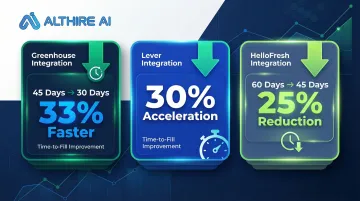
Delays between hiring stages are one of the most common reasons strong candidates accept offers elsewhere. ATS integration compresses those gaps and keeps momentum in the process. Research shows significant improvements: Greenhouse customers reduced time-to-hire from 45 to 30 days (33% reduction), while Lever customers achieved 30% acceleration in time-to-fill after integrating with their HRIS. Another example: HelloFresh reduced time-to-fill from 60 to 45 days by adding interview scheduling automation.
Slower hiring means longer vacancies, higher temporary staffing costs, and lost productivity—all of which have measurable dollar impact. For revenue-generating roles, each day a position remains vacant can cost thousands in lost revenue contribution.
KPIs impacted:
- Time-to-hire
- Time-to-fill
- Offer acceptance rate
- Vacancy duration
- Cost-per-hire
When this advantage matters most:
Speed gains are most significant during high-volume hiring periods, competitive talent markets, or when filling revenue-generating roles where vacancy cost is high.
Eliminated Manual Errors and Duplicate Data Entry
Without integration, recruiters manually transfer candidate information between systems—copying names, contact details, application status, and assessment scores from one platform to another. This introduces errors, inconsistencies, and wasted time.
ATS integration solves this: data entered once in the ATS flows automatically to connected tools, and updates in connected tools (such as a background check result or an interview score) write back to the ATS without human intervention.
Why this is an advantage:
A single data error—a wrong email address, a missed stage update, or a mis-recorded offer amount—can derail a hire, create compliance risks, or damage candidate trust. Recruiters spend 14% of their time on ATS data entry and updates, representing 3.6 hours per week per recruiter that could be reclaimed through integration.
In regulated industries, inaccurate candidate records create audit and compliance exposure. Federal contractors face particular risk: analysis of OFCCP data shows 18.1% of compliance evaluations found organizations unprepared, with recordkeeping being the top cited violation. Integration reduces that surface area by creating a unified, auditable system of record.
KPIs impacted:
- Data accuracy rate
- Recruiter hours saved per week
- Compliance audit readiness
- Rework rate
When this advantage matters most:
This is especially critical at scale. The higher the volume of candidates and the more tools in the stack, the greater the compounding risk of manual errors.
Improved Recruiter Productivity and Candidate Experience
ATS integration frees recruiters from the administrative work that crowds their days: status updates, email triggers, manual data transfers. That time shifts toward candidate engagement, stakeholder alignment, and the judgment calls that actually require a human.
Candidates feel the difference too. When systems are connected, responses arrive faster, communication stays consistent, and the application process doesn't stall waiting for someone to manually push data to the next tool.
Why this is an advantage:
Recruiter burnout and candidate drop-off are both symptoms of process friction. Integration directly reduces the administrative load that drives both. One company saved approximately 1,226 hours per year across recruiting, finance, and compensation teams through custom ATS integration. Another organization saved the equivalent of 1.5 full-time employees by integrating background checks into their ATS.
Research shows 60% of job seekers quit in the middle of filling out online applications due to their length or complexity. When systems are integrated and processes streamlined, drop-off rates decline significantly. Lever customers saw offer acceptance rates rise to 81%, correlated with increased integration usage.
When recruiters have more time for meaningful candidate interaction, they make better assessments, reduce bias risk, and improve the quality of hire.
KPIs impacted:
- Recruiter productivity (roles managed per recruiter)
- Candidate satisfaction/NPS
- Offer decline rate
- Application completion rate
When this advantage matters most:
This advantage is highest-impact at companies where recruiters manage high requisition loads (the median is 20 requisitions per recruiter annually, rising to 60 for extra-large organizations) or where candidate experience is a competitive differentiator for talent attraction.
Real-World Examples of ATS Integration in Action
ATS integration looks different depending on which tools are connected. The following examples represent the most common and highest-value integration points across a typical hiring workflow.
AI-Powered Interview Platforms
When a candidate reaches the interview stage in the ATS, an AI interview platform like AltHire AI is triggered automatically—sending the candidate an interview invitation, conducting the structured AI interview, and syncing the detailed report and candidate score back into the ATS for recruiter review, with no manual handoff required.
ensures all candidate data lands in one place, preventing missed applications and fragmented records. Research shows a 48-hour delay between application and ATS review can result in the best applicants accepting other offers.
Background Verification Platforms
Once a candidate reaches the pre-offer or offer stage in the ATS, candidate data is automatically sent to a background check provider. Results are returned and recorded in the ATS without requiring recruiter action to transfer information.
The value: Reduces the time between offer and clearance, eliminates manual data re-entry for sensitive PII, and creates a consistent compliance record within the ATS. One organization reduced time-to-hire by 3 days and saved 1.5 FTEs in administrative effort through background check integration.
Onboarding and E-Signature Tools
When an offer is accepted in the ATS, the new hire's data—name, role, start date, compensation details—automatically populates in the onboarding or e-signature platform, triggering document generation and the digital signing workflow.
New hires begin onboarding immediately after acceptance, reducing time-to-productivity and eliminating the gap between offer acceptance and first-day readiness. One study found integration reduced onboarding time by 4 days, from 28.75 to 22.62 days.
What Happens When ATS Integration Is Missing
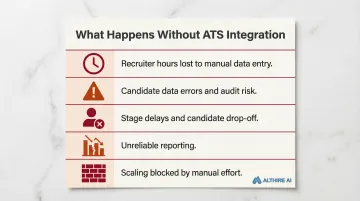
Missing ATS integration doesn't show up as one big failure. It bleeds out through friction — slowly, across every workflow, until the cumulative cost becomes hard to ignore.
Common consequences of operating without ATS integration:
- Recruiter hours disappear into manual data entry, status updates, and cross-platform coordination. For a recruiter managing four open roles monthly, administrative tasks can consume nearly 850 hours per year
- Candidate data drifts across disconnected systems, increasing audit risk and introducing errors into offers, communications, and compliance records
- Stages stall between handoffs — candidates wait days for next steps that automation could trigger instantly, leading to drop-off and lost offers
- Reporting becomes unreliable when data lives in separate tools instead of flowing into a single source of truth in the ATS
- Growth hits a wall — every new hire added to the pipeline means more manual effort, not more capacity, limiting how fast a team can actually scale
How to Get the Most Value from ATS Integration
ATS integration delivers its full value only when applied consistently across the hiring workflow, not just at one or two touchpoints.
The integrations that drive the most impact share three characteristics:
- Cover every stage where data moves manually: from sourcing through onboarding, not just job posting or application intake. Each manual handoff you eliminate compounds time savings and reduces error risk.
- Stay actively monitored: sync errors, failed triggers, and data mismatches should be caught and resolved quickly — not discovered during an audit or a candidate complaint.
- Feed decisions, not just dashboards: candidate scores, status updates, and reports only create value when hiring teams actually use them. Integration that generates data no one reviews adds complexity without benefit.
The tools you choose also shape how quickly you realize that value. Native ATS integrations — those built into the platform rather than requiring custom API work — go live in hours or days. Custom-built connections often take weeks and introduce ongoing maintenance overhead. Where native options exist, they're almost always the faster path to a functioning, reliable workflow.
Conclusion
ATS integration's value lies in the control it gives recruiters over the hiring process—data flows reliably, stages progress without manual prompting, and every stakeholder from candidate to hiring manager sees consistent information.
These gains compound when integration runs end-to-end rather than in isolated pockets. Faster time-to-hire, fewer errors, better recruiter productivity, and stronger candidate experience all reinforce each other. Organizations that connect their full hiring stack have documented time-to-hire reductions ranging from 30% to 47%.
Those results don't hold on autopilot. Teams that sustain hiring efficiency over time treat ATS integration as living infrastructure: reviewing connections regularly, expanding coverage as the stack grows, and acting on the data it surfaces. That operational discipline is what separates a one-time setup from a lasting competitive edge in talent acquisition.
Frequently Asked Questions
Is 72 a good ATS score?
A score of 72 is generally considered competitive, though thresholds vary by ATS platform and role requirements. Most systems treat scores above 70 as a strong match. That said, a high ATS score alone does not determine hiring outcome — recruiters still evaluate context, experience, and fit.
What is ATS integration and how does it work?
ATS integration connects an applicant tracking system with other tools in the hiring stack via APIs, so candidate data flows automatically between platforms. This eliminates manual data entry and keeps hiring stages in sync without recruiter intervention.
Which tools can be integrated with an ATS?
The main categories include:
- Job boards and sourcing platforms
- AI interview platforms
- Background check providers
- Onboarding and e-signature tools
- HRIS systems
Most modern ATS platforms support dozens of tools via API, with some offering 20+ pre-built connections.
How does ATS integration improve the candidate experience?
Integrated systems eliminate delays between hiring stages, send faster and more consistent communications, and remove the need for candidates to repeat information across platforms. Research shows offer acceptance rates as high as 81% for companies using multiple integrations — a direct signal of improved candidate satisfaction.
What are the most common challenges with ATS integration?
The most frequent issues are data field mismatches between systems, delayed or failed syncs, and maintaining integrations as ATS platforms release updates. Selecting tools with native ATS integration support reduces these risks significantly.
How long does it take to set up ATS integration?
Setup time varies: native integrations built into both platforms can be activated in hours or days, while custom-built API connections may take weeks. Using platforms that already support your ATS (like tools offering 20+ native integrations already built in) cuts this timeline to hours or days.