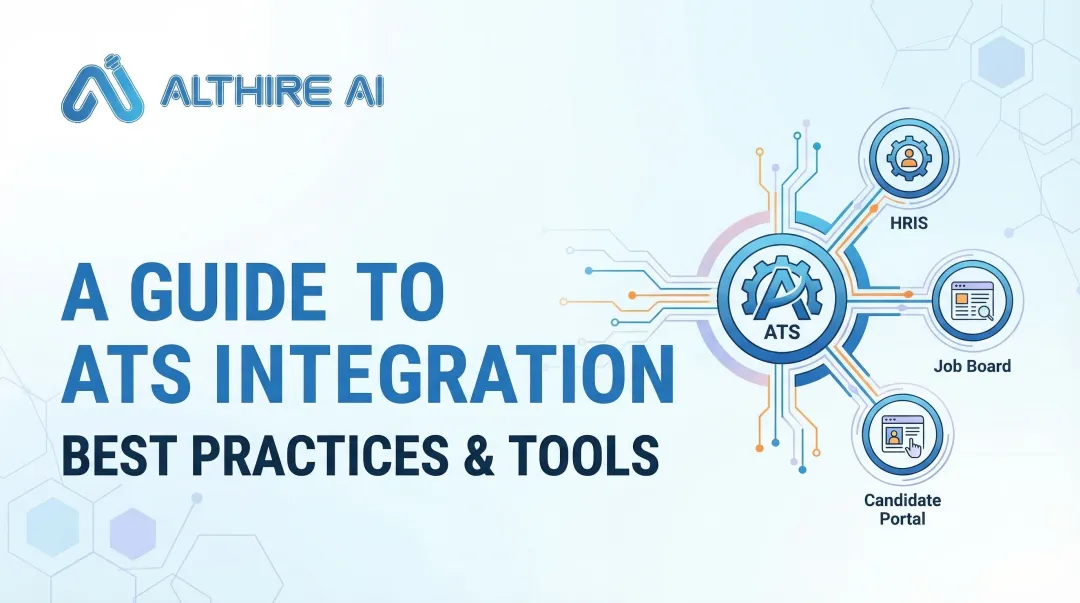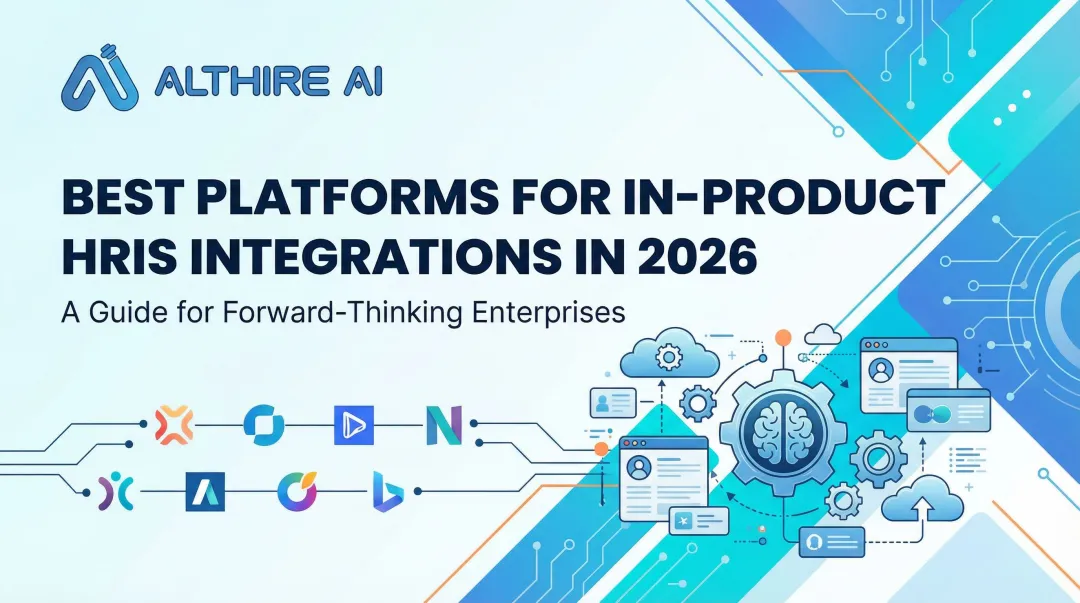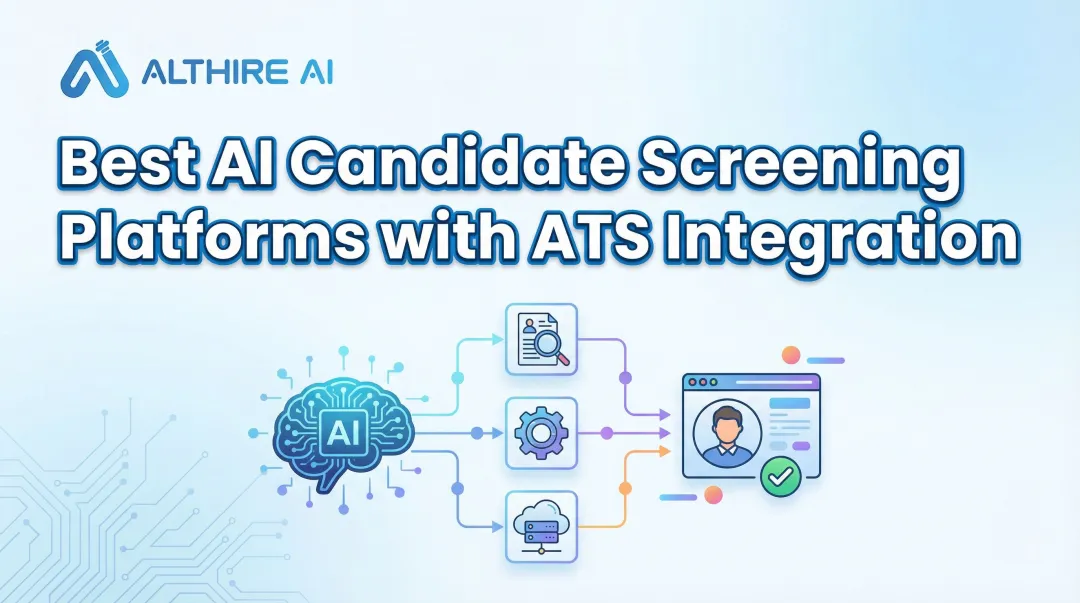
In-product ATS integrations solve this problem by transforming your ATS from a passive record-keeping system into an active hiring engine. The right integrations eliminate swivel-chair workflows, keep candidate records synchronized in real time, and surface richer evaluation data exactly where hiring teams need it—inside the ATS itself.
Key Takeaways
- In-product ATS integrations connect specialized recruiting tools to your ATS, automating workflows and eliminating data silos
- The right integrations cut manual admin, eliminate data silos, and accelerate hiring decisions with real-time synchronization
- Key categories include integration infrastructure (Merge), AI interviewing (AltHire AI), scheduling automation (GoodTime), skills assessments (TestGorilla), and interview intelligence (Metaview)
- AltHire AI syncs AI interview scores, transcripts, and proctoring reports automatically across 20+ ATS platforms
- Evaluate integrations on bi-directional data flow, field-level mapping depth, and security compliance, not just feature lists
What Are In-Product ATS Integrations?
In-product ATS integrations are software tools that plug directly into your applicant tracking system to extend its capabilities without requiring manual data transfer. These integrations enable specialized recruiting platforms—interview tools, assessment systems, scheduling software—to read candidate data from your ATS, perform their function, and write results back into candidate profiles automatically.
Three Integration Approaches
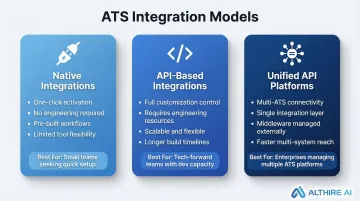
Organizations typically choose from three integration models, each with distinct trade-offs:
Native Integrations
- Built directly into the ATS and activated with a few clicks
- Offer tight governance and seamless user experience
- Limited to tools the ATS vendor chooses to support
- Best for teams standardized on a single enterprise suite
API-Based Integrations
- Connect directly using the ATS's published API
- Provide full control over data mapping and custom fields
- Require engineering resources to build and maintain
- Ideal for a few strategic, high-volume connections
Unified API Platforms
- Use middleware like Merge to connect multiple tools through one endpoint
- Abstract maintenance complexity and normalize data across systems
- May limit access to highly specific custom objects
- Best for rapid multi-ATS expansion
Why This Matters for Talent Teams
The productivity drain is measurable. Beyond the 16 hours per week spent scheduling, 60% of companies reported increased time-to-hire in 2024 due to rising application volumes and manual processing constraints. 60% of recruiters cite poor integration as their greatest frustration with HR technology.
Those frustrations have a measurable downstream cost. Shallow integrations that only sync basic fields lead to continued manual entry, duplicate records, and reduced visibility. The result: only 3% of companies use all functionality within their ATS, and fewer than 20% are highly satisfied with their current provider.
Best Platforms for In-Product Integrations With ATS Tools
Each platform below earns its spot through deep ATS compatibility, measurable workflow impact, and adoption by recruiting teams across industries.
Merge
Merge is a unified API platform that lets software companies build integrations with entire categories of tools—including 40+ ATS systems—through a single API endpoint, making it the go-to infrastructure layer for product teams building recruiting or HR software.
What makes it different: Merge abstracts the complexity of maintaining dozens of individual API connections, normalizes data across ATS platforms, and provides enterprise-grade observability and security. Rather than building and maintaining separate connectors for Greenhouse, Lever, Workday, and 37 other systems, product teams integrate once with Merge's unified API and gain immediate access to the entire ecosystem. The platform is certified for SOC 2 Type II, ISO 27001, HIPAA, GDPR, and CCPA, making it suitable for enterprise deployments handling sensitive candidate data.
| Attribute | Details |
|---|---|
| Key Use Case | Unified API infrastructure for building multi-ATS product integrations |
| ATS Platforms Supported | 40+ including Greenhouse, Lever, Ashby, Workable, BambooHR, Workday |
| Best For | Product/engineering teams embedding ATS integrations into their own software |
AltHire AI
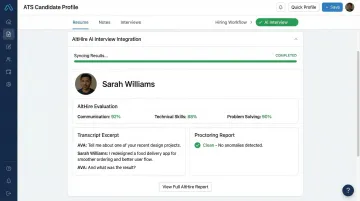
AltHire AI is an AI-powered interview platform that conducts adaptive, human-like interviews 24/7 and syncs candidate results, transcripts, and structured evaluation reports directly into the hiring team's ATS—supporting 20+ integrations with platforms like Greenhouse, Lever, Ashby, Workable, and BambooHR.
The integration advantage: AltHire AI eliminates the gap between interview execution and ATS record-keeping by pushing AI-generated candidate reports, comprehensive proctoring data, and multidimensional scoring directly into the ATS pipeline. The platform automatically syncs complete video recordings, time-stamped transcripts, question-by-question evaluation scores, and detailed integrity monitoring flags—including identity verification results, behavioral alerts, and AI answer detection—into candidate profiles.
This reduces screening time by up to 60% and saves recruiters 33+ hours per week without any manual data re-entry. Most integrations can be completed in just a few days, and the platform delivers 350+ weekly interviews across its customer base with 100% AI proctoring.
| Attribute | Details |
|---|---|
| Key Use Case | AI-conducted interviews with automated ATS sync of scores, transcripts, and reports |
| ATS Integrations | 20+ including Greenhouse, Lever, Ashby, Workable, BambooHR, JazzHR, iCIMS, Jobvite |
| Best For | Recruiting teams and enterprises looking to automate structured interviews at scale |
GoodTime
GoodTime is an interview scheduling automation platform that integrates with ATS systems to coordinate multi-panel interviews, send candidate-facing booking links, and log confirmed interview slots back into the ATS without recruiter involvement.
Where it delivers: GoodTime reduces scheduling time significantly by reading interviewer calendar availability in real time and automating the entire coordination loop. The platform reports an 88% reduction in time spent scheduling, with third-party case studies like Remote documenting a 42% reduction in time to schedule and 50% reduction in time spent scheduling. For high-volume or enterprise hiring where scheduling bottlenecks slow pipeline velocity, GoodTime's bi-directional ATS sync ensures interview confirmations, cancellations, and rescheduling all update candidate records automatically. The platform is certified for SOC 2 Type II, SOC 3, ISO 42001, GDPR, and CCPA.
| Attribute | Details |
|---|---|
| Key Use Case | Automated interview scheduling synced with ATS candidate records |
| ATS Platforms Supported | Greenhouse, Lever, Workday, iCIMS, SmartRecruiters, SAP SuccessFactors, Jobvite |
| Best For | Enterprise recruiting teams with complex multi-panel interview coordination |
TestGorilla
TestGorilla is a pre-employment skills assessment platform that integrates with ATS systems to automatically trigger candidate tests, track completion, and push scores and results directly into candidate profiles within the ATS.
Key advantage: TestGorilla offers 350+ pre-built assessments covering technical skills, cognitive ability, and role-fit—and its ATS integrations ensure that assessment data enriches candidate profiles without requiring recruiters to leave the ATS to review results. This enables objective, bias-reduced screening at the top of the funnel.
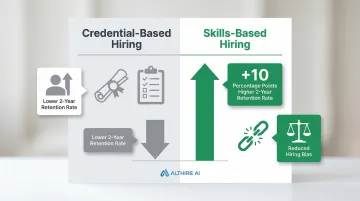
Research shows that skills-based hiring reduces bias and improves accuracy, with non-degreed candidates hired into roles that dropped degree requirements showing a 10-percentage point higher two-year retention rate. The platform supports plug-and-play integrations with major systems and is certified for SOC 2 Type II, ISO 27001, and GDPR.
| Attribute | Details |
|---|---|
| Key Use Case | Pre-employment skills testing with score syncing to ATS candidate profiles |
| ATS Platforms Supported | Greenhouse, Lever, Workable, SmartRecruiters, iCIMS, SAP SuccessFactors, Workday |
| Best For | Teams standardizing skills-based screening across high-volume roles |
Metaview
Metaview is an AI-powered interview intelligence platform that records, transcribes, and analyzes live interviews, then pushes structured notes, summaries, and candidate insights directly into the ATS—replacing manual note-taking and inconsistent feedback with structured, searchable data.
Why the data quality matters: Metaview's ATS integrations (Greenhouse, Ashby, Lever, Workday, and more) ensure that every interview produces a consistent, high-quality record in the ATS, enabling hiring managers to compare candidates on structured criteria and improving overall interview quality over time. Peer-reviewed research demonstrates that structured employment interviews significantly improve hiring consistency and validity. Metaview puts this into practice by auto-generating structured summaries that sync with ATS workflows, reducing manual note-taking and accelerating decision-making. The platform is SOC 2 Type II certified and compliant with GDPR and CCPA.
| Attribute | Details |
|---|---|
| Key Use Case | AI interview transcription and structured notes auto-synced to ATS |
| ATS Platforms Supported | Greenhouse, Ashby, Lever, Workday, SmartRecruiters, iCIMS, BambooHR |
| Best For | Recruiting teams that want to capture richer, more consistent candidate data from every interview |
How We Chose the Best ATS Integration Platforms
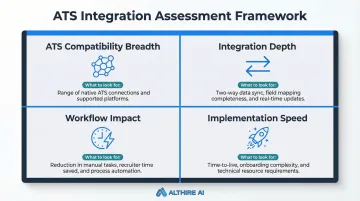
Evaluating ATS integration platforms requires looking beyond feature lists. Each platform below was scored on four dimensions:
- ATS compatibility breadth — How many major systems are supported with named, published connectors? Vague "ATS integration" claims often mean manual CSV exports, not real-time API connections.
- Integration depth — Does data flow bi-directionally in real time? Deep integrations sync candidates, applications, interviews, scorecards, and offers — including custom fields. Shallow ones fragment workflows and force recruiters to switch systems.
- Workflow impact — Does the integration eliminate whole categories of manual work (scheduling, note-taking, data re-entry) or surface insights — like AI interview scores — that wouldn't otherwise exist?
- Implementation speed — Can recruiters activate it in days, or does it require an engineering sprint? Faster setup means faster ROI and less dependency on technical teams.
The Most Common Selection Mistake
Teams often choose tools based solely on feature lists without verifying actual ATS connector depth. Many platforms claim "ATS integration" but only support one-way data pushes or require manual CSV exports. The SHRM warns that integration definitions vary widely, from manual flat-file uploads to custom APIs. Look for platforms with published API documentation, named ATS connectors, and evidence of bi-directional sync.
Non-Negotiable Evaluation Criteria
Integration security and data compliance should be baseline requirements, especially when candidate PII flows between systems. Under GDPR Article 28, the ATS customer acts as the Data Controller while the integration platform acts as the Data Processor, requiring formal Data Processing Agreements and documented security measures. SOC 2 Type II certification is the industry standard for SaaS vendors processing candidate data, proving that security controls operate effectively over time.
Conclusion
The right in-product ATS integrations do more than add features. They turn your ATS into a single source of truth where interview data, assessment scores, scheduling confirmations, and AI-generated insights flow in automatically. This eliminates the swivel-chair workflows that consume 16+ hours of recruiter time each week and ensures hiring decisions are based on complete, synchronized candidate records rather than fragmented data across disconnected tools.
Start by identifying your biggest manual bottleneck — interview coordination consuming entire afternoons, inconsistent evaluations from poor note-taking, or skills screening that stalls pipeline progression. Then follow these steps before expanding your stack:
- Prioritize the integration that eliminates that bottleneck first
- Verify it supports true bi-directional sync with your specific ATS
- Confirm security certifications are in place
AltHire AI integrates with 20+ ATS platforms out of the box, delivering structured candidate reports, complete transcripts, and proctoring data directly into your existing hiring workflows. Explore a demo to see how automated interviews can reduce screening time by 60% while maintaining data integrity across your recruiting stack.
Frequently Asked Questions
What is ATS integration?
An ATS integration is a software connection that allows an applicant tracking system to share data automatically with other recruiting or HR tools, eliminating manual data entry and syncing candidate records across platforms automatically.
Does every company use ATS now?
ATS adoption is nearly universal among large enterprises—99% of Fortune 500 companies use an ATS regularly, and 70% of large companies overall. However, only 20% of small and mid-sized businesses currently use a dedicated ATS.
What is the difference between native and third-party ATS integrations?
Native integrations are built into the ATS and activated in a few clicks, but are limited to tools the vendor supports. Third-party integrations use the ATS's API or middleware (like Merge or Zapier) to connect a broader ecosystem of tools the ATS doesn't natively cover.
How do in-product ATS integrations improve recruiter productivity?
Integrations cut redundant data entry, automate status updates, and surface interview and assessment data inside the ATS. Recruiters spend 16 hours per week on scheduling alone—automation reclaims that time for higher-value hiring decisions.
Can small businesses benefit from ATS integrations?
Yes, even small teams benefit, particularly from scheduling and assessment integrations that cut coordination time. Many platforms offer free tiers or pay-per-use pricing that makes integration accessible without enterprise budgets, and implementation timelines as short as a few days minimize disruption.