Introduction
Modern HR teams juggle an average of 10–15 software tools to manage hiring, onboarding, payroll, and performance management. When these systems don't communicate, the result is predictable: data silos, manual re-entry, and hiring delays that cost both time and money. HR professionals spend up to 14 hours per week on administrative tasks tied to data entry and system updates—time that could go toward strategic hiring instead.
In-product HRIS integrations solve this by building data synchronization directly into the platform—no separate connector tools, no manual workarounds. The setup is part of the product experience itself.
The right integration reduces onboarding delays, closes compliance gaps, and frees recruiters from repetitive data entry. This guide covers the platforms doing it best in 2026.
Key Takeaways
- In-product HRIS integrations are native data connections built directly into a platform—no separate iPaaS tools required
- Top platforms offer broad connector coverage, real-time bidirectional sync, and low setup friction out of the box
- Top picks: Rippling, Workday HCM, BambooHR, Greenhouse, and Ashby
- Evaluate platforms on connector depth, sync frequency, how they surface errors, and their security model
- The right choice cuts onboarding delays, closes compliance gaps, and eliminates repetitive recruiter tasks
What Are In-Product HRIS Integrations?
An in-product HRIS integration is a native data connection built directly into a software platform. It automatically syncs employee records, job data, and workflow triggers with an HRIS — no standalone middleware like Workato or Boomi required.
In-Product vs. Middleware Integrations
While tools like MuleSoft or Workato offer powerful connectivity, in-product integrations deliver distinct advantages:
- Setup happens within the product UI — no separate platform to configure
- The platform provider handles API updates, not your team
- Data flows and sync status are visible directly inside the product
- HR teams can activate integrations without heavy IT involvement
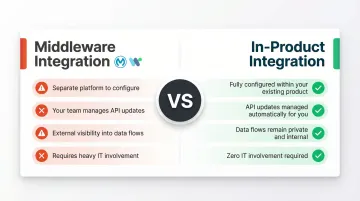
As native integration ecosystems mature, the key question isn't whether a platform connects to your HRIS — it's how much of the underlying data it actually uses, and whether that sync holds up when APIs change.
Best Platforms for In-Product HRIS Integrations in 2026
These platforms were selected based on integration breadth, connector depth, data sync quality, ease of setup, and overall reliability within their core product experience.
Rippling
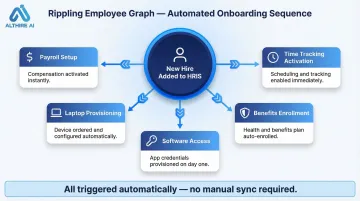
Rippling is an all-in-one workforce management platform that natively unifies HR, IT, and finance data in a single employee record, enabling automated actions across 500+ connected apps the moment an employee event occurs.
The "Employee Graph" architecture is what sets it apart: when data changes in one module (such as a new hire in HRIS), it instantly propagates across payroll, app provisioning, and time tracking without manual sync or middleware. Onboarding a new employee automatically triggers laptop provisioning, software access, payroll setup, and benefits enrollment in a single workflow.
| Aspect | Details |
|---|---|
| Key Features | Unified employee data layer; 500+ app integrations; real-time cross-system triggers; automated onboarding and offboarding workflows |
| Best For | Mid-market to enterprise companies wanting a single system of record that drives all HR and IT actions |
| Notable HRIS Integrations | Workday, ADP, BambooHR, Greenhouse, Okta, Slack, and 500+ more |
Workday HCM
Workday HCM is an enterprise-grade human capital management platform with a native integration cloud that connects its HR, payroll, and recruiting modules to a wide ecosystem of third-party tools, all within the Workday product environment.
The Workday Extend framework allows enterprises to build custom in-product integrations on top of core Workday data without leaving the platform. Native integration templates provide structured data mapping for complex organizational hierarchies.
That depth makes Workday the go-to for multi-entity enterprises that need governance-grade controls across every integration layer.
| Aspect | Details |
|---|---|
| Key Features | Native integration cloud; pre-built connector templates; Workday Extend for custom in-product builds; real-time and batch sync options |
| Best For | Large enterprises with complex, multi-entity HR environments requiring governance-grade integration controls |
| Notable HRIS Integrations | SAP SuccessFactors, ADP, Oracle HCM, Greenhouse, HireVue, and major payroll/benefits providers |
BambooHR
BambooHR is a widely adopted SMB and mid-market HRIS with 125+ native integrations built directly into the platform, covering ATS, payroll, LMS, performance management, and recruiting tools.
A clean, well-documented API and an in-product marketplace make BambooHR the default HRIS that many recruiting and interview platforms connect to first. Most connections require just a few clicks to authenticate and configure, so teams can activate data sync in hours rather than days.
| Aspect | Details |
|---|---|
| Key Features | 125+ marketplace integrations; clean REST API; native ATS and onboarding modules; two-way data sync with leading recruiting tools |
| Best For | Small to mid-sized businesses seeking straightforward HRIS integration without enterprise complexity |
| Notable HRIS Integrations | Greenhouse, Lever, Workable, Docebo, ADP, TalentLMS, Absorb LMS |
Greenhouse
Greenhouse is a leading applicant tracking system that has built deep, native HRIS integrations directly into its recruiting product, enabling automated candidate data flow between ATS and HRIS the moment a hire is made.
It stands out for bidirectional sync with major HRIS platforms, structured data mapping (job codes, departments, cost centers), and pre-built connectors maintained by Greenhouse, which reduces IT burden on HR teams. According to Greenhouse's integration directory, the platform officially supports over 400 pre-built integrations, including 36 dedicated HRIS connectors.
When a candidate is marked as "hired," Greenhouse automatically exports offer and profile data to the HRIS via secure SFTP or AWS S3 with PGP encryption, syncing salary, job code, cost center, and pay frequency without manual re-entry.
| Aspect | Details |
|---|---|
| Key Features | Native HRIS sync at point of hire; structured department and job code mapping; pre-built and certified connectors; in-product data validation |
| Best For | Companies using Greenhouse as their ATS who want seamless new hire data to flow into their HRIS without manual re-entry |
| Notable HRIS Integrations | Workday, BambooHR, Rippling, ADP, UKG, SAP SuccessFactors |
Ashby
Ashby is a modern, API-first recruiting platform that has embedded deep HRIS integration capabilities directly into its product, built for fast-growing tech companies that prioritize data integrity across their hiring and HR stack.
A developer-friendly integration model paired with an in-product sync dashboard gives recruiting teams real-time visibility into data flows between Ashby and their HRIS, without needing engineering support. Custom field mapping and structured analytics keep recruiting and HR data consistent across systems, so nothing needs to be reconciled manually.
| Aspect | Details |
|---|---|
| Key Features | API-first architecture; real-time HRIS sync; in-product integration dashboard; custom field mapping; structured analytics across recruiting and HR data |
| Best For | High-growth tech companies and startups that need reliable, flexible HRIS integration within a modern ATS |
| Notable HRIS Integrations | Workday, BambooHR, Rippling, Personio, HiBob |
How We Chose These Platforms
Platforms were assessed on integration depth (not just connector count), sync reliability (real-time vs. batch), bidirectional data flow, ease of in-product setup, and vendor maintenance responsibility. A common mistake buyers make is choosing platforms based on the number of listed integrations rather than verifying what data actually syncs.
Why Connector Depth Matters More Than Count
According to research on HRIS API marketplaces, a marketplace with 100 deep, bidirectional integrations is far more valuable than one with 500 shallow, one-way syncs. Shallow field coverage forces manual dual-entry for edge cases, while deep integrations handle complex data types like pay changes, benefit elections, and organizational structure updates.
For example, Greenhouse's HRIS Link for ADP Workforce Now demonstrates true connector depth by mapping critical fields including job codes, department codes, cost centers, salary, and pay frequency—but it's explicitly labeled a "partial platform integration" requiring specific onboarding templates and practitioner permissions to function. Not all native connectors offer equal depth.
Business Impact of Integration Quality
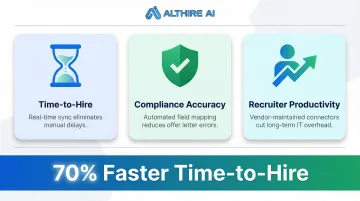
Connector depth directly affects:
- Time-to-hire - Real-time sync eliminates manual data entry delays
- Compliance accuracy - Automated field mapping reduces errors in offer letters and employment contracts
- Recruiter productivity - Vendor-maintained integrations reduce long-term IT overhead compared to self-managed custom builds
That last point—vendor maintenance—is where platform choice has the most long-term impact. AltHire AI, for instance, supports 20+ ATS and HRIS integrations natively, with AI-powered interview workflows that trigger automatic data handoffs to the HRIS without manual steps. The result: 70% faster time-to-hire with no added integration overhead on the recruiter's side.
Conclusion
Choosing a platform for in-product HRIS integrations means evaluating the depth, reliability, and maintenance model of its native connections—not just the number of logos on its integrations page. The right choice reduces data silos, speeds up hiring workflows, and eliminates manual re-entry at every stage of the employee journey.
If you're building or optimizing your HR tech stack, AltHire AI offers an AI-powered interview platform with 20+ native HRIS and ATS integrations. Teams using it have cut time-to-hire by 70% without adding integration overhead.
Ready to see it in action? Explore AltHire AI or book a free consultation to see how tighter integrations can speed up your hiring process.
Frequently Asked Questions
What does HRIS stand for?
HRIS stands for Human Resource Information System—a software platform that stores employee data and manages core HR functions like onboarding, payroll, benefits, and compliance in a centralized system.
What is an HRIS integration?
An HRIS integration is an automated connection between an HRIS and another business tool (ATS, payroll, LMS, etc.). It syncs employee data across systems, eliminating manual data entry and keeping records consistent throughout your HR tech stack.
What are the top HRIS systems?
Leading HRIS platforms in 2026 include Rippling, Workday HCM, BambooHR, ADP Workforce Now, and SAP SuccessFactors. Company size and integration needs should guide the choice—SMBs often prefer BambooHR's simplicity, while enterprises require Workday's governance controls.
What are the types of HRIS systems?
The main types are operational HRIS (core employee data and transactions), tactical HRIS (recruitment, training, compensation), and strategic HRIS (workforce planning, analytics). Modern platforms often combine all three capabilities in a unified system.
What are the 7 core HR processes?
The 7 core HR processes are:
- Recruitment
- Onboarding
- Payroll
- Benefits administration
- Performance management
- Learning and development
- Offboarding
A well-integrated HRIS automates data flow across all of them, reducing manual work and errors.
What should I look for in a platform's in-product HRIS integration?
Go beyond the integration count. Evaluate these five factors:
- Connector depth: which specific data fields actually sync
- Sync frequency: real-time vs. batch updates
- Bidirectional flow: whether data moves both ways
- Vendor ownership: who maintains the connector over time
- Security model: how data is protected in transit and at rest
Ask vendors for concrete examples of data mapping and error handling before committing.