Introduction
By 2025, 51% of organizations were already using AI to support recruiting efforts, making it the most common HR application of artificial intelligence. For most hiring teams, it's no longer optional infrastructure. Applicants per opening rose 11% year-over-year, while hiring windows keep shrinking and recruiting teams face mounting pressure to deliver quality talent faster.
The pressure points are familiar: manual screening collapses under volume, traditional sourcing can't keep pace with demand, and inconsistent interview practices introduce bias that creates compliance risk.
AI recruiting software has moved well past basic applicant tracking. Today's platforms use machine learning to automate sourcing, screening, interviewing, and analytics work that previously consumed entire recruiter days.
This guide breaks down which AI features deliver real impact in 2026 — from adaptive interview agents to predictive analytics and bias detection systems.
Key Takeaways
- AI recruiting software automates sourcing, screening, interviewing, and analytics using machine learning, freeing hours of recruiter time per week
- Essential 2026 features: AI interview agents, predictive analytics, bias detection, and advanced proctoring
- The right platform cuts time-to-hire while improving candidate quality through objective, skills-based evaluation
- Match features to your specific bottlenecks—screening volume, interview consistency, or sourcing reach—rather than chasing feature count
What Is AI Recruiting Software?
AI recruiting software applies machine learning, natural language processing, and automation across the full hiring lifecycle—from candidate sourcing through final selection—rather than simply storing and tracking applications like a traditional ATS.
Traditional ATS vs. AI-Powered Recruiting:
The difference is fundamental. A traditional ATS functions as a system of record: it posts jobs, collects applications, tracks candidate status, and maintains communication history. Manual resume review takes 30 seconds to 3 minutes per candidate, and recruiters spend 6-14.6 hours per week on manual sourcing.
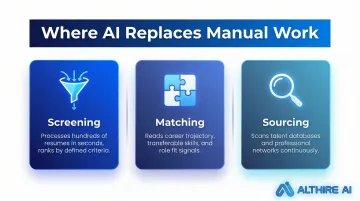
AI-powered recruiting tools transform this reactive workflow into an intelligent, proactive system. Instead of waiting for applications to arrive, the software works continuously across three areas:
- Screening: Processes hundreds of resumes in seconds, extracting skills and ranking candidates against defined criteria
- Matching: Reads contextual signals—career trajectory, transferable skills, role fit—rather than just filtering by keywords
- Sourcing: Scans talent databases and professional networks to surface qualified candidates without human intervention
Spotting Genuine AI Capability:
"AI-powered" has become overused marketing language. Genuine AI capability shows up in three ways:
- Learns from hiring outcomes and adapts its recommendations over time
- Provides explainable scoring so you understand why a candidate ranks where they do
- Improves accuracy as it processes more data, not just more rules
Automation that applies fixed rules and never improves is scripted workflow, not AI.
Must-Have AI Recruiting Software Features for 2026
AI-Powered Candidate Sourcing and Matching
AI sourcing tools continuously scan job boards, professional networks, and talent databases to surface qualified candidates automatically. This eliminates the manual search work that typically consumes 6-14.6 hours of recruiter time weekly, freeing teams to focus on relationship-building rather than database mining.
Intelligent candidate matching moves beyond keyword filtering. AI analyzes contextual signals including career trajectory, transferable skills from adjacent roles, and role fit patterns based on successful hires. Rather than requiring exact keyword matches, these systems understand that a "Marketing Manager" with CRM experience may fit a "Customer Success Lead" role based on skill overlap and career progression patterns.
The impact on quality-of-hire is measurable: 24% of organizations using AI for recruiting report improved ability to identify top candidates, according to SHRM's 2025 research.
Automated Resume Screening and Ranking
Corporate job postings receive varying application volumes—typically 11-50 applicants per role based on recent surveys—but even modest volumes create screening bottlenecks when handled manually. AI resume screening processes hundreds of applications in seconds, extracting skills, experience, and qualifications while ranking candidates against defined criteria.
The time savings are substantial: academic research documents a 70% reduction in screening time—from 120 minutes to just 36 minutes per 100 resumes. This efficiency gain allows recruiters to focus evaluation time on top-ranked candidates rather than sifting through unqualified applications.
The best tools incorporate a learning loop: they improve ranking accuracy over time based on which candidates were ultimately hired and how they performed. The more hiring data processed, the sharper the predictions become.
AI Interview Automation and Adaptive Questioning
AI interview agents conduct structured, conversational interviews 24/7—the defining capability for 2026 is adaptive questioning, where the AI follows up dynamically based on each candidate's actual responses rather than running a fixed script.
AltHire AI demonstrates this at scale, delivering 350+ weekly interviews through agents that assess skills, culture fit, and potential beyond resume credentials—probing deeper into specific competencies as each conversation unfolds.
AI Proctoring: Now a Core Requirement
Advanced platforms now monitor interview integrity through behavioral and environmental signals. AI proctoring detects multiple faces in frame, tracks eye movements that suggest looking away from the screen, identifies multiple voices or background noise indicating external assistance, and flags tab switches or screen activity that suggests answer lookup.
The technology analyzes coding patterns for unnatural speed or copy-paste behavior, detects AI-generated responses by matching known output patterns, and verifies identity through real-time face comparison—ensuring every candidate is evaluated under fair, consistent conditions.
Human oversight remains essential: flagged events are reviewed by analysts to ensure context-aware, fair outcomes while protecting candidate trust.
Predictive Analytics and Hiring Insights
Predictive analytics forecasts which candidates are most likely to accept an offer, perform well, and stay long-term. Studies document accuracy rates above 95% in identifying at-risk employees—though the real value comes from acting on those predictions, not just generating them.
What a Strong 2026 Dashboard Includes:
Real-time visibility into key metrics helps leaders identify bottlenecks and prove ROI:
- Funnel metrics: Applicants per opening, conversion rates between stages, interview-to-offer ratio, offer acceptance rate
- Source ROI: Hires by source, cost-per-hire by source, quality-of-hire (1-year retention) by source
- Time metrics: Time-to-fill, time-to-hire, time spent in each stage, pipeline velocity
- Quality indicators: First-year retention rates, ramp time to productivity, hiring manager satisfaction scores
- Diversity analytics: Applicant flow by demographic, selection rates by cohort, representation at each funnel stage
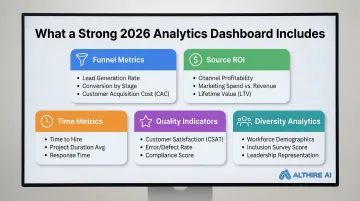
These dashboards reveal patterns that manual tracking misses, enabling continuous process improvement.
Bias Detection and DEI Analytics
AI bias detection analyzes job descriptions for exclusionary language, anonymizes candidate data during initial screening, and flags demographic skews in selection patterns. The stakes are twofold: fairness outcomes and legal compliance exposure.
How Bias Detection Works:
The mechanism combines statistical testing and structured audits:
- Disparate impact testing compares selection rates across protected groups using the EEOC's four-fifths rule as a guideline
- Fairness metrics measure demographic parity (equal selection rates), equalized odds (equal true/false positive rates), and predictive parity (equal probability of success for a given score)
- Counterfactual testing involves swapping names associated with different genders or ethnicities to see if the AI's score changes
- Explainability analysis uses techniques like SHAP to identify which features most influence decisions, uncovering reliance on proxies for protected attributes
Critical Nuance—AI Can Amplify Bias:
AI trained on historically skewed data will replicate and scale those biases. Models can learn to use proxy features—zip codes, educational institutions, speech patterns—as stand-ins for protected characteristics, producing discriminatory outcomes even when demographic data is explicitly removed.
Responsible AI design means building in accountability from the start:
- Auditable models with transparent scoring criteria
- Human review checkpoints at key decision stages
- Continuous monitoring for model drift over time
Regulations including the EU AI Act, NYC Local Law 144, and EEOC guidance now mandate bias audits, explainability requirements, and human oversight for AI hiring tools.
ATS Integration and Workflow Automation
Even feature-rich AI recruiting tools lose value if they operate in a silo. Seamless ATS integration means bi-directional data sync, candidate status updates flowing automatically, and zero duplicate data entry.
AltHire AI supports 20+ ATS integrations including Greenhouse, Lever, Ashby, Workable, BambooHR, JazzHR, iCIMS, Jobvite, Smart Recruiters, Recruitee, and BreezyHR. This integration coverage represents the benchmark for robust connectivity—data flows in real time without manual intervention.
Workflow Automation Beyond Integration:
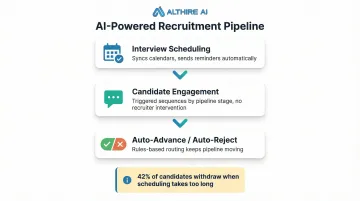
Comprehensive automation includes:
- Interview scheduling that syncs calendars and sends reminders automatically—critical since 42% of candidates withdraw from processes when scheduling takes too long
- Candidate engagement sequences triggered by pipeline stage, maintaining communication without recruiter intervention
- Auto-advance or auto-reject rules that keep processes moving based on defined criteria, eliminating bottlenecks
The Real Benefits of AI Recruiting Software
Faster Time-to-Hire and Time-to-Fill
AI recruiting software compresses hiring timelines through automated screening, intelligent sourcing, and instant interview availability. Organizations leveraging AI report approximately 21% faster time-to-fill, with some platforms documenting reductions from 48 days to 41 days year-over-year.
The acceleration comes from eliminating wait time: AI screens hundreds of resumes instantly, sources candidates continuously rather than in batches, and conducts interviews 24/7 without scheduling delays.
Improved Quality of Hire
Objective, skills-based evaluation removes the inconsistency of human screening and expands the candidate pool beyond active job seekers. AI matching surfaces passive candidates whose career trajectory and transferable skills indicate strong fit—people who wouldn't have applied through traditional channels.
24% of organizations using AI for recruiting report improved ability to identify top candidates, according to SHRM research. Better-matched hires mean higher retention, faster ramp time, and stronger performance over the long run.
Recruiter Productivity Gains
Automating repetitive tasks—screening, scheduling, follow-up emails—frees recruiters to focus on relationship-building, negotiation, and offer conversion. The time savings add up fast:
- Academic research documents 70% reductions in screening time, saving 8-12 hours per 100 applications
- Recruiters spending 6-14.6 hours weekly on manual sourcing reclaim 33+ hours per week through automation
Better Candidate Experience
Productivity gains inside the recruiting team also show up on the candidate side. AI tools keep applicants informed around the clock—instant acknowledgment, automated status updates, and on-demand interview access replace the silence that kills candidate confidence.
This reduces candidate drop-off and strengthens employer brand, especially in competitive talent markets where 42% of candidates withdraw when scheduling takes too long.
How to Choose the Right AI Recruiting Software for Your Team
Start with Your Actual Bottlenecks
If your biggest pain is screening volume, prioritize AI resume ranking and automated filtering. If it's interview consistency, focus on structured AI interview tools with standardized scorecards. If it's sourcing reach, invest in AI-powered candidate discovery. Avoid buying on feature count alone — unused capabilities don't deliver ROI.
Evaluate Integration Depth and Scalability
Before committing, verify the platform connects natively with your core systems:
- ATS and HRIS: Native connections are more reliable than third-party middleware
- Calendar tools: Scheduling automation only works if it syncs without friction
- Future ATS migrations: Check whether the integration survives a platform switch
Ask vendors explicitly which integrations are native versus middleware-dependent. Then stress-test the scalability question: can the platform handle 100 interviews monthly today and 1,000 next year without slowing down?
Demand AI Transparency and Compliance
Any AI tool influencing hiring decisions should offer explainable scoring — not a black box where you can't understand why candidates rank as they do. The platform must support GDPR/EEOC-compliant data handling and allow human override at every decision point.
Request documentation on how the model was trained, what data it uses, and how bias is monitored over time. Vendors should provide bias audit results from within the last 12 months and show a clear process for ongoing remediation — not just a one-time review.
Common Mistakes to Avoid When Adopting AI Recruiting Tools
Treating AI as a Full Replacement for Human Judgment
AI is most effective as an augmentation layer: it surfaces, ranks, and screens, but final hiring decisions should always involve human review. Teams that remove humans from the loop entirely risk compliance issues, candidate experience failures, and systematic errors from model drift.
Regulations like the EU AI Act and EEOC guidance explicitly require human oversight for high-risk AI systems. Human reviewers provide context that AI cannot — understanding unique career paths, evaluating soft skills through conversation, and making judgment calls on borderline candidates.
Skipping Change Management
Even the best AI recruiting platform underperforms if recruiters don't trust or understand the outputs. Only 17% of HR professionals rate their AI implementation as 'highly successful,' often due to poor change management.
A solid rollout plan makes the difference. To give your team the foundation they need:
- Onboard recruiters with hands-on training before go-live
- Train teams to interpret AI scores, not just accept them
- Build feedback loops so the system learns from real hiring outcomes
- Explain what signals the AI weighs most heavily and when to override it

Without this groundwork, recruiters revert to manual workarounds that undermine the tool's value.
Frequently Asked Questions
What is AI recruitment software?
AI recruitment software applies machine learning and automation across the hiring lifecycle—sourcing, screening, interviewing, and analytics—to help teams hire faster and more accurately than manual processes allow. It goes beyond traditional ATS functionality by actively making intelligent recommendations rather than just tracking applications.
What is the AI-powered recruitment process?
The process moves through four connected stages, each with human review at key decision points:
- Automated sourcing and matching surfaces qualified candidates continuously
- AI screening ranks applicants by fit against role criteria
- AI interview agents conduct structured assessments with adaptive questioning
- Predictive analytics inform final hiring decisions
What can AI do for recruiters?
Recruiters gain the most by offloading volume work: resume screening, interview scheduling, and initial candidate ranking. AI surfaces better-matched candidates faster, reduces bias through objective scoring, and shifts recruiter time toward interviews and offer conversations. 89% of HR professionals using AI for recruiting report time savings.
What are the features of ATS?
Core ATS features include job posting, application tracking, candidate pipeline management, and communication history. AI recruiting software extends beyond the ATS by adding intelligent matching, predictive analytics, automated screening, and adaptive interviewing—capabilities that traditional ATS platforms don't provide.
How does AI reduce bias in recruitment?
Three mechanisms do the most work: resume anonymization removes names and demographic information, standardized scoring criteria apply consistently to every candidate, and job description analysis flags exclusionary language. The caveat worth noting—AI can introduce bias if trained on skewed historical data, so model auditing and human oversight aren't optional.
What should I look for when choosing AI recruiting software?
Focus on three criteria before committing:
- Feature fit: Does it address your actual bottleneck—screening volume, interview consistency, or sourcing reach?
- Native integrations: Does it connect directly to your existing ATS and HR stack without middleware?
- Auditable AI: Does the vendor provide bias monitoring documentation and compliance support?