Introduction
Pricing pages for AI recruiting software are often vague, gated behind demos, or listed as "contact us"—leaving HR teams unable to budget confidently before entering a sales cycle. This opacity has real consequences: teams underbudget for year one, lock into the wrong pricing model, or get hit with unexpected costs at renewal.
AI recruiting software pricing varies enormously—from $15/user/month for budget ATS tools to $35,000+/month for enterprise-grade platforms—depending on tool type, pricing model, team size, and features required.
According to Mordor Intelligence, the AI in recruitment market is projected to reach $640.99 million in 2026. Over 51% of HR organizations now use AI somewhere in their recruiting workflows, which means more vendors, more pricing models, and more room for costly mismatches.
This guide breaks down real pricing ranges by tier, the factors that move costs up or down, what's typically included versus hidden, and a framework to estimate the right budget for your situation.
Key Takeaways
- AI recruiting software ranges from ~$15/user/month (budget tools) to $35,000+/month (enterprise platforms), with most teams landing in the $99–$599/month range for mid-market solutions
- Pricing model matters as much as price—per-seat, per-job, per-candidate, and flat enterprise contracts can make the "cheapest" option expensive fast if not matched to your hiring volume
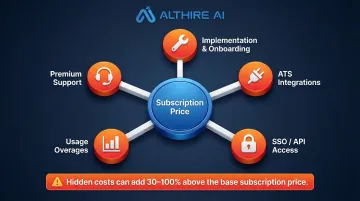
- Hidden costs (implementation, integrations, ATS connectors, training, overages) routinely add 30–100% on top of the subscription price
- Budget for the pricing model that minimizes time-to-hire and cost per screened candidate at your hiring volume, not just the lowest sticker price
How Much Does AI Recruiting Software Cost in 2026?
AI recruiting software does not have a fixed price—costs vary significantly based on tool type (ATS, sourcing, AI interview, full-suite), team size, hiring volume, and features required. Misunderstanding pricing leads to predictable budget problems: underbudgeting for year one, choosing the wrong pricing model, and getting caught off guard by hidden costs at renewal.
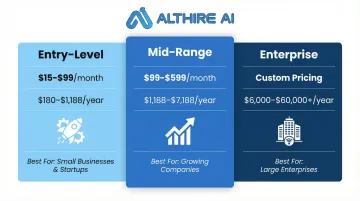
Pricing Overview by Tier:
| Tier | Monthly Cost | Annual Cost | Best For |
|---|---|---|---|
| Entry-Level | $15–$99 | $180–$1,188 | Small businesses, startups, low-volume hiring |
| Mid-Range | $99–$599 | $1,188–$7,188 | Growing companies, recruitment agencies, moderate volume |
| Enterprise | Custom | $6,000–$60,000+ | Large enterprises, complex workflows, global teams |
Entry-Level / Budget Tools ($15–$99/month)
Entry-level tools cover the essentials: basic ATS features, AI candidate scoring or matching, limited job postings, standard integrations, and self-serve support.
Common options in this range include:
- Manatal — from $15/user/month (billed annually) with AI candidate enrichment, automated recommendations, and AI-generated job descriptions
- Recooty — starts at $79/month with AI resume parsing and scoring
- Juicebox.ai — from $79/month with AI sourcing agents and talent insights
Best suited for small businesses, startups, and teams with straightforward hiring needs under 10 hires per month.
As hiring volume and workflow complexity grow, mid-range platforms start to justify the step up in cost.
Mid-Range AI Recruiting Platforms ($99–$599/month)
Mid-range platforms deliver more depth: adaptive interviews, AI proctoring, video screening, structured scorecards, analytics dashboards, team collaboration tools, and broader ATS integrations. Setup is typically faster than enterprise tools, with less reliance on vendor implementation.
Platforms operating in this range include:
- Spark Hire — $249/month (billed annually) with unlimited one-way and live video interviews, AI video review, AI summaries, and 49 native ATS integrations
- Hireflix — $150/month (medium plan) with unlimited positions and users
- AltHire AI — AI-powered adaptive interviews, 100% AI proctoring, and 20+ ATS integrations designed for teams targeting 70% faster time-to-hire
Best suited for growing companies, recruitment agencies, and teams in technology, healthcare, finance, and education with 10–50 hires per month.
For organizations with complex procurement requirements or multi-country hiring operations, enterprise platforms are the next step.
Enterprise / Full-Suite Platforms ($6,000–$60,000+/year or custom)
Enterprise contracts are fully custom, typically including SSO/SAML, audit logs, dedicated customer success managers, SLA guarantees, deep HRIS integrations, compliance controls, and full-lifecycle hiring capabilities.
Enterprise tools like Greenhouse, iCIMS, HireVue, and Paradox operate in this range. Pricing is never published: vendors require custom quotes based on company size, hiring volume, required integrations, and compliance needs.
Best suited for large enterprises with complex, cross-team hiring workflows, global teams, and strict security or procurement requirements — typically 50+ hires per month or 500+ employees.
Key Factors That Drive AI Recruiting Software Pricing
Pricing is shaped by a mix of technical, operational, and business factors. Understanding what drives costs up or down helps teams avoid over-specifying and overspending.
Type of AI Recruiting Tool
Not all AI recruiting software does the same thing—ATS platforms, sourcing automation tools, AI interview/screening platforms, and conversational AI chatbots are priced very differently.
Sourcing tools like Fetcher use plan-based pricing with usage caps—the Growth plan costs $379/month (1 user seat, 500 candidates/year), while the Amplify plan is $649/month (2 user seats, 1,000 candidates/year). Lusha uses a credit-based model at $37.45/month for 4,800 annual credits.
AI interview platforms typically offer monthly or annual subscriptions based on active jobs or user accounts. Spark Hire starts at $299/month for 5 active jobs and 5 users.
Conversational AI chatbots vary by target market. Mya offers transparent tiers at $199/month (Basic) and $499/month (Premium), while Paradox (Olivia) requires custom enterprise quotes.
Compare tools within the same category—sourcing vs. sourcing, interview platform vs. interview platform—to get pricing that actually means something.
Hiring Volume and Usage Scale
Per-candidate or per-interview pricing models mean costs scale directly with volume—a good fit for low-volume hiring, but potentially expensive during peak or spike months. Per-seat models work best for stable teams, while per-job models suit high-volume inbound roles.
Example: A company normally screens 100 candidates per month at $5 per screening = $500/month. During a spike month with 300 candidates, the bill jumps to $1,500—a 200% increase. Under a flat per-seat model at $299/month for unlimited screenings, the cost stays constant regardless of volume.
Number of Users and Seats
Seat-based pricing can become expensive when platforms charge for every hiring manager, not just recruiters. Before signing, clarify exactly who counts as a paid seat:
- Active recruiters conducting interviews almost always count as paid seats
- Hiring managers who only review reports may or may not be charged
- Admin and viewer roles are sometimes free, sometimes not
- Unlimited seat models exist and can significantly reduce costs for larger teams
Critical pre-purchase question: "Who counts as a paid seat?" The answer can change your annual cost by thousands.
AI Feature Depth and Sophistication
More advanced AI capabilities—adaptive conversational interviews, AI proctoring, real-time scoring, bias-detection, multi-language support, and detailed analytics—command higher price points.
Basic AI (keyword matching, resume parsing) costs far less than platforms with true conversational AI. AltHire AI, for instance, adjusts follow-up questions in real-time based on each candidate's actual responses—role-specific customization that static question banks can't replicate.
Integration Requirements and ATS Compatibility
Native integrations with ATS platforms (Greenhouse, Lever, Workable, BambooHR, Ashby) are often included at mid-range tiers, but deep custom integrations, SSO, and API access typically sit behind higher tiers or carry separate fees.
Integration costs are easy to miss in initial quotes but can add thousands to year-one spend. Platforms that support 20+ ATS integrations out of the box—AltHire AI connects natively with Greenhouse, Lever, Ashby, Workable, and BambooHR, among others—reduce that risk by eliminating custom build fees entirely.
What's Included in the Price — and What Costs Extra
The subscription fee is rarely the full cost. Understanding what's bundled versus billed separately is where most budgeting errors happen.
Here's what typically appears — and what typically doesn't — on the invoice:
Core subscription / license Covers the base platform, standard AI features, and usage within plan limits. What counts as "standard" varies widely — confirm specifically which AI features are included versus add-on, such as proctoring, video interviews, assessments, and analytics reporting.
Implementation and onboarding Often a one-time cost, but frequently absent from pricing pages. Fees range from $0 for self-serve tools to several thousand dollars for enterprise platforms requiring configuration, data migration, and stakeholder training. SHRM and Software Advice note that implementation fees can start at a few hundred dollars for basic setups and climb significantly for advanced configurations — making this one of the most commonly missed budget line items.
Integrations and ATS connectors Some platforms include standard integrations across all plans; others charge per integration or lock API access to higher tiers. Custom field mapping, HRIS connections, and SSO/SAML are almost always enterprise-only or add-on costs.
Manatal, for instance, includes SSO and API access only in its Enterprise Plus Plan. Spark Hire lists both as paid add-ons. Platforms that natively support 20+ ATS integrations out of the box reduce this cost risk considerably.
Overages, usage caps, and premium support Per-candidate or per-interview billing means costs can spike in high-volume months. AI feature usage — token caps, transcription limits, proctoring minutes — may also be capped at plan thresholds.
Dedicated customer success managers, faster SLA response times, and priority support are typically enterprise add-ons. As a safeguard, model at least one "spike month" scenario before signing: quantify your financial exposure and negotiate for contractual controls like real-time usage dashboards and hard spending caps.
AI Recruiting Software Pricing Models Explained
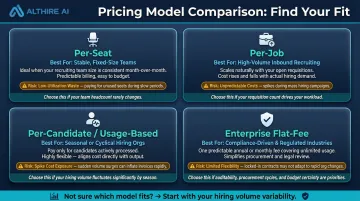
Four pricing models dominate the AI recruiting software market, and the right one depends on your team's size, hiring cadence, and compliance requirements.
| Pricing Model | Best For | Key Consideration |
|---|---|---|
| Per-seat (per-user) | Stable teams with predictable headcount | You pay per account whether active or not — risky if utilization is low |
| Per-job/requisition | Fewer open roles with high applicant volume | Suits high-volume inbound roles like retail or customer service |
| Per-candidate/usage-based | Variable or seasonal hiring | Costs scale with activity — low risk in slow months, but spikes during peak periods |
| Enterprise flat-fee | Teams where SSO, compliance, and SLAs are non-negotiable | Custom annual contracts offer budget certainty but limited flexibility |
Hybrid models (base subscription + usage fees) are increasingly common. They combine a predictable baseline cost with usage-based flexibility, making them a practical middle ground for growing teams with fluctuating hiring cycles.
Decision Matrix:
- If team size is stable → per-seat
- If hiring spikes seasonally → usage-based
- If managing many high-volume roles → per-job
- If security and governance are priorities → enterprise contract
Negotiation tip: As noted by HR tech consultants, buyers can often propose alternative pricing structures (for example, per-candidate-contacted instead of per-seat)—vendors selling SaaS at scale have flexibility, especially for annual commits.
How to Estimate the Right Budget (and Mistakes to Avoid)
4-Step Budget Estimation Framework:
Start by identifying your bottleneck. Are you losing time on sourcing, screening, or scheduling? The answer determines which tool type actually moves the needle.
Estimate hiring volume for both a normal month and a spike month. Average months are misleading — your busiest quarter is where pricing models get stress-tested.
Run the math across pricing models. Apply your normal and spike volumes to per-seat, per-candidate, and per-job structures to see which scales most affordably for your pattern.
Add a TCO buffer for implementation, integrations, training, and overages. According to OutSail, companies should budget an additional 50–75% on top of vendor quotes to cover costs that rarely appear in the initial pitch.
That buffer pays for itself quickly when the tool performs. AltHire AI, for example, documents 70% faster time-to-hire and 33+ recruiter hours saved per week. At a median recruiter hourly wage of $35.05, that's $1,157 in weekly savings — or $60,164 per recruiter annually.
Even with clear ROI potential, several common missteps can inflate costs or invalidate those projections.
Common Mistakes to Avoid
- Focusing only on the subscription sticker price without modeling TCO
- Ignoring what happens to the bill during a spike hiring month
- Choosing the cheapest tool without evaluating reliability, integration depth, or AI quality
- Over-specifying enterprise features (SSO, custom SLAs) when a mid-market solution would fully meet needs
- Failing to validate contract terms (auto-renewal clauses, overage rules, data export rights) before signing
Practical note: The best way to validate actual cost is to run a real pilot — screen real candidates, not a guided demo — before committing budget. Many mid-market AI recruiting platforms offer free trials or try-before-you-buy models for this reason.
Frequently Asked Questions
How much does AI recruiter cost?
AI recruiting software ranges from ~$15/user/month for budget ATS tools to $35,000+/month for enterprise platforms, with most growing teams spending $99–$599/month for capable mid-range AI interview or screening tools. The actual cost depends heavily on team size, hiring volume, and the pricing model.
What is the cheapest AI recruiting software available?
Manatal starts at $15/user/month (billed annually), Recooty from $79/month, and Juicebox from $79/month. Free tiers exist but typically restrict AI features, integrations, or candidate volume—making them suitable for very small teams or initial evaluation only.
What pricing model is best for AI recruiting software?
There is no universally "best" model—per-seat works for stable teams, per-candidate suits variable hiring volume, per-job fits high-volume inbound roles, and enterprise flat-fee makes sense when security and SLAs are mandatory. The right model depends on your hiring pattern.
What hidden costs should I watch out for when buying AI recruiting software?
The most common hidden costs include implementation and onboarding fees, ATS integration costs, SSO/SAML and security add-ons, premium support tiers, and overages when hiring volume exceeds plan limits. These can add 30–100% to the headline subscription price.
Is AI recruiting software worth the investment?
For most teams, yes. Platforms like AltHire AI report a 50% reduction in recruiting costs and 33+ recruiter hours saved per week. At mid-market price points, those gains typically offset the subscription cost within the first few hiring cycles.
How do I calculate the ROI of AI recruiting software?
Compare (platform fees + implementation + integrations) against (recruiter hours saved × hourly cost + reduction in cost per hire × annual hires + faster time-to-fill value). Tracking cost per screened applicant before and after adoption gives you the most direct, like-for-like comparison.