![9 Best AI Tools for HR in 2026 [Free & Paid Options]](https://file-host.link/website/althire-vm3u5n/assets/blog-images/e40a4a04-5e4f-48ff-80f1-d9f34d883f8c/1774995710177705_e2a3d5f51c20485698d1ddf31f92e553/360.webp)
Introduction
HR teams are under pressure from every direction: hire faster, cut costs, and keep employees engaged—all at once. It's no surprise that 72% of HR professionals now use AI tools, up from just 26% in 2024, especially when 41% of employees' daily time goes toward work that doesn't contribute to organizational value. AI is where teams are reclaiming that time.
Today's AI HR tools span the full employee lifecycle—from automated candidate screening and AI-powered interviews to performance management and 24/7 employee self-service. Options exist for every budget and team size, whether you're a 10-person startup or a Fortune 500 enterprise.
This article covers the 9 best AI tools for HR in 2026, organized by core function—recruiting and interviewing, employee engagement and feedback, and HR operations. Each entry includes pricing, key features, and recommendations for who the tool suits best.
Key Takeaways
- AI tools now cover the full employee lifecycle—recruiting, interviewing, onboarding, engagement, and HR operations
- These 9 tools fall into three functions: recruiting/interviewing, engagement/feedback, and HR operations
- Free options like ChatGPT lower the barrier to entry; AltHire AI handles interview automation while Lattice focuses on engagement
- Choose based on company size, hiring volume, budget, and where manual work drains the most time
- Combining tools across functions outperforms any single all-in-one platform
Why HR Teams Are Turning to AI in 2026
The core problem is clear: 41% of employees' time every day is spent on work that doesn't contribute to the value their organization creates. For HR professionals, this translates to hours lost on administrative tasks—scheduling interviews, screening resumes, answering policy questions—instead of strategic work like culture building and talent development.
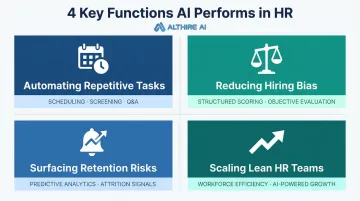
AI is now handling four key functions in HR:
- Automating repetitive tasks — Scheduling, screening, policy Q&A, and onboarding documentation
- Reducing bias in hiring — Structured evaluations and objective scoring replace subjective impressions
- Surfacing engagement and retention risks early — Predictive analytics flag attrition signals before employees resign
- Enabling lean HR teams to scale — Small teams can manage larger workforces without proportional headcount growth
89% of HR professionals using AI in recruiting report it saves time or increases efficiency. That efficiency compounds quickly: with average cost-per-hire at $5,475 for nonexecutive roles and $35,879 for executive hires, any tool that reduces screening time or improves quality of hire delivers immediate ROI.
The tools below are grouped into three functional categories—Recruiting & Interviewing, Engagement & Feedback, and HR Operations—so you can zero in on the area where your team is losing the most time.
9 Best AI Tools for HR in 2026
Tools were selected based on depth of AI functionality, ease of deployment, pricing transparency, user reviews, and fit across company sizes—not just brand recognition.
Category 1: Recruiting & Interviewing
AltHire AI
AltHire AI is an AI-powered interview platform built for talent acquisition teams that need to screen and evaluate candidates at scale. It conducts adaptive, human-like interviews 24/7 and integrates with 20+ ATS platforms including Greenhouse, Lever, Ashby, Workable, and BambooHR.
The platform's AI adapts follow-up questions based on each candidate's actual responses—not a fixed script. Teams report 70% faster time-to-hire and a 60% reduction in screening time, with bias-free structured scoring and AI-generated reports.
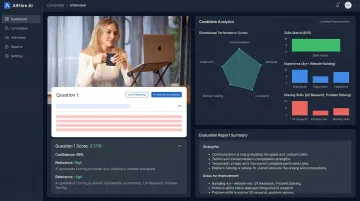
The interview engine analyzes responses in real time, adjusting difficulty and probing deeper based on what each candidate reveals. For technical roles, it includes coding assessments across multiple languages. For functional roles, it evaluates communication, problem-solving, and culture fit through scenario-based questions.
Built-in proctoring covers:
- Camera verification, screen monitoring, and audio integrity checks
- Detection of multiple voices, AI-generated responses, and impersonation attempts
- Question-by-question evaluations with time-stamped video transcripts
- Dimensional performance scores and comprehensive proctoring details
| Key Features | AI interview agents, adaptive questioning, advanced proctoring, ATS integrations, detailed analytics reports |
|---|---|
| Pricing | Custom pricing based on hiring volume; free consultation available at calendly.com/rajeev-althire/30min |
| Best For | Recruiting teams, staffing agencies, and enterprises running high-volume technical or functional hiring |
HireVue
HireVue is a structured video interviewing platform used by enterprise HR teams to standardize candidate evaluation across large hiring pipelines. The system records candidate video responses to predetermined questions, then applies AI analysis against structured evaluation frameworks.
AI-scored video interviews reduce time spent on first-round screening and improve consistency across interviewers. Rather than five hiring managers applying five different standards, HireVue evaluates every candidate against the same criteria. The platform also includes virtual job tryouts, conversational AI, and automated scheduling.
HireVue holds a 4.1/5 star rating on G2 based on 254 reviews and 4.4/5 stars on Gartner Peer Insights from 24 ratings.
| Key Features | AI-scored video interviews, structured evaluation, bias reduction through standardization, candidate analytics |
|---|---|
| Pricing | Custom enterprise pricing; available upon request |
| Best For | Enterprise companies conducting structured, high-volume interviews for the same role |
Eightfold AI
Eightfold AI is a talent intelligence platform that uses deep learning to match candidates to roles based on skills and career trajectory—not just resume keywords or job titles. The system analyzes billions of data points to understand how skills transfer across roles and industries.
Eightfold surfaces internal candidates for open roles, flags skills gaps for reskilling, and provides bias-aware recommendations that look beyond educational pedigree or employer name. STMicroelectronics saved 160+ hours in two months with workflow automation and achieved a 75% interview-to-offer rate.
Eightfold was recognized as a Leader in the 2025 IDC MarketScape for Worldwide Talent Intelligence, validating its position in the enterprise talent management space.
| Key Features | Skills-based matching, internal mobility engine, workforce planning analytics, bias-aware candidate recommendations |
|---|---|
| Pricing | Custom enterprise quote based on employee count; no public pricing |
| Best For | Mid-to-large organizations focused on skills-based hiring and internal talent development |
Category 2: Employee Engagement & Feedback
Lattice
Lattice is an AI-enhanced performance management platform that helps HR teams run continuous feedback cycles, track OKRs, and identify disengagement risks before they become attrition. The platform combines performance reviews, goal tracking, and engagement surveys in one system.
AI surfaces recurring feedback themes per employee and flags performance or engagement trends, enabling managers to have better-informed 1:1 conversations. Instead of performance reviews being a checkbox exercise, Lattice turns them into a growth driver—with personalized development plans and AI-generated comment summaries.
Lattice holds a 4.7/5 star rating on G2 based on 4,069 reviews, reflecting strong user satisfaction.
| Key Features | AI feedback analysis, OKR tracking, engagement surveys with predictive insights, 1:1 meeting templates |
|---|---|
| Pricing | Talent Management base: $11/seat/month; add-ons include Engagement (+$4/seat/month), Grow (+$4/seat/month), Compensation (+$6/seat/month) |
| Best For | HR teams running structured performance reviews and continuous feedback programs |
Culture Amp
Culture Amp is an employee experience platform that adds sentiment analysis and predictive analytics to engagement surveys, helping HR leaders understand why employees feel the way they do—not just that they're disengaged. The platform analyzes open-text feedback to identify recurring themes and early warning signs.
AI-powered benchmarking against industry data surfaces actionable recommendations for managers, along with early attrition risk signals derived from survey patterns. The AI Coach feature gives managers personalized nudges based on their team's feedback—turning survey data into concrete next steps.
Culture Amp holds a 4.5/5 star rating on G2 based on 1,541 reviews and was evaluated in The Forrester Wave: Employee Experience Management Platforms, Q2 2025.
| Key Features | Engagement surveys, sentiment analysis, predictive attrition insights, manager coaching nudges, industry benchmarking |
|---|---|
| Pricing | Custom quote based on employee count and modules (Engage, Perform, Develop); billed annually |
| Best For | HR teams at growth-stage and enterprise companies prioritizing data-driven engagement strategy |
Leena AI
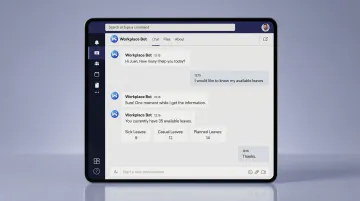
Leena AI is an AI-powered HR virtual assistant that handles employee queries—policy questions, benefits, PTO, onboarding documentation—around the clock, reducing HR ticket volume significantly. The platform operates as an agentic AI colleague that connects to existing HRIS systems and policy documents.
Employees get accurate, instant answers without routing every question to the HR team. The system integrates with Workday, SAP SuccessFactors, ServiceNow, BambooHR, Jira, Slack, and Microsoft Teams. Analytics show which questions are asked most often, signaling gaps in employee communication. According to Leena AI, the virtual assistant automatically resolves up to 90% of employee queries.
| Key Features | 24/7 HR chatbot, HRIS integration, policy and document search, ticket analytics, onboarding support |
|---|---|
| Pricing | Enterprise quote-based pricing driven by employee headcount and modules |
| Best For | Mid-size to enterprise HR teams looking to reduce helpdesk load and improve employee self-service |
Category 3: HR Operations & Management
BambooHR
BambooHR is a full-featured HRIS platform built for small to mid-sized businesses that has added AI-powered reporting and insights to its core HR functions—employee records, time-off tracking, hiring, onboarding, and payroll. The platform consolidates HR data in one place, eliminating the need for multiple disconnected systems.
Its AI capabilities predict turnover risk, identify compensation inequities, and surface policy recommendations from workforce data patterns. The "Ask BambooHR" assistant answers HR questions instantly, and AI-powered eNPS insights track employee sentiment—all within a single platform that doesn't require a dedicated HR ops team to maintain.
BambooHR holds a 4.4/5 star rating on G2 based on 4,052 reviews, with particular praise from SMB users.
| Key Features | Core HRIS, AI-powered reporting, ATS, onboarding workflows, employee self-service portal |
|---|---|
| Pricing | Core: $10/employee/month; Pro: $17/employee/month; Elite: $25/employee/month; free trial available |
| Best For | Small businesses (10–500 employees) that need one system to manage core HR functions with built-in AI insights |
Workday
Workday is an enterprise-grade human capital management (HCM) platform with AI functionality embedded across recruiting, talent mobility, reporting, and performance management. It's commonly used by Fortune 500 HR teams managing complex, global workforces.
AI recommendations within Workday help managers make faster decisions on compensation, promotions, and role transitions by surfacing relevant workforce data—rather than requiring manual analysis across siloed HR systems. Workday Illuminate, the platform's next-generation AI, powers Skills Cloud for skills-based hiring and workforce planning.
| Key Features | AI-powered HCM, recruiting automation, talent mobility, workforce analytics, payroll integration |
|---|---|
| Pricing | Enterprise contract-based pricing; no public per-employee list pricing |
| Best For | Large enterprises (500+ employees) needing an integrated HR platform with deep AI capabilities across all HR functions |
ChatGPT (Free AI Tool for HR)
ChatGPT is a free generative AI tool that HR professionals use to draft job descriptions, write policy documents, create onboarding FAQs, generate interview questions, and craft employee communications. No specialized HR software required. 66% of organizations use AI to generate job descriptions, making it one of the most common HR use cases.
Practical limitations: outputs require human review for compliance, tone, and accuracy. ChatGPT doesn't connect to internal HR systems, and confidential employee data should never be entered into the public version. OpenAI advises users not to enter sensitive information into consumer services. However, as a free starting point for HR writing tasks, it delivers immediate value.
Note: GPT-4o was retired in February 2026, replaced by GPT-4.1 and GPT-5.4 models.
| Key Features | Policy drafting, JD writing, interview question generation, email templates, brainstorming—free to use |
|---|---|
| Pricing | Free (GPT-3.5); ChatGPT Plus: $20/month; ChatGPT Business: $25/user/month (billed annually) |
| Best For | HR professionals at any company size who need a free, flexible AI writing assistant for non-sensitive HR tasks |
How We Chose the Best AI Tools for HR
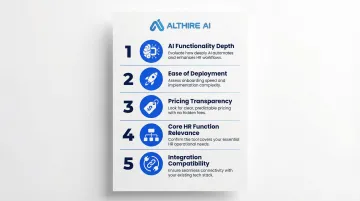
Tools were assessed on five criteria:
- Depth of genuine AI functionality (not just "AI-labeled" features)
- Ease of deployment without months of onboarding
- Pricing transparency and availability of free or trial plans
- Relevance to at least one core HR function — recruiting, engagement, or operations
- Integration compatibility with existing ATS or HRIS systems
The most common mistake HR teams make when evaluating tools: choosing based on brand reputation or feature volume rather than fit to their specific pain point and team size. A 15-person startup and a 5,000-person enterprise need very different tools. The startup benefits most from an all-in-one platform like BambooHR; the enterprise needs integration-heavy platforms like Workday alongside point solutions for recruiting or engagement.
One factor that often gets underweighted is explainable AI outputs. Gartner recommends adopting a responsible AI framework and conducting regular AI system audits to mitigate bias in performance management. HR teams must be able to audit decisions for fairness and compliance — which requires transparency into how AI scoring works.
That transparency issue connects to a broader adoption problem. Common pitfalls to avoid include implementing AI without clear objectives and layering new tools over outdated workflows. 65% of HR leaders cite limited digital skills as a barrier to AI adoption — meaning the most sophisticated tool won't deliver value if your team doesn't know how to use it.
Conclusion
AI tools for HR are no longer optional for teams trying to hire faster, hold onto talent, and scale without adding headcount in lockstep. However, the right tool depends on where your team's time is currently being drained the most.
Start with one category—recruiting, engagement, or operations—rather than overhauling your entire HR tech stack at once. Pilot one tool, measure the outcome (time saved, quality of hire, employee satisfaction), then expand. The best outcomes come from combining tools across functions, not relying on a single all-in-one platform.
If hiring speed is where you're starting, AltHire AI's interview platform automates candidate screening with adaptive, proctored AI interviews—replacing hours of manual review with structured, bias-free assessments. Schedule a consultation to see how it fits your workflow.
Frequently Asked Questions
What are the best AI tools for HR?
The best tools depend on which HR function needs improvement. For recruiting: AltHire AI and HireVue excel at automated interviewing; Eightfold AI leads in skills-based matching. For engagement: Lattice and Culture Amp provide performance management and sentiment analysis. For operations: BambooHR suits SMBs; Workday serves enterprises; Leena AI automates employee queries.
What can AI be used for in HR?
AI covers the full HR lifecycle — sourcing and screening candidates, running adaptive interviews, automating onboarding, answering employee queries 24/7, analyzing engagement data, and predicting attrition risk. According to SHRM, 89% of HR professionals using AI in recruiting say it saves time or increases efficiency.
Are there free AI tools for HR teams?
Yes. ChatGPT is free for drafting job descriptions, policies, and communications. BambooHR, HireVue, and AltHire AI all offer trial or demo access, while Leena AI has limited free tiers for small teams. Enterprise features on most platforms require a paid plan.
How do I choose the right AI HR tool for my company size?
Match the tool to your headcount: small businesses (under 100 employees) benefit most from all-in-one platforms like BambooHR. Mid-market teams (100–500) tend to do better with specialized tools per function — AltHire AI for recruiting, Lattice for performance. Enterprises (500+) typically need integration-heavy platforms like Workday plus targeted point solutions.
Can AI replace HR professionals?
No. AI automates repetitive tasks — screening, scheduling, answering FAQs — but cannot replace human judgment in sensitive decisions, culture-building, conflict resolution, or empathy-driven conversations. AI frees HR professionals from administrative work so they can focus on strategic priorities like talent development, employee experience, and organizational design.
What is the best AI tool for recruiting and interviewing candidates?
AltHire AI stands out for end-to-end interview automation, with adaptive AI interviews, proctoring, and ATS integrations that deliver 70% faster time-to-hire. HireVue is a strong enterprise choice for structured video screening at scale. Eightfold AI leads on skills-based matching and internal mobility. The best fit depends on hiring volume, role complexity, and your existing tech stack.