Introduction
Healthcare organizations face onboarding challenges that go far beyond typical HR paperwork. With the national acute care hospital turnover rate at 18.3% and RN turnover at 16.4%, the average cost of replacing a single bedside nurse has reached $61,110. Meanwhile, credentialing delays of 90 to 120 days cost providers up to $122,000 in lost revenue per physician.
Generic HR onboarding tools simply cannot handle the complexity of healthcare settings, where license verification, HIPAA compliance training, immunization tracking, and clinical competency assessments must all be completed before a new hire can step into a patient-facing role. A lapsed license discovered post-hire creates both a patient safety crisis and a direct legal liability — two risks no compliance team can afford.
The platforms reviewed here are evaluated on compliance capability, workflow automation, ease of use, and integration depth. Each section breaks down what the software does well, where it falls short, and which healthcare settings it fits best — so you can match the right tool to your organization's specific clearance requirements.
Key Takeaways
- Effective healthcare onboarding software covers credentialing, HIPAA compliance, and clinical training—well beyond basic paperwork
- Leading platforms combine automated workflows, e-signatures, document management, and role-specific training tracks
- Leading solutions for 2026 include Medbridge, Absorb LMS, Connecteam, BambooHR, and Rippling
- Match your choice to organization size, workforce type, and existing ATS or HRIS integrations
- Faster pre-hire screening reduces downstream onboarding time and compliance risk
Why Healthcare Onboarding Is Different From Other Industries
Healthcare onboarding extends far beyond standard HR paperwork. Before any clinical staff member can be cleared to work, organizations must complete a checklist that general HR tools weren't built to handle:
- License and credential verification
- HIPAA training and documentation
- Infection control protocol sign-offs
- Immunization tracking
- Background checks
- Role-specific clinical competency assessments
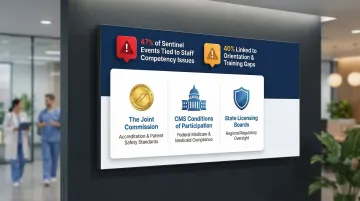
The regulatory stakes are severe. According to The Joint Commission, staff competency issues contribute to 47% of sentinel events. Orientation and training gaps account for another 40%. Non-compliant onboarding puts organizations at risk of accreditation loss, patient safety incidents, and direct legal exposure. Healthcare organizations must meet standards from The Joint Commission, CMS Conditions of Participation, and state licensing boards—all of which require documented, auditable onboarding records.
The platforms evaluated below are assessed specifically for their ability to meet these healthcare-grade requirements, not just as general onboarding tools.
Best Software for Healthcare Staff Onboarding in 2026
These platforms were shortlisted based on the following criteria:
- Compliance depth — HIPAA alignment, audit trails, credentialing support
- Automation capability — workflow triggers, pre-boarding, task assignment
- Healthcare-specific training — clinical onboarding tracks, competency assessments
- Integration — compatibility with leading ATS and HRIS systems
- Workforce fit — suitability for clinical, administrative, and field-based staff
Medbridge
Purpose-built for healthcare organizations, Medbridge serves hospitals, home health agencies, hospice providers, and therapy practices with a clinical LMS that covers onboarding, continuing education, skills competency tracking, and compliance training.
Few platforms are designed exclusively for healthcare staff. Medbridge ships with prebuilt clinical onboarding tracks for nursing, physical therapy, occupational therapy, and speech-language pathology — saving HR teams from building content from scratch.
| Feature Category | Details |
|---|---|
| Key Features | Clinical skills assessments, compliance training modules, guided learning paths, continuing education courses, mobile clinician app, competency tracking dashboards |
| Healthcare-Specific Capability | Prebuilt role-based onboarding tracks for nursing, therapy disciplines, home health, and hospice; OASIS and HHVBP support; nurse engagement and retention tools |
| Pricing | $325–$329 per seat/year for Student, Education, Premium, and Small Business In-Home Essentials plans; BAA included on Pro plans |
Absorb LMS
Absorb LMS is a cloud-based learning management system used across industries including healthcare, offering HIPAA-aligned compliance training delivery, AI-driven learning personalization, and scalable onboarding that works for multi-site health systems with hundreds or thousands of staff.
Its WCAG 2.1 AA accessibility compliance is a practical differentiator — healthcare organizations onboard staff with widely varying digital literacy levels, and ADA requirements aren't optional. The pre-built compliance course library and AI-powered skills gap analysis reduce setup time considerably for large health systems.
| Feature Category | Details |
|---|---|
| Key Features | AI-driven learning recommendations, compliance training automation, gamification, role-based course assignment, reporting dashboards, SCORM support |
| Healthcare-Specific Capability | HIPAA-compliant training modules, audit trails for regulatory documentation, integration with ADP, Workday, SAP SuccessFactors, BambooHR, and Paylocity |
| Pricing | Custom pricing upon request; free trial and demo available; BAA requires custom negotiation |
Connecteam
Connecteam is a mobile-first onboarding and HR platform designed specifically for deskless and field-based workforces—making it an ideal fit for home health aides, traveling nurses, hospice workers, and other healthcare staff who are rarely at a desk.
The single-app approach matters for this workforce type. Field-based healthcare workers can complete compliance document collection, custom training courses, and team communication entirely from their phone — no computer or in-person HR visit required.
| Feature Category | Details |
|---|---|
| Key Features | Mobile onboarding checklists, custom training course builder, compliance document upload, interactive quizzes, time tracking, team chat, employee directory |
| Healthcare-Specific Capability | Ideal for home health, hospice, and traveling nursing staff; supports non-desk onboarding workflows; digital document management ensures compliance from day one |
| Pricing | Free plan for up to 10 users; paid plans from $29/month for up to 30 users; HIPAA-compliant accounts available with additional fees and BAA |
BambooHR
BambooHR is a widely adopted HRIS platform with a dedicated onboarding module that supports e-signatures, automated task checklists, pre-boarding workflows, and deep integrations with applicant tracking systems—well-suited to mid-sized healthcare organizations and staffing agencies managing high-volume hiring.
The recruitment-to-onboarding pipeline is where BambooHR earns its place in healthcare. Once a candidate is hired, their data flows directly from the ATS into the onboarding workflow — cutting manual data entry errors that carry real consequences in credentialing-heavy environments.
| Feature Category | Details |
|---|---|
| Key Features | Custom onboarding templates, e-signature collection, pre-boarding automation, manager and buddy reminders, onboarding progress dashboard, HRIS data sync |
| Healthcare-Specific Capability | Integrates with Greenhouse, Lever, Workday, and Checkr for background checks; supports multi-role onboarding track customization for clinical vs. administrative staff |
| Pricing | $10–$25 per employee/month with a 7-day free trial; no credit card required for trial |
Rippling
Rippling is an all-in-one workforce management platform that handles HR, IT, and payroll in a single system—built for larger healthcare networks that need to simultaneously onboard staff, provision systems access (EHR logins, communication tools), and manage compliance documentation across multiple locations.
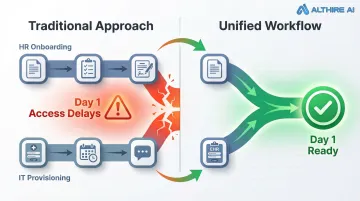
In most healthcare organizations, HR onboarding and IT provisioning are handled by separate teams — creating a gap that delays new hires' access to EHR systems, scheduling software, and secure messaging. Rippling closes that gap by handling both in the same workflow, so day-one access is ready before the hire even walks in.
| Feature Category | Details |
|---|---|
| Key Features | Automated HR and IT onboarding workflows, payroll integration, global workforce management, role-based access provisioning, compliance tracking, 500+ app integrations |
| Healthcare-Specific Capability | Handles multi-location healthcare networks; automates credentialing document collection; integrates with healthcare ATS and EHR-adjacent tools including eClinicalWorks and Wellsky; supports compliance audit trails |
| Pricing | Custom enterprise pricing; demo available |
Key Features to Look for in Healthcare Onboarding Software
Compliance and Credentialing Management
The software must support automated collection and tracking of licenses, certifications, immunization records, and background checks—with alerts for expiring credentials. In healthcare, a lapsed license discovered post-hire is both a patient safety and liability issue. According to HealthStream, 35% of organizations now complete automated primary source verification in 15 days or less, cutting credentialing delays.
Role-Specific Training Tracks
Generic onboarding checklists are insufficient. Look for platforms that allow HR teams to build separate onboarding journeys for nurses, physicians, allied health professionals, and administrative staff—each with the specific compliance modules, clinical procedures, and policy acknowledgments relevant to their role.
HIPAA-Compliant Document Management
All onboarding documentation—contracts, consent forms, background check results, vaccination records—must be stored and transmitted through HIPAA-compliant infrastructure.
The HHS Office for Civil Rights explicitly requires covered entities to enter into Business Associate Agreements (BAAs) with cloud service providers handling Protected Health Information (PHI). Before signing with any vendor, confirm they provide a BAA and can detail their data encryption and access control standards.
Integration with Existing ATS and HRIS Platforms
Healthcare HR teams should not re-enter candidate data manually. Choose software that integrates with your existing applicant tracking system so newly hired candidates move directly into onboarding workflows—no duplicate data entry, no dropped handoffs. Tighter pre-hire to onboarding integration also reduces the gap between offer acceptance and Day 1 readiness, which matters in high-turnover healthcare environments.
Reporting and Audit Trails
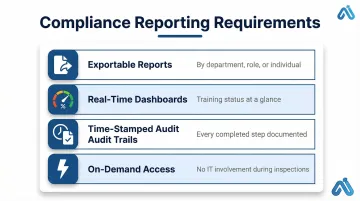
Accreditation bodies and state regulators can request onboarding documentation at any time. Your platform should be ready when they do. Look for:
- Exportable completion reports by department, role, or individual
- Real-time dashboards showing training status at a glance
- Time-stamped audit trails that document every completed step
- On-demand access without IT involvement during inspections
How We Chose These Platforms
Platforms were assessed across five criteria:
- Healthcare compliance depth (credential tracking, HIPAA alignment)
- Workflow automation (reducing manual tasks and errors)
- Role-based training capability (customizable clinical onboarding tracks)
- Integration ecosystem (ATS, HRIS, and EHR compatibility)
- Suitability for organization type (hospital, home health, staffing agency)
A common mistake is selecting a generic onboarding tool that lacks HIPAA-compliant storage or can't be configured for clinical role tracks. Each criterion above ties directly to business outcomes: the best platform reduces time-to-clearance for new clinical staff, reduces compliance documentation errors, and ensures every hire is patient-ready before their first shift.
Those outcomes have a direct dollar value. A low-cost tool that fails a compliance audit or delays staff readiness by weeks can cost far more than the license savings — credentialing delays alone cost providers up to $10,000 per day in deferred revenue.
Treat platform selection as a revenue-cycle decision, not just an HR line item.
Conclusion
The right onboarding software directly affects compliance, retention, and revenue. With RN turnover costing over $61,000 per hire and credentialing delays running thousands of dollars per day in lost capacity, the administrative stack you choose carries real financial weight.
Assess not just current needs but also scalability. A platform that works for 50 hires per year may collapse under the demands of a large hospital system onboarding 500 new nurses after a retention crisis.
Onboarding quality also depends on what happens before day one. Faster, more consistent screening means the right candidates reach onboarding sooner. AltHire AI's interview platform helps healthcare organizations qualify candidates up to 70% faster, cutting time-to-offer so onboarding can start without delay. Book a demo to see how AltHire AI fits your healthcare hiring workflow.
Frequently Asked Questions
What is the best onboarding platform?
The best onboarding platform depends on organization type and needs. For healthcare, platforms with compliance tracking and clinical training (like Medbridge or Absorb LMS) outperform generic tools. Key factors include credentialing support, HIPAA compliance, and ATS integration.
What are the 5 C's of effective onboarding?
The 5 C's are Compliance, Clarification, Culture, Connection, and Check-back. In healthcare, compliance carries the most weight — licensing and HIPAA requirements must be met before clinical staff can work. The remaining C's ensure new hires understand their role, align with organizational values, build relationships, and receive ongoing feedback.
What features should healthcare onboarding software include?
Essential features include credential and license tracking, HIPAA-compliant document storage, role-specific clinical training tracks, e-signatures, and integration with existing ATS or HRIS platforms. Automated expiration alerts and audit trails are also critical for regulatory compliance.
How does onboarding software help with healthcare compliance?
Healthcare onboarding platforms automate document collection (immunizations, licenses, background checks), send alerts for expiring credentials, and maintain time-stamped audit trails ready for regulatory inspections. This eliminates manual tracking gaps and keeps organizations inspection-ready year-round.
How long does healthcare staff onboarding typically take?
Onboarding timelines vary significantly by role. Administrative staff typically clear in 2–4 weeks, while clinical staff can take 30–90 days — registered nurses average 59–109 days and physicians 125–344 days depending on specialty and license verification requirements.
Can healthcare onboarding software integrate with hospital HR systems?
Yes, most leading platforms integrate with major HRIS and ATS tools like Workday, BambooHR, Greenhouse, and ADP. Candidate data flows automatically into onboarding workflows, eliminating manual re-entry and cutting time-to-clearance.