Introduction
Healthcare recruiting has never been harder — and the numbers make that clear. The U.S. faces a projected shortage of 86,000 physicians by 2036 and 108,960 registered nurses by 2038, with every unfilled role posing a direct risk to care quality. RN time-to-fill has already stretched to 83 days — more than double the cross-industry average. Those delays don't just slow hiring; they drive staff burnout and erode patient outcomes.
That gap points to a larger problem: general-purpose ATS tools weren't built for healthcare's demands. Credential tracking, compliance audits, and round-the-clock staffing gaps require software designed specifically for clinical workflows and regulatory requirements. This guide breaks down the features that separate purpose-built healthcare recruiting software from generic alternatives.
Key Takeaways
- Healthcare recruiting requires specialized software due to strict credentialing, high turnover, and compliance requirements
- Purpose-built platforms consolidate license verification, screening, scheduling, and compliance tracking into a single workflow
- Essential features include credentialing automation, AI-powered interviewing, unified candidate management, and ATS integrations
- Using generic recruiting tools in healthcare risks compliance failures and longer vacancies that directly affect patient care
Why Healthcare Recruiting Demands Specialized Software
Healthcare recruiting differs from other industries in one critical way: every hire must satisfy strict credentialing requirements that general recruiting tools cannot track or automate effectively. Licenses, certifications, background checks, and ongoing compliance monitoring all fall outside what standard ATS platforms handle well.
Unlike retail or technology hiring, where skills can be verified through interviews and references, healthcare professionals must meet regulatory standards enforced by state licensing boards, The Joint Commission, and CMS before they can touch a patient.
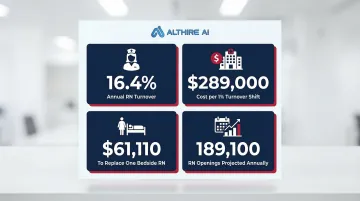
The operational pressures are significant. Key numbers illustrate the scale:
- RN turnover averages 16.4% annually, with overall hospital employee turnover at 18.3%
- Each 1% shift in RN turnover costs the average hospital $289,000 per year
- Replacing a single bedside RN averages $61,110
- 189,100 RN openings are projected annually, with a national vacancy rate of 9.6%
Staffing agencies and healthcare HR teams must fill roles on tight timelines — without cutting corners on compliance.
While the market is full of general recruiting tools, healthcare teams need software built for their operational reality. The features covered below show exactly where purpose-built platforms close that gap.
Must-Have Features in Healthcare Recruiting Software
Not all recruiting software is equal. The features below separate purpose-built healthcare recruiting platforms from generic ATS tools that force healthcare teams into manual workarounds.
Feature 1: Automated Credentialing and Compliance Tracking
Credentialing is the most healthcare-specific feature in recruiting software. Every nurse, physician, or allied health professional must have verified licenses and certifications before placement. Tracking these manually across hundreds of candidates is error-prone and creates serious risk.
What this feature should include:
- Automated license verification through trusted databases
- Real-time expiration alerts for licenses and certifications
- Centralized compliance dashboards showing credential status at a glance
- Audit-ready documentation to support regulatory reviews (Joint Commission, CMS PECOS)
The business consequences of credentialing failures are severe. In 2025, the Fourth Circuit upheld a $9 million judgment against Steadfast Medical Staffing for worker misclassification.
The Kadlec Medical Center v. Lakeview Anesthesia Associates case established strict liability for negligent credentialing when organizations fail to disclose provider impairments during the credentialing process.
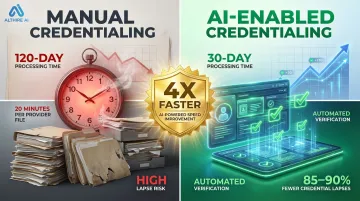
Manual credentialing exposes organizations to placement delays and regulatory penalties. AI-enabled credentialing platforms reduce processing time from 120 days to 30 days, while automated primary source verification saves 20 minutes per provider file and prevents 85-90% of potential credential lapses.
The best platforms build credentialing into every stage of the hiring workflow—not as an add-on, but as a core function that runs from application through onboarding and renewal.
Feature 2: AI-Powered Candidate Screening and Interviewing
AI-powered screening matches candidates to roles based on qualifications, specialty, location, and certification status in seconds rather than hours. Recruiters skip the manual resume pile and go straight to the most qualified candidates.
AI-driven interview automation delivers measurable speed advantages:
- Platforms conduct adaptive, structured interviews 24/7 without scheduling bottlenecks
- Healthcare organizations screen candidates during high-demand surge periods or overnight shifts
- 46% of top-performing staffing firms report AI cuts screening time in half, with 56% achieving placements in under 10 days
Structured, bias-free assessments ensure every candidate is evaluated on skills, cultural fit, and potential rather than resume keywords alone. Peer-reviewed research confirms that structured interviews using standardized questions and anchored grading scales reduce racial and gender bias while improving recruitment outcomes.
Platforms like AltHire AI conduct AI-proctored interviews with adaptive follow-up questions and generate detailed candidate reports that help recruiters make faster, fairer decisions. This approach maintains assessment integrity while accelerating pipeline velocity—critical in healthcare where every day of delay increases vacancy costs.
Feature 3: Unified Candidate Management and CRM
Healthcare recruiters often juggle hundreds of active candidates across multiple facilities, specialties, and contract types. Without a centralized system, critical candidate data gets siloed, duplicated, or lost between teams.
A strong candidate management and CRM layer includes:
- 360° candidate profiles with credential history, placement records, and communication logs
- AI-powered search and matching to surface ready-to-deploy candidates quickly
- Collaboration tools enabling smooth recruiter handoffs without data loss
A built-in CRM also enables proactive talent pipeline building. Healthcare agencies can nurture passive candidates and re-engage previously placed professionals for new assignments, reducing sourcing time for repeat fills. One healthcare recruitment agency reduced average RN time-to-fill by 38%—from 83 days to 51 days—by centralizing credential tracking and automating nurse outreach through their CRM.
Feature 4: Integrated Communication and Interview Scheduling Automation
Communication delays are a major source of candidate drop-off in healthcare recruiting. Candidates in demand will accept offers elsewhere if response times are slow. 44% of healthcare job seekers will abandon the process if they aren't contacted within 48 hours of applying, and 45% admit to ghosting employers during the interview process.
Integrated communication features should include:
- Built-in texting, email, and calling within the platform
- Automated reminders for credential renewals, interview confirmations, and onboarding tasks
- Single communication log tied to each candidate record for full team visibility
Automated interview scheduling—with calendar syncing and self-scheduling options—removes the back-and-forth that typically adds days to healthcare hiring timelines. Automated qualification and self-service scheduling slashes time-to-interview by 50%, dropping the average from 3-5 business days to 1.5-2 days.
Feature 5: Advanced Reporting and Analytics
Without analytics, agencies operate blind—unable to pinpoint where bottlenecks occur, which roles are hardest to fill, or whether recruiter productivity is improving. Real-time data turns those unknowns into decisions.
Reporting capabilities that matter most in healthcare:
- Time-to-fill and placement velocity by role or specialty
- Credential expiration and compliance status dashboards
- Source effectiveness tracking showing which job boards or channels deliver the most qualified candidates
- Recruiter productivity metrics
Analytics also support business conversations with clients. Healthcare staffing agencies that can demonstrate fill rates, quality of hire, and compliance metrics have a measurable advantage in client retention and contract renewals. With 80.3% of travel nurse revenue flowing through VMS or MSP models, healthcare CFOs increasingly evaluate staffing firms on operational metrics—order fill rates, submission speed, assignment completion—rather than just relationships.
Feature 6: ATS Integrations and Mobile Accessibility
Healthcare recruiting software doesn't operate in isolation. It must connect with existing tools—payroll systems, HR platforms, VMS platforms, and leading job boards—to eliminate manual data entry and keep records consistent across systems.
For agencies serving hospital systems and large healthcare networks, VMS integration isn't optional. Platforms like Beeline, SAP Fieldglass, Workday VMS, and Coupa Contingent Workforce represent how the majority of contingent labor is managed—your software needs to speak their language.
Mobile access directly affects candidate engagement. Recruiters and managers working across multiple facilities need to view schedules, update candidate status, and send approvals from their phones. 60% of healthcare job applicants check text messages more often than email, which means a platform without mobile-first communication loses candidates before a conversation even starts.
Look for platforms with native mobile apps or fully responsive interfaces that support recruiter workflows—status updates, messaging, approvals—on any device.
How to Choose the Right Healthcare Recruiting Software
The most common mistake teams make when evaluating recruiting software is selecting a general ATS and assuming it can handle healthcare workflows. The result: credentialing gets managed in spreadsheets, compliance tracking is manual, and recruiter time is consumed by administrative work the software should be handling.
Key evaluation criteria decision-makers should use:
- Purpose-built for healthcare workflows, not adapted from a general-purpose ATS
- Compliance-first architecture with audit-ready reporting and primary source verification
- Scales across travel, per diem, and full-time staffing simultaneously
- Backed by support staff who understand healthcare operations, not just software
According to Staffing Industry Analysts' 2025 Healthcare Staffing Technology Landscape report, firms should select purpose-built healthcare systems that natively handle credentialing rules, facility requirements, shift types, and licensure checks over general-purpose platforms.
Before committing, run a pilot or request a demo against your most complex real-world scenario — for example, verifying credentials for 50 travel nurses across three states. This reveals whether the automation holds up or whether manual workarounds are still required.
Conclusion
Healthcare recruiting software earns its value when it's built around the specific demands of the industry: compliance requirements, credentialing complexity, and the pressure to fill roles before patient care suffers. Platforms that automate screening, credentialing verification, and candidate communication free recruiters from manual bottlenecks — and reduce the compliance risk that comes with them.
If you want to speed up healthcare screening without trading away quality or compliance, see how AltHire AI's interview platform integrates with your existing ATS — cutting screening time, reducing bias, and getting the most qualified candidates in front of your hiring team faster.
Frequently Asked Questions
Do recruiters still use ATS?
Yes — 93% of recruitment professionals use an ATS, and 65% of healthcare recruiters rely on one specifically for candidate sourcing. In healthcare, ATS platforms centralize candidate records, compliance documentation, and communication in a single system, making them especially hard to replace.
What features should I look for in healthcare recruiting software?
Look for features built specifically for healthcare's regulatory and operational demands:
- Automated credentialing and license tracking
- AI-powered candidate screening and matching
- Unified candidate management across pipelines
- Integrated communication tools
- Advanced reporting and compliance documentation
- Seamless ATS and VMS integrations
Generic recruiting tools rarely address these needs out of the box.
How does AI help with healthcare candidate screening?
AI handles three core tasks that slow down manual screening:
- Matches candidates to roles based on qualifications and active certifications
- Conducts structured interviews around the clock without scheduling delays
- Generates objective scoring reports for consistent evaluation across large applicant pools
The result is faster hiring decisions with less bias in the process.
What is credentialing automation in healthcare recruiting?
Credentialing automation refers to software that automatically verifies licenses, tracks certification expiration dates, sends renewal alerts, and maintains audit-ready compliance documentation. Without it, manual tracking creates compliance gaps, placement delays, and failed audits — all avoidable with the right software.
How is healthcare recruiting software different from general recruiting software?
Healthcare recruiting software is purpose-built for credential verification, compliance tracking, role-specific onboarding, and VMS integrations. General ATS platforms don't include these capabilities, making them a poor fit for the regulatory demands of healthcare hiring.