Introduction
A single failed leadership hire can cost your organization up to 10 times the executive's annual salary, according to Harvard Business Review. Beyond the financial hit, 75% of voluntary team turnover stems from poor management, per Gallup research. Yet most interviewers still rely on gut feel or generic questions like "What's your leadership style?" This approach lets rehearsed candidates shine while revealing little about judgment, values, or how they'll actually perform under pressure.
Senior candidates are coached to perform well in standard interviews. Research shows that over 90% of job candidates engage in some form of impression management — and executive roles attract the most polished responses.
That polish is exactly why surface-level questions break down at the leadership level, where interpersonal judgment, conflict resolution, and strategic thinking matter more than credentials.
This guide provides 15 targeted leadership interview questions organized by competency — with guidance on what strong answers actually look like across the five areas that define effective leaders.
Key Takeaways
- Generic leadership questions fail — rehearsed answers reveal little about real behavior or judgment
- These 15 questions help you identify leaders who can actually execute — not just interview well
- Strong candidates show specificity, ownership, and self-awareness under pressure
- Structured interviews with consistent evaluation frameworks reduce bias and improve hiring accuracy by 34%
Why Leadership Interviews Need More Than Gut Feel
Interviewing for a leadership role differs fundamentally from assessing individual contributors. You're evaluating influence over others, not just personal output. This requires questions that surface how candidates think, handle pressure, and align teams—not just what they've accomplished.
Senior candidates often arrive with polished, rehearsed narratives. A meta-analysis by Schmidt and Hunter found that unstructured interviews yield a predictive validity of just .38, compared to .51 for structured interviews. Without structure, gut feel takes over—and bias follows.
The gold standard combines two question types:
- Behavioral ("Tell me about a time when...") — surfaces actual track record and past decisions under pressure
- Situational ("What would you do if...") — tests reasoning, priorities, and strategic judgment in real time
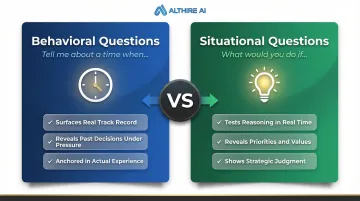
The 15 questions below use both formats to cut through prepared answers and reveal how candidates actually lead.
15 Leadership Interview Questions to Identify Top Talent
These 15 questions are grouped into five leadership competency categories. Select based on the role's most critical demands and pair each with follow-up probes like "What was the outcome?" or "What would you do differently?"
Vision and Strategic Thinking
Question 1: "How have you translated a broad organizational goal into a concrete action plan for your team?"
Strong answers reveal the ability to break down ambiguity, communicate direction clearly, and align team effort with company objectives. Top candidates describe specific situations where they converted abstract goals (e.g., "increase market share") into measurable milestones, resource allocations, and team responsibilities — and explain how they secured buy-in along the way.
Weak answers stay vague ("I made sure everyone understood the vision") or focus only on their own tasks rather than team orchestration.
Question 2: "Tell me about a time you identified a market or operational opportunity before others did. What did you do with it?"
Anticipatory thinking separates strategic leaders from reactive ones. Strong candidates name a specific situation with measurable impact — identifying an emerging customer need, spotting a competitive gap, or recognizing an efficiency opportunity. They describe how they validated it and mobilized resources to act.
Generic observations ("I noticed our industry was changing") without action or outcomes signal surface-level awareness, not strategic leadership.
Question 3: "Describe a decision you made that wasn't immediately popular but turned out to be right. How did you bring others along?"
This reveals conviction, communication, and the ability to lead through resistance. Look for self-awareness about why the decision faced pushback, how they influenced without authority, and evidence they maintained relationships despite disagreement.
Red flags include blaming others for not "getting it" or claiming the decision was universally praised from the start.
Team Management and Motivation
Question 4: "How do you identify and develop leadership potential in your team members?"
Top candidates describe a specific system or behavior — stretch assignments, 1:1 coaching, sponsoring for visibility, or creating development plans. They name individuals they've developed and the outcomes (promotions, expanded responsibilities, retention).
Red flag: Candidates who focus only on performance management or can't name concrete development actions they've taken.
Question 5: "Tell me about a time a team member was consistently underperforming. What steps did you take, and what was the result?"
This reveals how candidates balance accountability with empathy. Strong answers show a structured approach:
- Clear expectations set and documented
- Regular feedback loops with specific examples
- Support offered (training, resources, role adjustments)
- Honest reflection on outcomes, including difficult decisions
Watch for candidates who either avoid accountability entirely or show no empathy for the individual's circumstances.
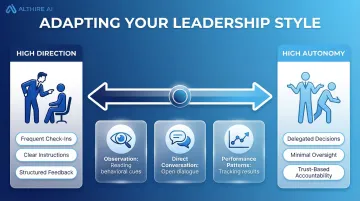
Question 6: "How do you adapt your leadership style to someone who is highly autonomous versus someone who needs more direction?"
Situational leadership — knowing when to direct versus when to step back — is a skill many managers claim but few demonstrate. Strong candidates describe reading individual needs through observation, direct conversation, or performance patterns, then adjusting deliberately. They give specific examples of tailoring communication frequency, decision-making authority, or support levels.
One-size-fits-all approaches ("I treat everyone the same") indicate a real leadership blind spot.
Conflict Resolution and Decision-Making
Question 7: "Describe a significant disagreement you had with a peer or senior leader. How did you handle it?"
Mature leaders can disagree without disrespecting hierarchy. Strong candidates describe the disagreement clearly, explain both their own perspective and the other party's, and detail how they navigated to resolution — whether through compromise, escalation, or agreeing to disagree professionally.
Evasive answers ("I don't really have conflicts") or blame-heavy responses are red flags.
Question 8: "Tell me about a time you had to make a high-stakes decision with incomplete information. What was your process?"
Judgment quality shows up clearly here. Look for structured thinking:
- What data they gathered and how quickly
- What assumptions they made and tested
- How they managed risk and communicated uncertainty
- What they learned from the outcome
Lucky outcomes without process indicate poor judgment that worked once but won't scale.
Question 9: "How do you handle a situation where two high-priority projects are competing for the same limited resources?"
Resource conflicts expose whether a leader has a real prioritization framework or just instinct. Strong candidates describe a clear process — business impact, strategic alignment, customer urgency, or ROI analysis — and explain how they communicated the decision to affected parties.
Picking intuitively without transparency creates resentment and confusion across teams.
Accountability and Results
Question 10: "Tell me about a goal you set for your team that you didn't hit. What happened and what did you learn?"
Willingness to own failure is a key leadership signal. Strong answers show honest analysis of what went wrong — unrealistic timeline, insufficient resources, market changes — what they would change, and evidence they applied that learning afterward.
Candidates who can't name a real failure, or who focus on planning missteps without examining their own role in them, lack the self-reflection senior roles require.
Question 11: "How do you measure whether your team is performing well beyond just hitting targets?"
Output numbers tell part of the story. Strong leaders also track engagement scores, retention rates, quality metrics, development progress, and cross-functional feedback — the signals that predict problems before they surface.
Managing by metrics alone creates burnout and misses early warning signs of dysfunction.
Question 12: "Can you walk me through how you've contributed to revenue growth or cost efficiency in a previous role?"
Leadership without business impact is management. Strong candidates quantify their contribution ($X revenue generated, Y% cost reduction) and trace the causal chain: how their decisions — a team restructuring, a process change, a strategic pivot — translated into measurable outcomes.
Vague claims ("I helped the company grow") without specifics suggest limited business acumen.
Adaptability and Growth Mindset
Question 13: "Tell me about the biggest professional failure of your career. What did it teach you?"
This is one of the most revealing questions in any leadership interview because it tests both self-awareness and psychological safety. Candidates who can't name a real failure or who deflect to external causes ("My boss didn't support me") are a concern. Research shows that while 95% of people believe they're self-aware, only 10–15% actually meet the criteria.
Strong answers identify a genuine failure, explain what they learned, and demonstrate how they've applied that lesson since.
Question 14: "How do you stay current in your field and continue developing as a leader?"
This surfaces intellectual curiosity and intentionality around growth. Look for specific habits:
- Books, podcasts, or publications they follow regularly
- Communities of practice or peer networks they engage with
- Mentorship relationships (as mentor or mentee)
- Courses, certifications, or conferences they've attended
Vague claims of "staying updated" without concrete examples suggest intellectual stagnation.
Question 15: "Describe a time when external circumstances forced you to fundamentally change your approach to a project or team. How did you manage the transition?"
Resilience isn't about weathering disruption — it's about adapting through it. Strong answers show how the candidate communicated the shift clearly, maintained team morale through uncertainty, and adjusted their own behavior, not just the plan. The best responses end with results delivered despite the disruption.
Candidates who blame external circumstances without showing adaptation lack the agility senior roles demand.
Red Flags vs. Green Flags: Reading Leadership Responses
Asking the right questions is only half the work. How candidates respond — and what those responses reveal — is where the real signal lives. Four patterns consistently separate strong leaders from convincing ones.
The Specificity Test
Strong leadership candidates answer with a named situation, a clear role they played, and a measurable or observable outcome. They say "In Q2 2023, when our largest client threatened to churn, I..." rather than "I always try to communicate clearly with stakeholders."
Vague generalities signal the candidate is performing rather than reflecting.
Ownership Signals
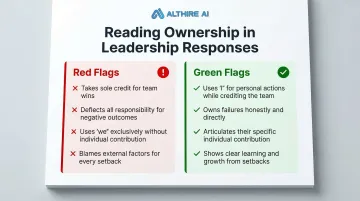
Top candidates use "I" to describe their actions and thinking, while also acknowledging team contributions. A strong answer sounds like: "I made the call to pivot our strategy, and the team executed brilliantly under tight deadlines."
Watch for these ownership red flags:
- Takes sole credit for team wins without mentioning others' roles
- Deflects all responsibility when outcomes were negative
- Uses "we" exclusively — can't articulate their individual contribution
- Blames external factors for every setback
Korn Ferry research shows that leaders who greatly overstate their abilities are 6.2 times more likely to be rated as a derailment risk.
The Self-Awareness Indicator
The best candidates acknowledge mistakes, tensions, or moments of uncertainty without being prompted. They say "Looking back, I should have involved the product team earlier" or "I underestimated how much change management this would require."
In practice, this kind of honesty tends to predict stronger team cohesion and lower turnover — leaders who can name their blind spots are far less likely to repeat costly mistakes.
Follow-Up Resilience
Strong candidates don't become defensive when interviewers probe or push back. They engage thoughtfully with questions like "What would you have done differently?" or "What did others think of that decision?"
Deliberately use probing follow-ups to test this reaction. A candidate who shuts down or gets prickly under gentle pressure is showing you exactly how they'll respond to real organizational stress — before you've made the hire.
How to Run a Structured Leadership Interview
Structured interviews—where every candidate is asked the same questions in the same order and scored against defined criteria—significantly reduce interviewer bias and improve predictive validity. Research demonstrates that structured interviews yield .51 predictive validity compared to .38 for unstructured approaches—a 34% improvement in hiring accuracy.
Build a Scoring Rubric for Leadership Competencies
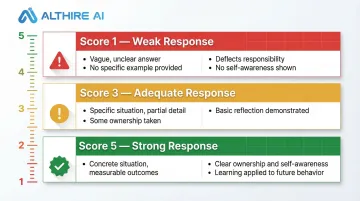
Each question should map to a specific competency—vision, accountability, conflict resolution—with anchor descriptions for what a 1, 3, and 5 response looks like. For example:
- 1 (Weak): Vague answer with no specific example, deflects responsibility, or shows no self-awareness
- 3 (Adequate): Provides a specific situation with some detail, shows partial ownership, basic reflection
- 5 (Strong): Names a concrete situation with measurable outcomes, demonstrates clear ownership and self-awareness, shows learning applied
This allows multiple interviewers to calibrate and compare candidates consistently, reducing individual bias.
Use AI-Powered Interview Platforms
AI-powered platforms like AltHire AI let teams standardize leadership questions, score responses against defined competencies, and generate structured evaluation reports. The platform adapts follow-up questions to each candidate's answers while keeping scoring consistent across all interviewers.
AltHire's 360° performance breakdown rates candidates across customizable dimensions—strategic thinking, team management, decision-making—giving hiring teams objective, comparable data to make faster calls on senior hires.
Conclusion
The right leadership interview questions don't just reveal what a candidate has done—they surface how they think, how they treat people under pressure, and whether their values align with your organization's. The goal isn't to find the candidate who answers most smoothly, but the one who demonstrates self-awareness, ownership, and measurable impact.
Before your next hire, review your current process and ask:
- Are your questions doing the real work of surfacing judgment, values, and influence?
- Or are they letting rehearsed candidates shine while hiding critical gaps?
If the answer is unclear, that's worth fixing before the next hire.
AltHire AI helps hiring teams design, run, and evaluate structured leadership interviews with consistent, objective scoring—so the best candidate wins on merit, not polish.
Frequently Asked Questions
What questions are asked in a leadership interview?
Leadership interview questions typically fall into behavioral and situational categories covering team management, conflict resolution, decision-making, vision, and accountability. The best questions ask for specific past examples ("Tell me about a time when...") rather than hypothetical answers, forcing candidates to demonstrate real experience rather than theoretical knowledge.
What are the 5 hardest leadership interview questions?
The most challenging questions require honest self-reflection and can't be answered with rehearsed responses. These include describing their biggest professional failure, a time they were wrong about an important decision, a significant conflict with a senior leader, a decision they regret, or a goal they failed to achieve and what they learned.
What are the 5 P's of leadership?
The 5 P's commonly refers to Purpose, People, Performance, Persistence, and Presence. Interviewers can use this model to check whether a candidate's answers reflect a well-rounded approach that balances strategic vision with people development and execution.
What are the 3 C's of leadership?
The 3 C's refer to Character, Competence, and Commitment, a framework from Ivey Business School. Each dimension maps to how leaders make decisions, apply their skills, and invest in their teams — all of which structured behavioral questions are designed to surface.
How do you evaluate leadership potential in an interview?
Evaluating leadership potential goes beyond credentials and past titles. Focus on how candidates describe their influence on others, how they handle ambiguity, and whether they take ownership of failures. Strong leaders also show evidence of developing others and adapting their approach based on context.
What makes a great leadership interview question?
Great leadership interview questions are specific enough to require a real example, open-ended enough to reveal thinking and values, and tied to a competency that matters for the role. Generic questions like "Are you a good leader?" produce rehearsed answers. Effective questions force candidates to describe specific situations, explain their reasoning, and reflect on outcomes—revealing judgment, self-awareness, and authentic leadership capability.