Introduction
The modern job market has shifted almost entirely online, and companies still relying on outdated hiring methods risk losing top candidates to faster-moving competitors. Research shows that 82% of Gen Z candidates expect the entire hiring process to take two weeks or less, yet 36% of North American candidates report waiting one to two months just to hear back after applying. This disconnect creates a critical vulnerability: 54% of Gen Z candidates will abandon an application if they feel the recruiting methods are outdated.
Closing that gap requires more than posting jobs online. Modern e-recruiting now incorporates AI-powered screening, automated interviews, ATS integrations, and data-driven decision-making — tools that compress hiring timelines without sacrificing candidate quality. What follows covers how these systems work end-to-end, where the real benefits lie, and how AI is changing the calculus for hiring teams today.
Key Takeaways
- E-recruiting uses digital platforms and software to attract, screen, and hire candidates online
- Moves hiring off paper and onto digital workflows that tap into talent across geographies
- Delivers lower costs, wider reach, and up to 70% faster time-to-hire
- AI interviews, automated screening, and ATS integrations now handle what used to take weeks of manual work
- Application overload and candidate fraud are manageable with the right AI tools in place
What Is E-Recruiting?
E-recruiting (also called electronic recruiting or online recruitment) is the use of internet-based technologies and platforms to attract, assess, and hire candidates. It's an umbrella term covering everything from job board postings and Applicant Tracking Systems to AI-powered screening and virtual interviews—not just a single tool or platform.
The concept began in the 1980s within the tech sector and went mainstream in the 1990s with job boards like Monster.com and online classifieds. Since then, it has evolved to include social recruiting, mobile applications, and AI-driven hiring workflows.
E-recruiting vs. traditional recruiting:
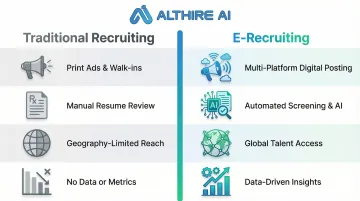
Traditional recruiting relied on print ads, walk-in applications, and manual resume reviews—slow processes capped by geography and recruiter bandwidth. E-recruiting removes those limits:
- Reach: Post to thousands of candidates across job boards, social platforms, and career sites simultaneously
- Speed: Automated screening and scheduling cuts days of back-and-forth to hours
- Consistency: Structured digital workflows reduce the variability of manual, judgment-based processes
- Data: Every application, assessment, and interaction generates insights that paper-based hiring never could
Because virtually all hiring now touches a digital platform at some point, "e-recruiting" and "online recruiting" are largely interchangeable terms today.
How E-Recruiting Works: The End-to-End Process
Stage 1: Job Requisition and Posting
The process begins with creating a role and publishing job advertisements across relevant digital channels—company career pages, job boards, and social media. Writing clear, inclusive job descriptions optimized for search visibility is critical, as 68% of Gen Z candidates use LinkedIn for job searches, while 86% feel they have a better chance when applying directly through a company's website.
Stage 2: Application Collection and ATS Management
An Applicant Tracking System (ATS) centrally collects applications, parses resumes, confirms receipt automatically, and organizes candidates into a structured pipeline. Modern e-recruiting stacks integrate with 20+ ATS platforms—Greenhouse, Lever, BambooHR, and Workable among them—so candidate data flows smoothly without manual transfers.
Stage 3: Screening and Shortlisting
Digital tools filter candidates by skills, experience, and qualifications using keyword matching, scoring systems, or customized criteria—reducing the manual effort of reviewing every resume individually. Platforms like AltHire AI provide automated resume matching that instantly evaluates candidate profiles against job requirements in seconds.
Stage 4: Digital Assessment and Interviewing
Stage 4 packs the most technology into the process. Candidates are evaluated through multiple digital formats before any in-person interaction:
- Online screening tests and skills assessments matched to role requirements
- Video interviews reviewed asynchronously or scored by AI
- AI interview agents that conduct adaptive, human-like conversations 24/7
- Dynamic follow-up questions generated based on each candidate's answers
Responses are scored consistently across all roles, removing the variability that comes with unstructured human interviews.
Stage 5: Decision, Offer, and Onboarding
Final selection, offer communication, and digital onboarding are managed within or integrated into the e-recruiting workflow, creating a seamless candidate journey from application to hire.
Key E-Recruiting Channels and Tools
Primary digital channels:
- Company career pages optimized for mobile and search
- General job boards (Indeed, LinkedIn, Monster)
- Niche/industry-specific job sites
- Social media platforms (LinkedIn, Facebook)
- Mobile recruiting apps
- Employee referral programs
Reaching top talent typically requires a multi-channel approach rather than relying on a single platform—46% of Gen Z candidates have applied for jobs directly from their mobile devices, making mobile optimization non-negotiable.
Core software tools:
- Applicant Tracking Systems (ATS) — centralize candidate pipelines and automate status tracking across hiring stages
- Recruitment marketing platforms — manage employer brand campaigns and attract passive candidates before they apply
- Video interviewing tools — conduct structured remote assessments with recorded or live formats
- **AI-powered screening and interview platforms** — evaluate candidates at scale using adaptive questioning and objective scoring
LinkedIn is worth calling out specifically: it functions as both a social network and a sourcing platform, which means passive candidate outreach—reaching people who aren't actively job hunting—has become a standard tactic rather than an advanced one. Pairing it with an AI-powered interview platform like AltHire AI lets teams move quickly once those candidates show interest.
Benefits of E-Recruiting
Cost Efficiency
E-recruiting significantly reduces expenses tied to traditional hiring. Common cost drivers it eliminates include:
- Print advertising and job board fees
- Physical application processing overhead
- Recruiter travel and in-person interview logistics
- staffing agency fees
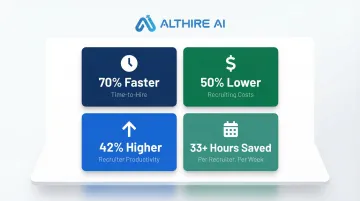
AltHire AI customers report up to a 50% reduction in recruiting costs — and up to $12M in annual savings per 1,000 hires — by replacing manual processes with automated workflows.
Speed and Time-to-Hire
Automation eliminates bottlenecks at every stage. What used to take weeks now takes days: jobs post instantly across multiple platforms, AI handles screening, and digital scheduling eliminates back-and-forth coordination. Platforms like AltHire AI enable 70% faster time-to-hire by automating screening, conducting AI-driven interviews 24/7, and generating instant candidate reports.
Expanded Talent Pool and Global Reach
Digital channels remove geographic constraints entirely, allowing companies to source candidates from anywhere—especially critical for remote roles, specialized technical positions, or companies scaling quickly. Reaching passive candidates (those not actively job-hunting) is now possible through social sourcing and professional network outreach.
Automation of Repetitive Tasks
E-recruiting software handles repetitive administrative work—multi-platform job posting, rejection emails, interview scheduling, and candidate status updates—freeing recruiters to focus on high-value activities like relationship-building and final evaluations. AltHire AI customers report **42% improvement in recruiter productivity** and 33+ recruiter hours saved per week through automation.
Better Candidate Experience and Employer Branding
A fast, digital-first application process signals that a company values candidate time. Mobile-friendly applications, quick responses, and consistent communication directly impact employer brand.
Organizations with top-rated candidate experience achieve a 38% higher Net Promoter Score at the research and attraction stage compared to average companies. For Gen Y and Gen Z candidates who expect digital-first interactions, a clunky application process is often enough to walk away.
Challenges of E-Recruiting (and How to Address Them)
E-recruiting removes geographic barriers and speeds up hiring—but it introduces real operational headaches. Here are the three most common challenges and how modern platforms address them.
Application Volume Overload
Easy online applications create a flood of unqualified submissions, making it harder for HR teams to identify strong candidates without drowning in noise.
Clear screening questions, skills-based ATS filters, and AI-powered pre-screening keep volume manageable without sacrificing quality. Automated resume matching and intelligent scoring help recruiters focus on candidates who actually fit the role.
Impersonality and Cultural Fit Gaps
Digital-only processes struggle to capture soft skills, personality, and cultural fit—qualities that resumes and static screening forms can't fully reveal.
Structured assessments and conversational interview tools close that gap. AI interview agents that adapt follow-up questions based on each candidate's answers can assess communication style, problem-solving depth, and how a person actually thinks—not just what they've written down.
Fraudulent Applicants and Data Security
Online recruiting brings exposure to resume fabrication, phony applications, and cybersecurity risks including data breaches and phishing attempts.
Identity verification and AI proctoring address this on multiple fronts:
- Verifies candidate identity through facial recognition before and during assessments
- Monitors for external assistance or unauthorized materials in real time
- Detects AI-generated responses that may misrepresent a candidate's actual ability
- Protects candidate data through secure, compliance-ready platforms
How AI Is Elevating Modern E-Recruiting
The Shift from Rule-Based Automation to Intelligent Hiring
Traditional e-recruiting automated logistics—posting, tracking, emailing—but AI-powered recruiting goes further. It understands context, evaluates responses, adapts to candidates, and generates data-driven hiring insights. That gap between first-generation tools and today's platforms is where hiring outcomes are won or lost.
AI-Powered Interviews and Conversational Assessments
AI interview agents conduct adaptive, human-like interviews 24/7—asking follow-up questions based on each candidate's actual answers, evaluating depth of response, and scoring candidates across all roles. Platforms like AltHire AI enable companies to build these interviews in under 10 minutes, assessing skills, culture fit, and potential beyond what any resume reveals.
Candidates complete interviews on their own schedule through Smart AI Dialogue, eliminating the back-and-forth of manual scheduling entirely.
Bias Reduction Through Structured, Objective Evaluation
AI-driven scoring models apply the same evaluation criteria to every candidate, removing the implicit human biases —name-based, gender-based, and appearance-based— that research has repeatedly shown affect manual screening. Structured evaluation frameworks measure candidates across customizable dimensions—technical proficiency, communication, problem-solving, and role-specific competencies—ensuring every candidate is assessed purely on skill and potential rather than subjective factors.
Advanced Proctoring and Candidate Authenticity
AI proctoring during remote assessments detects impersonation, verifies candidate identity, and ensures evaluation integrity—a critical concern as remote hiring becomes the norm. Advanced systems monitor multiple dimensions:
- Camera verification confirming the right person is taking the test
- Detection of multiple faces or external assistance
- Audio analysis identifying multiple voices or coaching
- Screen monitoring flagging tab switches or AI tool usage
- Coding pattern analysis detecting copy-paste behavior
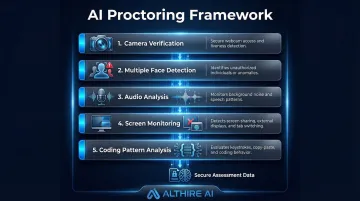
100% AI-proctored interviews protect both the employer's hiring quality and the fairness of the process for genuine candidates.
Data-Driven Hiring Insights and Continuous Improvement
Modern e-recruiting platforms generate detailed candidate reports, pipeline analytics, and recruitment metrics that enable hiring teams to continuously improve their process. Instant AI-powered reports cover:
- Dimensional performance scores across every evaluated competency
- Question-by-question evaluation with AI-flagged anomalies
- Complete video recordings with time-stamped transcripts
- Comprehensive proctoring details for audit and review
These insights identify where candidates drop off, which channels produce the best hires, and how to optimize for quality-of-hire over time—directly supporting the 70% faster time-to-hire that AltHire AI customers report.
Frequently Asked Questions
How does E-Recruitment work?
E-recruitment digitizes the entire hiring process. Jobs are posted across digital channels, applications flow into an ATS, and candidates move through automated screening and AI-powered interviews before a final hire decision is made.
Is E-Recruitment cost-effective?
Yes, e-recruiting is significantly more cost-effective than traditional methods. It eliminates print advertising costs, reduces recruiter hours through automation, lowers cost-per-hire, and enables companies to fill roles faster—reducing the financial impact of extended vacancies.
How to know if a recruiting company is legit?
Check for verifiable client references, look for established ATS integrations and enterprise customers, review transparency in their process and pricing, and verify they have a documented track record. Red flags include upfront fees for job seekers and vague sourcing methods.
What is the difference between e-recruiting and traditional recruiting?
Traditional recruiting relies on print ads, physical resumes, and in-person processes that are slow and geographically limited. E-recruiting uses digital platforms, automation, and AI to reach a global talent pool faster, at lower cost, and with measurable efficiency gains.
What tools are commonly used in e-recruiting?
Core tools include Applicant Tracking Systems (ATS), job boards, social media platforms, video interviewing tools, AI-powered screening platforms, and recruitment marketing software. Most organizations integrate these into a unified hiring stack for consistent data flow across every stage.
What are the biggest challenges of e-recruiting?
The main challenges include managing high application volumes, maintaining candidate engagement in a digital-only process, preventing fraudulent submissions, and ensuring data security. These can be mitigated with the right combination of AI tools, structured screening, and proctoring solutions.